
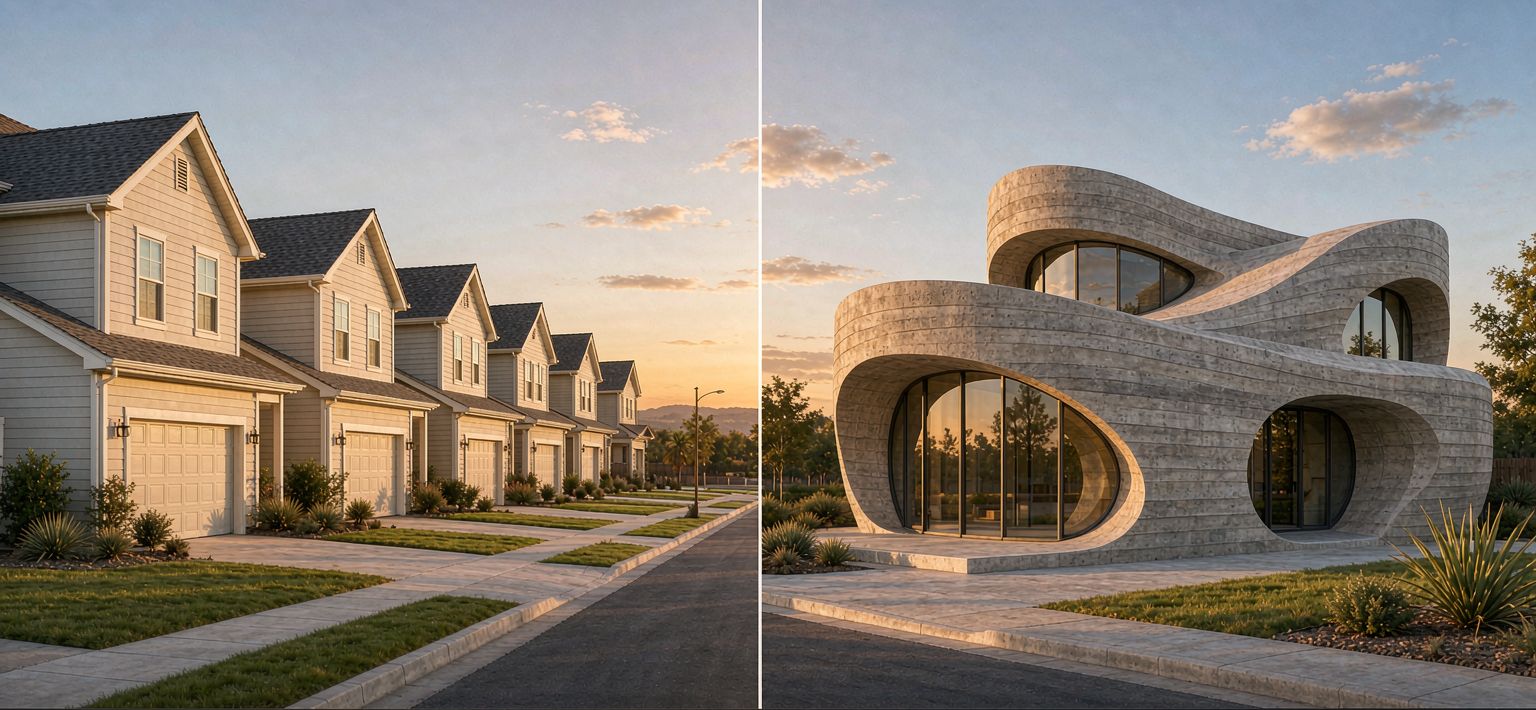
Over the past decade, 3D‑printed construction has evolved from prototypes to complete residential communities. A neighbourhood with 100 3D‑printed homes has emerged in Texas, USA; Denmark is home to Europe’s largest complex of 3D‑printed apartments; and Dubai and Riyadh have incorporated this technology into their urban development agendas. While technical challenges are being overcome one by one, what determines whether 3D‑printed buildings can become mainstream housing is not nozzle precision, but whether occupants are willing to give their consent. This paper reviews surveys and academic studies from the United States, South Africa, China, India, Chile and other regions to address a core question: To what extent are people around the world willing to move into 3D‑printed houses?
Key Findings: Approximately Two‑Thirds of Respondents Are Open to Consideration
| Survey | Region / Sample | Key Findings |
| Realtor.com × HarrisX 2021 | United States, n=3026, margin of error ±1.8% | 66% would consider moving in; 75% among Millennials; only 16% would definitely not consider it |
| South Africa DSTI 2020 | South Africa | 67% would live in 3D‑printed housing; over 78% accept square, rectangular or circular architectural forms |
| 2016 Chinese Media Street Survey | A city in southern China | After learning about the technology, 31% hoped to live in such housing and another 31% were willing to try it; 37.9% were unwilling due to safety concerns |
| India NHB 2024 | India | Respondents generally recognised advantages including cost reduction, customisability and less material waste, yet raised doubts over costs and widespread adoption |
| Chile SIGraDi 2025 | 75 participants | Curved surfaces and textures trigger emotional resonance and a sense of comfort; higher acceptance among women |
Definitions of “acceptance” vary across surveys. There is a long gap between “thinking favourably upon hearing about it” and “signing a purchase contract”. The figure of over 60 % represents a genuine potential market base rather than realised purchasing power.
Why People Say “Yes”
According to Realtor.com’s large‑scale national US survey, factors driving willingness to consider 3D‑printed housing are ranked as follows: lower costs (54 %), improved energy efficiency (51 %), enhanced disaster resistance (42 %), faster construction (41 %), greater customisation (39 %), and reduced material waste (32 %).
South African respondents added more subjective perspectives: fewer construction defects, consistent workmanship and strong technological appeal. Indian respondents highlighted its potential to serve remote locations and reduce on‑site construction accidents. Chilean experiments found that curved walls and printed textures themselves create an aesthetic sense of warmth.
In Wujiacun, Hebei Province, China, a 106 m² 3D‑printed rural house built by Professor Xu Weiguo’s team at Tsinghua University in 2021 drew this comment from its resident: “We no longer suffer from poor thermal insulation in winter and summer, and we rarely need to run air‑conditioning.” Thermal performance, comfort and cost‑saving benefits resonate universally across markets.
Why People Say “No”
Concerns are remarkably consistent and fall into four categories. Understanding these reservations is more critical than understanding public enthusiasm.
① Lack of long‑term durability evidence. Traditional masonry structures have a centuries‑long service track record, whereas performance data for 3D‑printed buildings spans less than a decade. In the US national survey, 36 % of hesitant respondents cited “waiting to observe long‑term performance” as their primary concern, and 22 % directly questioned durability. The only remedy lies in time and real‑world completed projects.
② Aesthetic concerns and fears of uniformity. 22 % prefer traditional appearances, while 18 % worry about identical‑looking neighbouring buildings. The corduroy‑like striated print texture is celebrated by some as a distinctive style yet dismissed by others as rough‑looking.
③ Unforeseen practical living details. Homeowners in Wolf Ranch praised thermal insulation and wind resistance, yet discovered that thick concrete walls block Wi‑Fi signals, requiring additional Mesh routers. Such unanticipated maintenance costs represent growing pains for all new building technologies.
④ Mortgages, insurance and resale value. Appraisers lack comparable completed transaction cases. Some banks once treated 3D‑printed construction as non‑standard, demanding higher down payments or additional insurance premiums. Encouragingly, in 2025, Fannie Mae and Freddie Mac clarified that code‑compliant 3D‑printed residential properties qualify for standard mortgage frameworks, meaning financial infrastructure is catching up.
Awareness Is the Biggest Variable
Across surveys, the groups with the highest acceptance are not necessarily technical experts, but those who have heard about the technology more frequently. In the 2016 Chinese street survey, more than 30 % of respondents had never heard of 3D‑printed construction; in the absence of awareness, people’s first reaction was to dismiss it as a gimmick. By contrast, 63 % of US participants were familiar with the concept, corresponding to higher acceptance. India’s NHB survey noted that a 3D‑printed post office in Bengaluru, completed in just 45 days, became a public starting point for public understanding through media coverage.
Demonstration projects drive shifts in public perception. Residents in Wujiacun recalled that neighbours initially remarked that printed houses were inferior to brick‑built homes, yet crowds came to visit once residents moved in and finished decoration. Wolf Ranch, sold as market‑rate commercial housing while meeting building codes, helped weaken the label of 3D‑printed homes as mere experimental prototypes.
Public acceptance ≈ public awareness × trust. Awareness is built via outreach and demonstration projects; trust is built via technical standards and real‑world deliveries.
Demographic Divides: Young Generations as the “3D‑Printing Generation”
Acceptance is not evenly distributed across populations. At 75 %, Millennials show markedly higher willingness than the overall average of 66 %. Digital‑natives possess almost no psychological barriers towards automated construction. Realtor.com economist George Ratiu’s widely‑cited observation states: “For rising digital‑native generations, new construction technologies may serve as a sustainable bridge to home ownership.” Baby‑boomers hold the most reservations, prioritising traditional aesthetics and long‑term reliability. Chilean research additionally indicates higher acceptance among women.
For enterprises targeting overseas markets, communication strategies must be segmented: highlight customisation and technological identity for younger buyers; emphasise proven durability, resale security and energy‑saving utility bills for family‑oriented and investment‑focused purchasers.
Real‑World Reality: The Market Has Not Yet Priced in Public Enthusiasm
In August 2024, 3D‑printed homes in the Wolf Ranch community had an average days‑on‑market of roughly 94 days, compared with 74 days for conventional homes in the same neighbourhood; monthly sales volume fell year‑on‑year by 32 %. Early buyers priced in discounts to account for technical uncertainty and resale risks. In early 2025, ICON laid off approximately 25 % of its workforce to focus on next‑generation printing systems while securing USD 56 million in financing. Several early‑stage direct‑home‑building firms have entered sales processes.
A consensus has formed within the industry: 3D‑printing only produces walls, which account for merely 20‑30 % of total residential construction costs. Roofing, mechanical‑electrical systems and interior finishes make up the remaining 60‑70 %. Labour and formwork savings achieved by printers are partially offset by equipment mobilisation expenses, specialised mortar and approval costs. Cost advantages can only materialise through large‑scale deployment. Enterprises must shift focus from “selling finished houses” to “selling construction capabilities and standards”. ICON’s 2026 strategy of selling multi‑storey printing equipment to third‑party builders signals that platform‑based business models represent the industry’s second growth curve.
From “Open to Consideration” to “Ready to Purchase”: Four Pillars for Building Trust
Between 2025 and 2026, four critical enabling pathways are advancing globally:
① Standards and regulatory compliance. ISO/ASTM 52939 (2023), ICC‑AC509 in the United States, and China’s T/CECS 1688‑2024 (implemented in 2025) have been successively released. Every advance in codes strengthens confidence among financial institutions and insurance providers.
② Normalised financing and insurance. Fannie Mae and Freddie Mac allow standard mortgage lending for code‑compliant 3D‑printed homes. As underwriting data accumulates, insurers apply conventional risk‑based pricing; some have even lowered premiums following successful wind‑resistance testing.
③ Tangible demonstration communities. Nothing is more persuasive than real occupied housing:
| Project | Significance |
| Wolf Ranch, USA (ICON × Lennar) | World’s largest 3D‑printed residential community (100 units), sold as commercial housing complying with building codes |
| DREIHAUS, Germany (PERI × COBOD) | Europe’s first multi‑storey 3D‑printed residential project supported by public funding; wall printing speed of roughly 5 min/m², about 30 % faster than conventional construction |
| Holstebro, Denmark (COBOD BOD3) | Europe’s largest 3D‑printed housing development: 36 apartments across six buildings, with 1654 m² of printed surfaces |
| 14Trees, Kenya / Malawi | Two‑bedroom houses printed in around 12 hours; target unit cost below USD 10 000 |
| Riyadh, Saudi Arabia (Dar Al Arkan × COBOD) | World’s tallest on‑site 3D‑printed building: three storeys, 345 m², completed in 26 days; printed concrete material costs below EUR 10 000 |
| TECLA, Italy (WASP) | Eco‑friendly house printed using local earthen materials with near‑zero embodied carbon |
④ Evolving design language. Projects such as Casa Semilla, the TECLA earthen dome, and designs treating print texture as façade ornamentation answer aesthetic concerns. Curved forms, monolithic construction and texture‑as‑decoration establish a distinct aesthetic identity for 3D‑printed architecture.
Conclusion
Viewed over a longer time horizon, public acceptance of 3D‑printed buildings follows the classic technology‑adoption curve: novelty → public curiosity and scepticism → occupancy by early adopters → reputation diffusion from demonstration communities → regulatory and financial catch‑up → mainstream‑market acceptance. Today, 3D‑printed construction sits between the third and fifth stages. Nearly two‑thirds of people are willing to consider it, yet only a small minority are ready to buy. This gap is steadily narrowing through every completed building, every newly‑published standard and every approved mortgage loan.
The next phase of competition will not centre on printing speed, but on the capacity to turn “willing to consider” into “willing to buy”. This means delivering verifiable durability data, streamlining property appraisal and mortgage processes, enabling prospective buyers to visit real demonstration homes, and convincing hesitant audiences through increasingly well‑designed 3D‑printed buildings.
The general public does not vote for technology. They vote for homes they want to live in.