
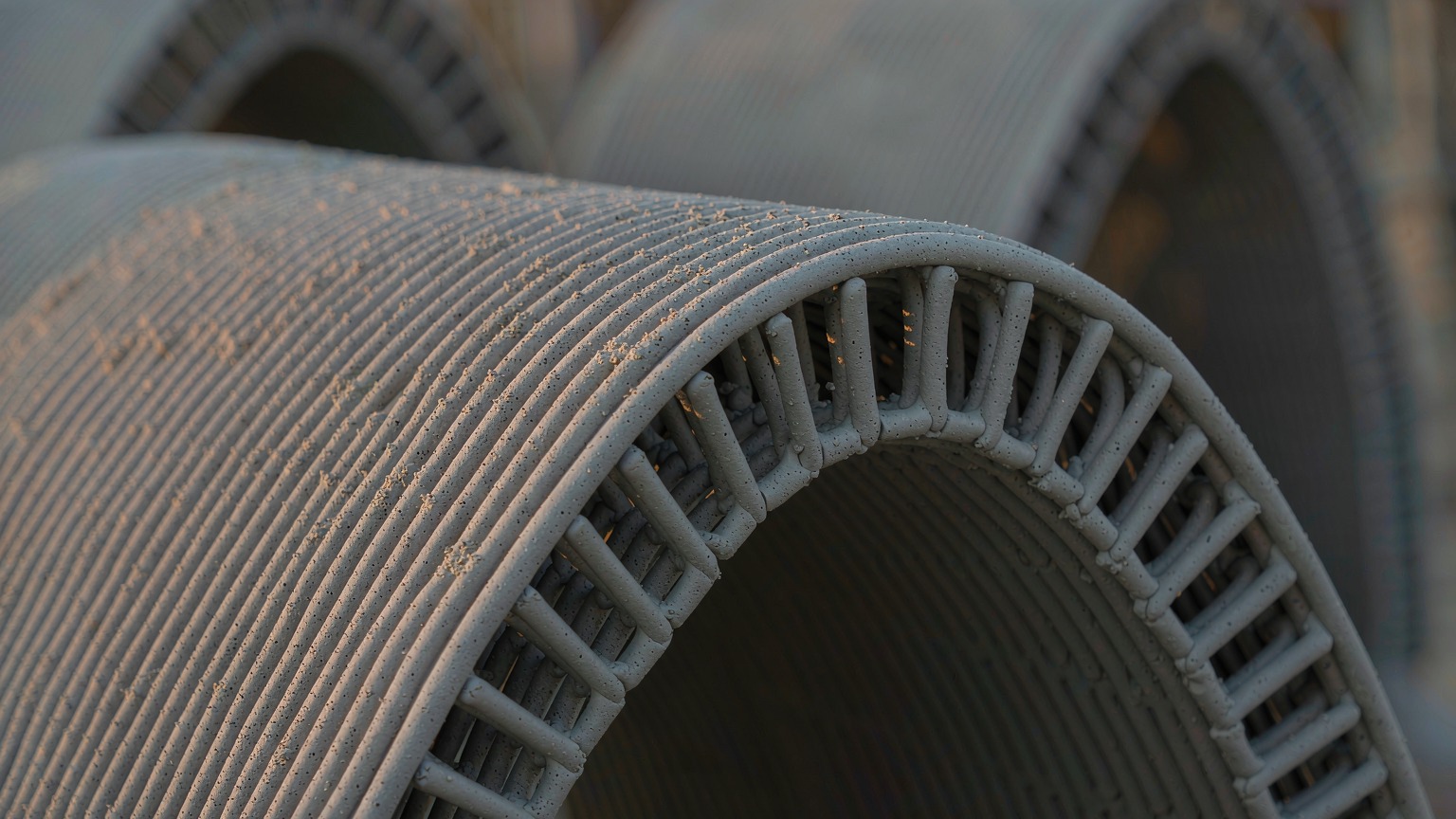
Printing several‑metre‑high walls is straightforward, yet achieving large spans poses major challenges. As span grows from 2‑3 m to over 10 m, bending loads intensify alongside rising self‑weight. Since 3D‑printed concrete performs well in compression but poorly against tension and bending, span capacity effectively gauges the maturity of 3D‑printing construction technology.
Span: a structural, not equipment challenge
A common misconception is that larger printers solve span limitations. The real bottleneck lies in interlayer interfaces: material extruded layer‑by‑layer creates weak joints vulnerable to tension. Research shows printed components exhibit anisotropic behaviour. Loads acting across printing layers reduce compressive capacity to 59 % and bending capacity to 53 % of monolithic cast concrete.
Approach 1: Compression‑only forms via shape optimisation
Arches make ideal compression‑only structures matching printed concrete’s strengths. The Striatus Bridge (2021 Venice Architecture Biennale) is assembled from 53 hollow printed concrete blocks, spanning 15.10 m without steel reinforcement. A six‑axis robot oriented print paths to keep all joints compressed; external steel tie rods resist arch thrust. Its successor, the Phoenix Bridge, uses recycled aggregates and cuts carbon emissions, with compressive strength deliberately lowered for lighter, low‑carbon design.
Limitations include heavy thrust on foundations. This method suits pedestrian and light‑load scenarios.
Approach 2: Segmental printing plus on‑site pre‑stressing
Large spans are split into factory‑printed segments, assembled on‑site and compressed by pre‑stressing. The 29.5‑m bicycle bridge in Nijmegen, the Netherlands, adopts this scheme, saving 30‑50 % material and eliminating formwork. Pre‑stress keeps assembly joints under continuous compression, offsetting external tensile forces and recovering bending performance. However, anchorages, grouting and tensioning add considerable on‑site work.
Approach 3: Delegate tension‑bearing to other materials
Tensile loads are transferred to steel bars, mesh, tie rods, stay cables or combined steel‑concrete systems. The Striatus arch’s external tie rods are a typical example. The 12.2‑m stainless‑steel 3D‑printed pedestrian bridge in Amsterdam further demonstrates multi‑material possibilities. Lacking dedicated codes at the time, it required full custom material testing and remains more of a research demonstrator.
Gaps between demonstration and real‑world engineering
Current international standard ISO/ASTM 52939:2023 governs manufacturing quality but offers little support for structural design. Engineers still adapt conventional concrete codes, risking unsafe approximations because printed components fail differently from cast concrete.
Long‑term field data on creep and joint durability remain insufficient. Cost‑wise, material savings are partially offset by expenses for pre‑stressing, assembly and certification, especially for larger spans.
Practical span boundaries and outlook
Completed 3D‑printed concrete bridges mostly range 8 m‑30 m, limited to pedestrian and bicycle loads, adopting arches or optimised compression‑dominated forms.
Future span expansion requires parallel progress in three aspects: standardised testing and design values for interlayer joints; streamlined on‑site pre‑stressing and assembly workflows; validated long‑term structural performance. No single technical breakthrough will suffice.
Large‑span 3D‑printed structures rely not on bigger printers, but rational load redistribution: concrete takes compression while steel/cables carry tension; large spans are divided into manageable factory‑fabricated segments. 3D printing enables load‑adapted free‑form geometry to cut material use and carbon emissions.
True maturity arrives when projects are evaluated by material consumption and carbon footprint, instead of mere printing speed.