
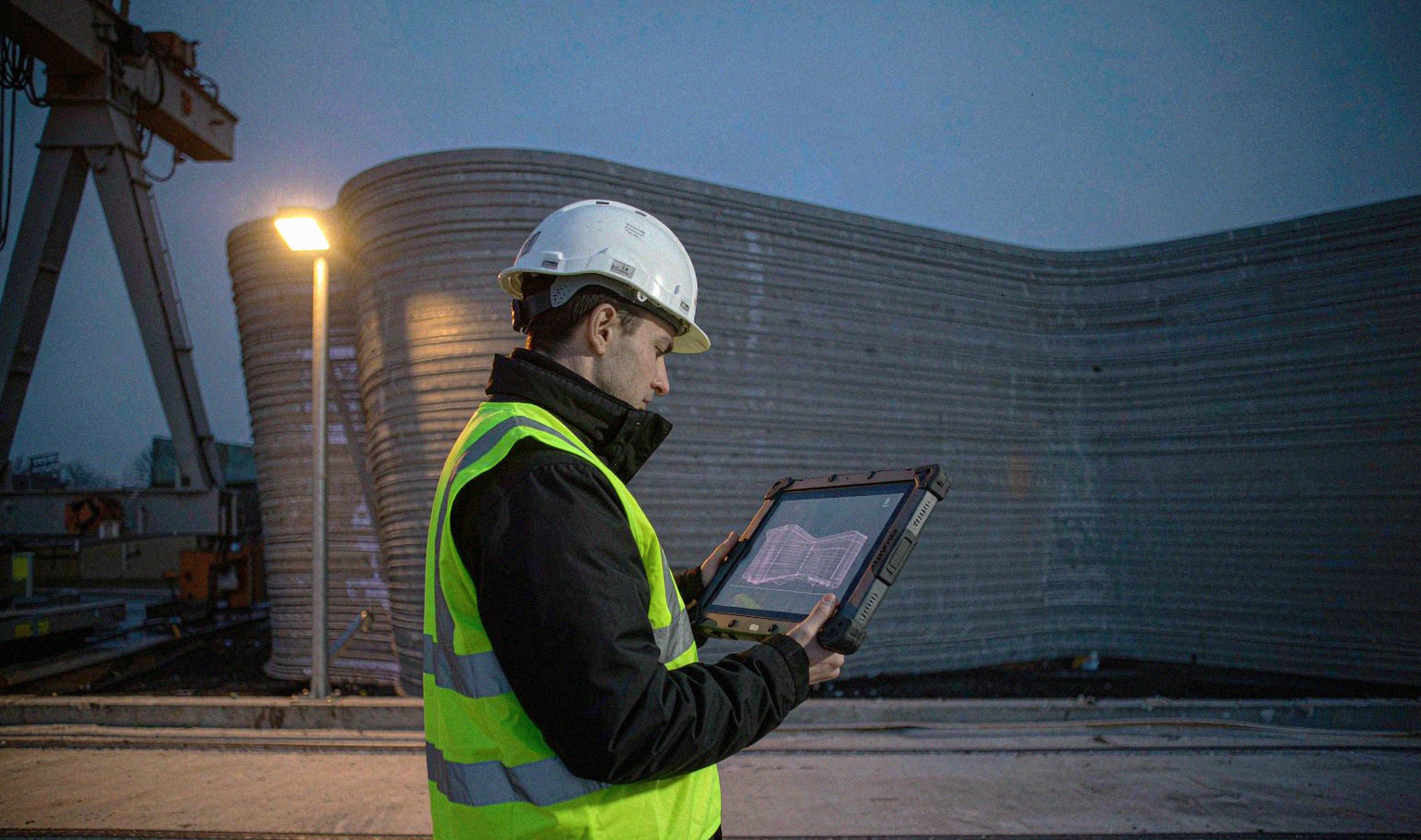
In conventional construction, design and execution are separated by a buffer. Drawings get revised, formwork gets struck, mistakes get patched locally. A printed wall has none of that slack. Design, fabrication and inspection collapse into one continuous line: material leaves the nozzle layer by layer, error accumulates layer by layer, and once the geometry has set, the remedy for a problem is demolition and reprint rather than repair.
That leaves exactly one window for correction, and it sits before the first layer is placed. Every decision that would once have been settled on site with a hammer and a chalk line has to be settled in advance, or not at all.
A digital twin fits that window. The building is printed in software first, in full, and the physical print then serves as the test of that rehearsal. The point is not a prettier model on a screen. It is a rehearsal detailed enough that the real print becomes a confirmation rather than an experiment.
Why printed buildings lean on a digital twin more than most
A digital twin is a living mirror of a physical asset in software, one that keeps evolving with the asset it represents. Several properties of additive construction make the pairing unusually tight.
Layering compounds error. Every layer rests on the one below, so a small extrusion deviation or a misaligned pass propagates upward for the rest of the build. Structural analysis normally examines a finished form. Printing has to reason about a form that is still becoming, and the stability of a wall that has not yet set, under its own weight and the load of the layers still to come, can only be assessed layer by layer.
Materials change while the job runs. Rheology and setting time for printable mixes shift with temperature, humidity and batch proportions. The same mix that pumps cleanly at nine in the morning can plug the line by mid afternoon. Print parameters, then, cannot be fixed in advance. They have to track the material.
There is no formwork to fall back on. With no mold holding the shape, geometry is decided entirely by the toolpath, which makes path planning part of structural design rather than a downstream step.
Virtual rehearsal: a complete print before the real one
Once the twin is in place, printability becomes a question that can be answered on screen. In the AiUltraprod workflow, the rehearsal covers four areas.
Structural feasibility. The layered build is simulated mechanically inside the twin model to flag buckling and collapse risk in green material, and to tune print speed, layer height and pass sequence around it. A wall that would stand once cured can still fail at layer forty, and the model is the only place to find that out cheaply.
Material fit. Rheology models feed the same simulation so pumping, extrusion and stacking can be reproduced, which shows whether a mix will carry the layers above it without sagging or cracking. Where the answer is no, the mix or the schedule changes, not the print.
Defect prediction. Process simulation exposes the cold joints, voids and shrinkage cracks a given parameter set is likely to produce, so the parameters or the path can be changed before those defects exist.
Process and cost comparison. Alternative paths and settings are compared on print time and material consumption in software, which moves trial and error off the site and onto the screen.
Physical verification: the print corrects the model
None of that rehearsal counts until the real print confirms it. A twin built once and never revisited is a model, not a twin. The useful version runs as a loop that keeps recalibrating.
During the build, sensors on the print head, the pumping system and the completed structure stream data back: temperature, extrusion flow, robot trajectory, layer-to-layer positional drift. That data returns to the model and keeps the virtual asset and the physical one moving together.
When measured values diverge from predicted ones, the system can trace the source. A batch change, drift in machine condition, accumulated path error: each leaves a different signature. The twin then corrects the parameters for the remaining layers, so the print adjusts while it is still running rather than being judged after the fact. Every component ends the build with its full process record attached, a traceable digital birth certificate that later supports acceptance testing and facility management.
AiUltraprod: rehearsal and verification as one system
AiUltraprod, the additive construction platform behind this work, starts from a different premise: design that follows the printing process, not a drawing set converted into machine code. Geometry, simulation, printing and verification run as one chain that begins at the digital twin.
Inside that chain the twin is a decision engine rather than a visualization layer. At design stage it answers whether the part can be printed at all. During rehearsal it answers which parameter set prints it best. On site it answers whether the print is running correctly. At handover it answers how compliance is demonstrated.
Beyond the build: the twin across the asset’s life
The twin does not stop mattering when the last layer lands. A component that enters operation with a complete process record turns the building into a digital asset that can keep being updated. Structural health monitoring, energy analysis, partial retrofit and reinforcement all get rehearsed on the same model before anyone touches the physical structure, which keeps the expensive experiments off the building itself. For firms delivering printed buildings at volume and across markets, this loop of rehearsal, verification and traceability is what underwrites owner confidence and, eventually, entry into standards and certification.
The real barrier in printed construction is not the machine. It is whether the whole build can be thought through and calculated before it happens. A digital twin pushes the cost of trial and error toward zero and moves the burden of proof into the virtual world. When rehearsal and verification close into one loop, printed buildings stop being a technology demonstration and start being a delivery model.