
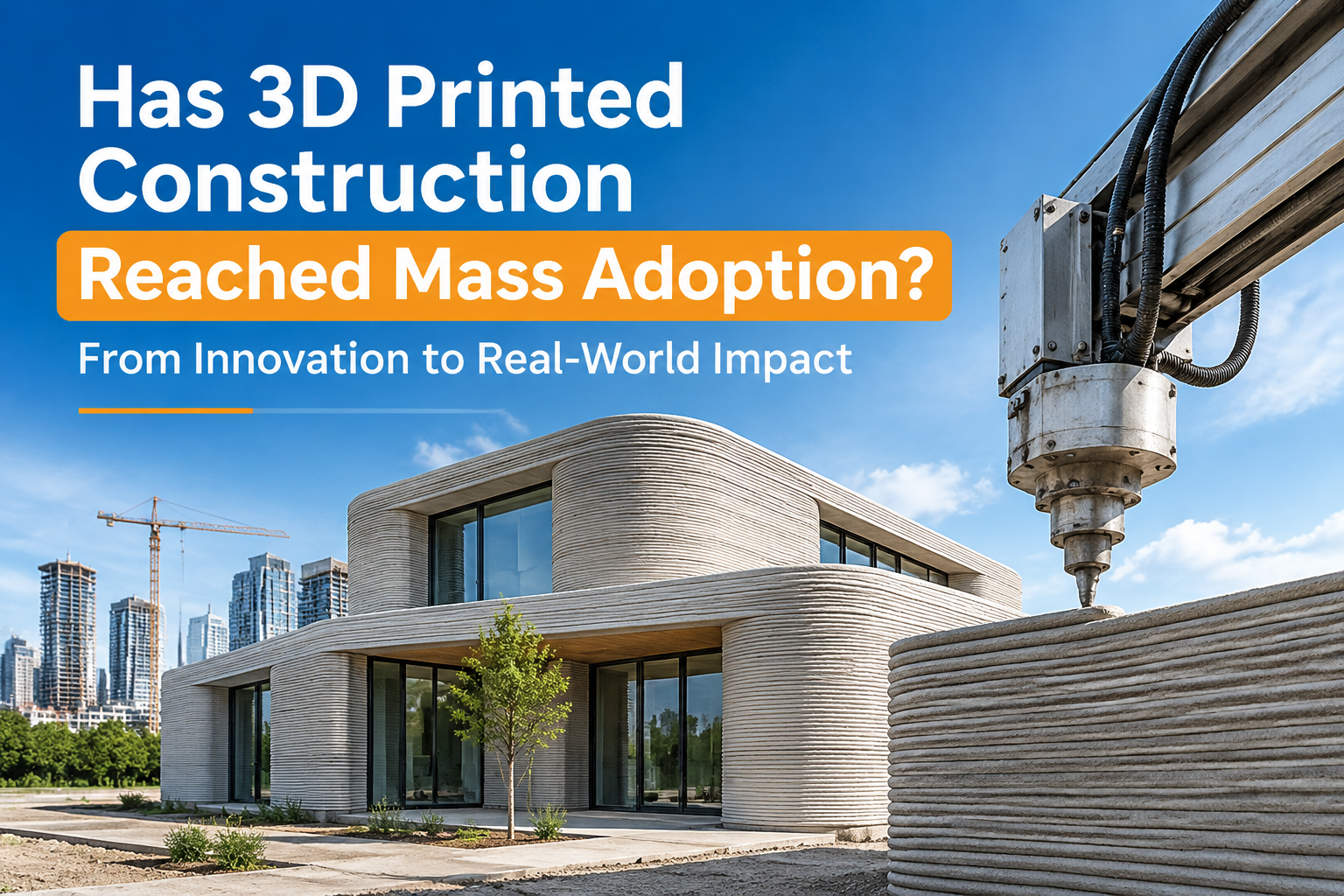
From Real-World Applications to Commercial Challenges and the Future of 3D Printed Buildings
Introduction
3D printed construction has moved beyond experimental projects. From residential buildings and commercial spaces to public infrastructure and architectural components, the technology is increasingly being used in real-world construction.
However, an important question remains: Has 3D printed construction truly reached the stage of mass adoption?
While advances in printing equipment, materials, and digital design have made construction 3D printing increasingly practical, widespread adoption still faces challenges related to cost, building regulations, structural performance, and project delivery.
The industry is moving from technical validation toward commercial implementation, but large-scale adoption remains a work in progress.
1. Where Does 3D Printed Construction Stand Today?
3D printed construction has progressed from prototype demonstrations to practical building applications. Its development is particularly visible in four areas:
- Residential construction: 3D printing is being used to produce residential walls and building structures, including small houses and accessory dwelling units (ADUs).
- Commercial buildings: Larger projects are demonstrating the potential of 3D concrete printing beyond small-scale residential construction.
- Public infrastructure: Bridges, landscape structures, and public facilities are expanding the technology’s application range.
- Architectural components: Customized walls, façade elements, benches, and other prefabricated components offer opportunities for more flexible production.
These applications demonstrate that 3D printed construction is commercially viable in selected scenarios.
However, printing a building’s walls does not necessarily mean the entire building is 3D printed. Foundations, roofs, reinforcement, electrical systems, plumbing, and interior finishes may still rely on conventional construction methods.
2. What Is Preventing 3D Printed Construction from Scaling?
Despite its potential, several challenges continue to limit the widespread adoption of 3D printed buildings.
Construction Costs and Equipment Investment
3D printing can reduce formwork requirements and certain labor-intensive processes. However, equipment investment, transportation, installation, material preparation, and maintenance all contribute to overall project costs.
Its economic advantages depend on project size, equipment utilization, design complexity, and local labor costs.
Material Performance and Structural Reliability
Concrete used for 3D printing must maintain sufficient flowability during extrusion while developing adequate early strength to support subsequent layers.
Key considerations include:
- Interlayer bonding strength.
- Shrinkage and crack resistance.
- Structural integrity and durability.
- Fire resistance and environmental performance.
Material consistency is essential for reliable construction.
Building Regulations and Certification
Building codes and approval procedures vary across countries and regions. Printed structures must meet applicable requirements for structural safety, fire protection, durability, and building performance.
The development of technical standards is therefore essential to wider commercial adoption.
Site Conditions and Construction Efficiency
On-site printing involves challenges such as equipment transportation, weather conditions, material supply, and continuous operation.
Improving equipment mobility, automation, and construction stability will be critical to expanding practical applications.
3. Which Applications Have the Greatest Potential?
Not every building project is equally suitable for 3D printing. The technology is most promising where design flexibility, production efficiency, and reduced formwork requirements provide clear advantages.
Residential Buildings and ADUs
Small residential buildings and accessory dwelling units offer opportunities for standardized designs and repeatable printing processes. They may become important applications as construction systems and approval processes mature.
Commercial and Public Buildings
Community facilities, small commercial buildings, and public spaces provide opportunities to apply 3D printing to larger architectural projects.
Landscape and Architectural Components
Concrete benches, planters, landscape walls, and customized architectural elements are relatively practical applications. They allow manufacturers to explore customized production without the complexity of delivering an entire building.
Prefabricated Building Components
Factory-based 3D concrete printing can improve production control and quality consistency. Wall panels, façade components, and customized structural elements are potential applications.
4. How Can 3D Printed Construction Achieve Mass Adoption?
Large-scale adoption requires more than faster printing equipment. It depends on an integrated construction system.
Four areas will play an important role:
- Digital Design: BIM and parametric modeling can connect architectural design with printing paths, material requirements, and construction processes.
- Automated Equipment: Gantry systems, robotic arms, and mobile printing equipment can improve production flexibility and operational efficiency.
- Advanced Materials: Printable concrete, low-carbon binders, and recycled aggregates can expand material options and improve sustainability.
- Integrated Project Delivery: Combining equipment, materials, software, engineering, and construction services can create more reliable and repeatable project solutions.
The future competitive advantage will increasingly depend on how effectively these elements work together.
5. Is 3D Printed Construction More Sustainable?
Sustainability is another important driver of construction 3D printing.
Compared with conventional construction methods, 3D printing can reduce formwork requirements and potentially minimize material waste through optimized structural design.
It may also support the use of recycled aggregates and alternative low-carbon materials.
However, 3D printing is not automatically more sustainable. Its environmental performance depends on cement content, material composition, equipment energy consumption, transportation, and the building’s service life.
A comprehensive life-cycle assessment is necessary to determine its actual environmental benefits.
6. Has 3D Printed Construction Reached Mass Adoption?
The answer is: Not yet, but it is moving toward broader commercial adoption.
3D printed construction has demonstrated its technical feasibility and established applications in residential buildings, commercial projects, public spaces, and prefabricated components.
However, widespread adoption still depends on several factors:
- More competitive construction costs.
- Consistent material and structural performance.
- Standardized building regulations and certification.
- Reliable equipment and automated production.
- Scalable business models and integrated project delivery.
Rather than completely replacing traditional construction, 3D printing is more likely to become an important complementary construction method.
The companies that successfully integrate digital design, printing equipment, materials, and engineering services will be better positioned to participate in the industry’s next stage of development.
At AiUltraprod, we believe the future of 3D printed construction lies not simply in printing more buildings, but in developing reliable, efficient, and scalable digital construction solutions.
The real measure of mass adoption is not how many buildings can be printed, but how consistently and economically they can be delivered.
Frequently Asked Questions (FAQ)
Is 3D printed construction commercially available?
Yes. 3D printing is already being used in selected residential, commercial, infrastructure, and architectural projects. However, widespread adoption is still developing.
Is 3D printed construction cheaper than traditional construction?
Not always. It can reduce labor and formwork costs, but equipment investment, materials, transportation, and project preparation must also be considered.
Are 3D printed buildings structurally safe?
They can meet applicable structural requirements when properly designed, engineered, tested, and approved. Material performance and interlayer bonding are particularly important.
What types of buildings are suitable for 3D printing?
Residential buildings, ADUs, small commercial spaces, landscape structures, and prefabricated architectural components are among the promising applications.
What is the future of 3D printed construction?
Future development will focus on automation, material innovation, standardized construction processes, digital design integration, and scalable commercial applications.
About AiUltraprod
AiUltraprod explores the development of 3D printing technology, digital construction, and intelligent manufacturing. By connecting equipment, materials, and digital solutions, we aim to support more efficient and flexible construction methods.
Discover more: https://aiultraprod.com/