
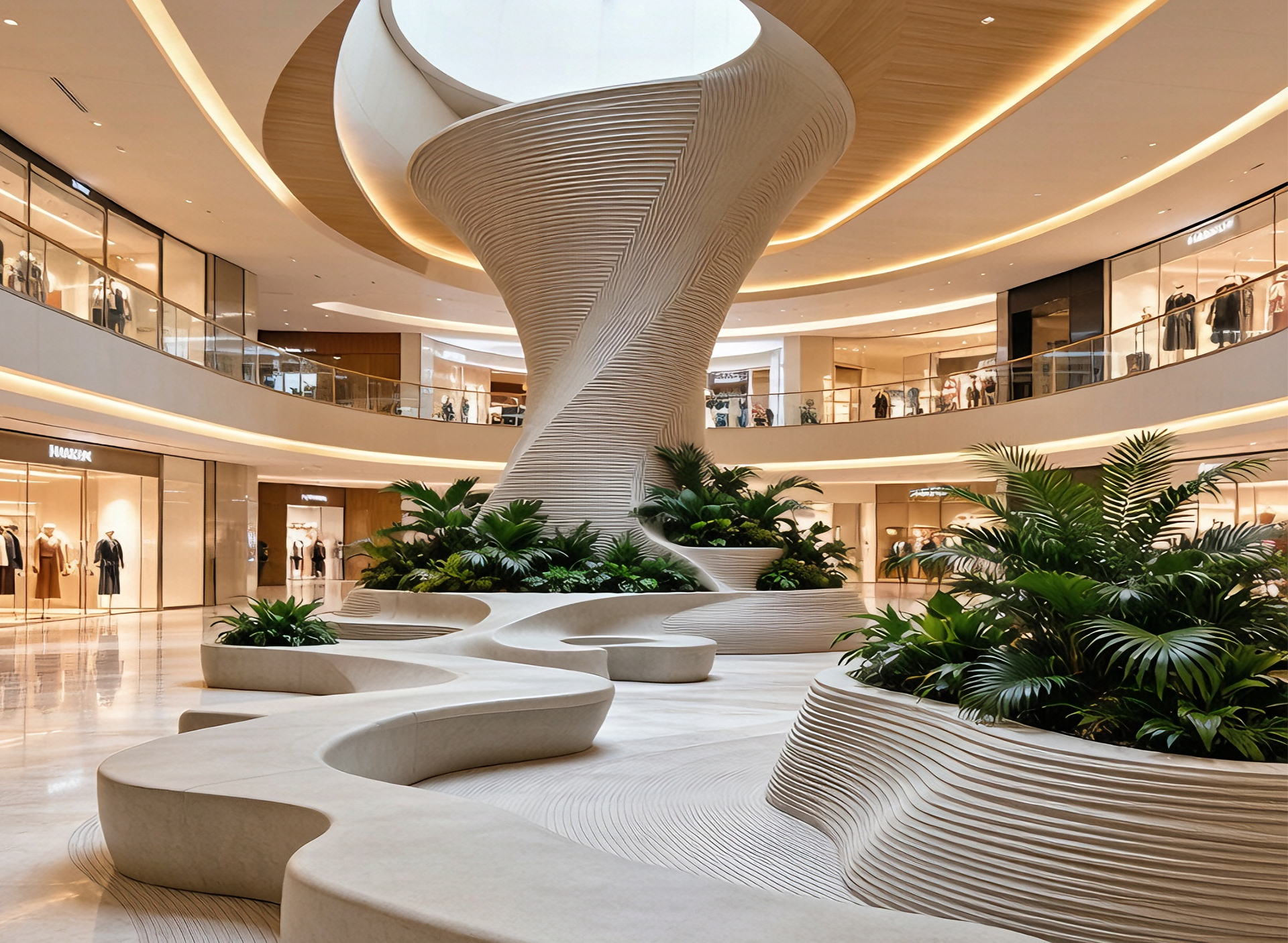
A spiral-shaped biodegradable pavilion debuted at Singapore Design Week; a luxury hotel rising out of Texas desert soil features curved walls nearly impossible to construct with traditional handcrafting; on Madison Avenue, a retail store’s ceiling flows in organic undulating forms—fabricated from recycled waste materials and installed within just a few days.
These are not renderings. They are unfolding realities.
I. From Greenery to Landscaping: A New Competition Among Commercial Spaces
Over the past decade, high-end commercial spaces competed primarily around brand leasing and tenant mix. Today, however, spatial experience itself has become the new decisive advantage.
Data shows that for every 10% increase in consumers’ dwell time in shopping malls, shopping conversion rates rise by approximately 15%. The core factor determining how long visitors stay has shifted from “how many brands are available” to “whether this space is worth visiting.” Consequently, commercial real estate operators have launched a new race: how to turn the space itself into a draw for foot traffic.
Traditional landscaping solutions are hitting bottlenecks. Standardized products lack distinctiveness, while custom solutions come with lengthy construction cycles and exorbitant costs. Organic, parametric geometric shapes can barely be realized using conventional molds and formwork. It is at this juncture that 3D-printed landscape technology has quietly entered the sightlines of commercial space developers—and it is no longer merely experimental.
II. Four Core Drivers Behind the Shift to 3D Printing
Driver 1: One-of-a-Kind Brand Differentiation
The biggest pain point for premium commercial spaces is generic, indistinguishable layouts across venues. The greatest value delivered by 3D printing lies in complete liberation of geometric design freedom.
Under traditional manufacturing, a curved custom flower bed can cost several times more than standard alternatives, requiring custom molds and extensive manual labor. By contrast, 3D printing directly translates digital models into physical objects. Whether it is parametric gradient textures, biomorphic tree pits, or custom installations embedded with brand logos, a single modeling session enables precise production.
This means commercial spaces can develop exclusive landscape aesthetics instead of picking off-the-shelf products from supplier catalogs.
Driver 2: Dramatically Shortened Delivery Cycles—From Weeks to Days
Time carries steep costs for commercial spaces: every delayed opening day translates to substantial revenue losses. Traditional custom landscape projects take a minimum of 3 to 4 weeks from design and mold production to final manufacturing.
Dutch large-format 3D printing studio Aectual has pioneered an alternative approach. It produces modular ceiling panels and storefront elements for lululemon’s global stores, starting in Milan and New York before expanding to Birmingham and Tokyo. Constructed from recyclable biomaterials and engineered for seamless assembly, these components can be installed at each location within days while maintaining a unified global visual identity.
The supply chain workflow has been streamlined from “order from catalog → await production → transport → install” to a three-step process: “design → print → install.” This eliminates inventory storage and all mold investment entirely.
Driver 3: Credible Sustainability Narratives Beyond Symbolic Posturing
ESG ratings have grown increasingly critical for commercial real estate, and 3D printing delivers tangible, quantifiable sustainability benefits:
- Zero-waste manufacturing: Material is deposited only where structurally required, eliminating mold waste and cutting scrap losses, pushing material utilization close to 100%.
- Closed-loop recycling: The panels used in lululemon stores are printed by Aectual from post-consumer waste. At the end of their service life, components can be crushed and reprinted into new architectural elements, creating a fully circular production cycle.
- Lower carbon emissions from transportation: Segmented printing and on-site assembly drastically reduce shipments of oversized structural pieces.
- Topology-optimized lightweight structures: Material is allocated solely to load-bearing sections, cutting concrete usage by 30% to 50% compared with conventional cast concrete.
For brands seeking authentic, verifiable sustainability storytelling, these are not abstract promises—they are measurable metrics.
Driver 4: Predictable Budgets with Zero Mold Expenses
Contrary to common misconceptions, 3D printing is often more cost-effective for custom curved projects.
Cost structures for traditional custom construction hinge on high upfront mold and tooling fees, skilled labor expenses, and raw material costs. The 3D printing model eliminates mold costs and drastically reduces labor input, concentrating expenses almost entirely on raw materials and machine runtime.
As a result, budgets can be fully locked in before project initiation, removing the uncertainty of waiting for mold fabrication to confirm total costs. This level of cost transparency is a transformative advantage for commercial developers managing multiple line items within tight capital expenditure budgets.
III. Real-World Global Case Studies Leading the Trend
1. lululemon × Aectual (Milan / New York / Birmingham / Tokyo)
Sportswear brand lululemon partnered with Dutch studio Aectual to reimagine its global retail identity via large-format 3D printing. The core objective: a cohesive sculptural interior language that complies with local building codes and enables rapid rollout across continents.
The solution features organic curves echoing lululemon’s circular logo, with modular ceiling and storefront components printed entirely from recyclable post-consumer waste. Panels fit together seamlessly with invisible joints. When store renovations take place, the panels are returned to Aectual for crushing and reprinting—an industrial-scale closed-loop economy implemented by one of the world’s most prominent active lifestyle brands.
2. El Cosmico by ICON + BIG (Marfa, Texas, USA)
In the high desert of West Texas, the world’s first 3D-printed hotel and residential development broke ground in September 2024. Initiated by hospitality icon Liz Lambert, designed by Bjarke Ingels Group (BIG), and constructed by ICON, El Cosmico spans over 60 acres.
The architecture itself serves as a textbook demonstration of 3D printing’s capabilities. Domes, vaults, arches, and parabolic geometries—forms prohibitively costly to build with traditional formwork—are fabricated by ICON’s robotic systems using local sand and soil, giving buildings the impression of growing naturally from the earth.
The development includes 3D-printed hotel rooms, bathrooms, swimming pools, restaurants, and private “Sunday Homes” starting at $2.29 million. Notably, the project also commits to constructing affordable 3D-printed housing for the Marfa community, with designs sourced from ICON’s Initiative 99 global design competition, which received submissions from over 60 countries.
El Cosmico proves that 3D printing has evolved from a novelty to a viable solution for luxury hospitality and community-scale development.
3. Cemer Scutoid Series (Turkey, Exported to 75 Countries)
Not all 3D-printed landscape elements need to be monumental. Turkish manufacturer Cemer, with 30 years of experience in precast concrete, launched its Scutoid line: 3D-printed modular concrete seating and planters redefining urban furniture.
Named after the scutoid geometric shape found in biological cell structures, the interlocking modules connect at seamless angles to form continuous flowing seating layouts for plazas, parks, and commercial districts. Each component is printed with eco-optimized concrete and customizable surface colors and textures. Critically, individual damaged modules can be replaced without disrupting adjacent pieces.
Now exported to 75 countries, the Scutoid series is deployed in commercial blocks, corporate campuses, and transit hubs worldwide. It demonstrates that 3D-printed landscape furniture is no longer a niche experiment but a scalable, commercially validated product category.
4. Altostrata by Mamou-Mani Architects (Touring: Romania → Singapore → Dubai)
Designed by London-based Mamou-Mani Architects and fabricated by Fab.Pub, Altostrata is a fully 3D-printed mobile auditorium spanning 30 meters, composed of 12 custom modules.
Its structure leverages a parametrically optimized organic truss system, printed entirely from compostable sugar-based bioplastic and premium PLA. Each module takes only three weeks to produce. The full pavilion fits inside standard shipping containers and has been assembled for events in three nations: the Sibiu International Theatre Festival in Romania, Singapore Design Week, and Dubai Design Week.
Altostrata establishes a new paradigm for premium temporary commercial event spaces: an aesthetically striking, sustainable, reusable, transportable structure built via printing rather than conventional construction.
IV. AiUltraprod: Scaling Accessible 3D-Printed Landscapes
The international cases above illustrate the full potential of 3D printing. Yet for most commercial developers and architects, a major barrier remains: how to source, evaluate, and coordinate professional 3D printing manufacturers across regions.
AiUltraprod was created to bridge this gap. As an AI-powered digital construction cloud platform, AiUltraprod serves as an all-in-one hub covering the full lifecycle of 3D-printed architectural and landscape elements from design to delivery.
Core Capabilities
- AI-driven design portal: Input conceptual descriptions in natural language or upload sketch drafts. AI generates design proposals matched against a growing library of production-verified templates.
- Built-in technical validation: Every design undergoes automated checks for over 10 key manufacturing constraints prior to printing, including overhang angles, wall thickness, and material compatibility.
- 30+ standard templates plus unlimited custom options: Template matching is free of charge; parametric custom design incurs a nominal fee fully deductible against formal production orders.
- End-to-end full transparency: Design reviews, instant quotations, production tracking, and logistics management are consolidated on a single digital dashboard.
AiUltraprod’s core philosophy—no binding contracts, no minimum order quantities, zero inventory, on-demand printing—aims to make sourcing 3D-printed landscape fixtures as straightforward as purchasing standard catalog goods, while unlocking unlimited geometric design freedom.
V. The Future Is Already Here
The widespread adoption of 3D-printed landscapes in high-end commercial spaces represents a fundamental shift from manufacturing limitations to digital design intent.
Old mindset: “Here are our available molds—choose a shape.”
New mindset: “Tell us your vision, and we will print it.”
This seemingly simple transformation elevates the design potential of commercial spaces to unprecedented heights. When every installation in an atrium can function as a unique artwork, and a brand’s spatial narrative can be directly translated from digital models into physical form, commercial real estate’s long-sought goal of immersive experience upgrading gains a definitive technological foundation.
For developers and architects planning upcoming projects, the question is no longer “Should we use 3D printing?”
Instead, it has become:
“If freed from the constraints of molds and lead times, what would you design for this space?”