
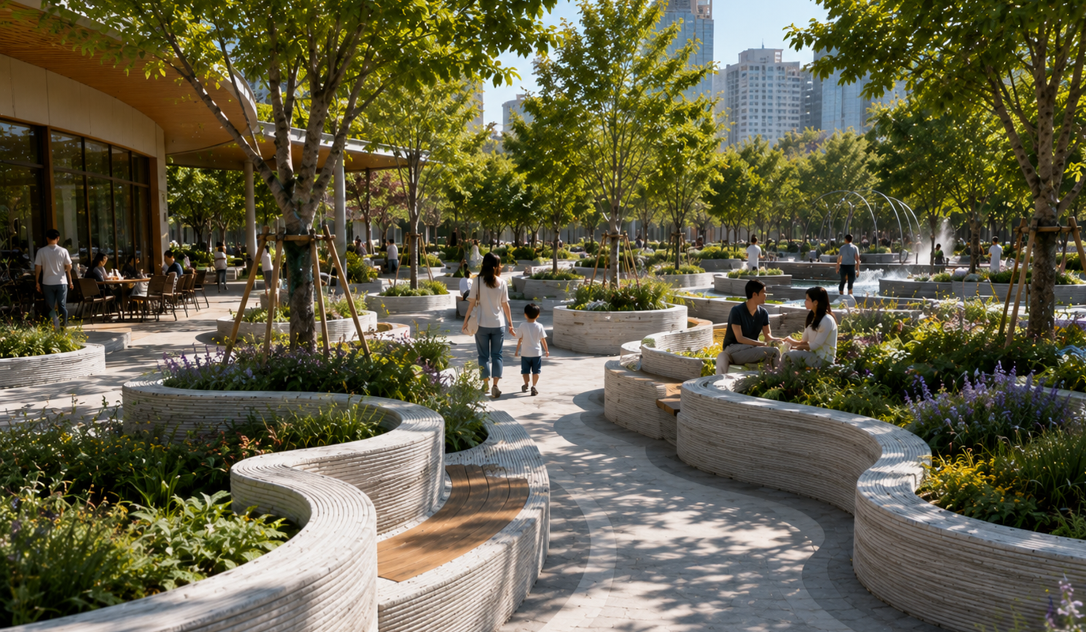
The way we shape cities is turning a new page—and this chapter is being printed layer by layer.
For decades, urban landscape design has relied on standardized, mass-produced materials: concrete paving slabs, prefabricated benches, metal guardrails, off-the-shelf planters. While these fulfill basic functional demands, they come with hidden costs: every park bench looks identical, every square feels interchangeable. Ironically, our public spaces end up lacking genuine “sense of place.”
Today, 3D printing is rewriting this narrative.
Once a niche technology reserved for architectural models and small furniture, additive manufacturing is rapidly expanding into far more ambitious territory—full landscape structures, street furniture, and load-bearing site components fabricated through layer-by-layer printing. From Amsterdam’s 3D-printed pedestrian bridge to the 3D-printed pavilion at Shenzhen Talent Park, a quiet revolution is underway.
From “Form Follows Function” to “Form Follows Freedom”
Traditional construction is constrained by moulds, formwork and standardised dimensions. Curved shapes drive up costs, and complex geometries come with premium price tags. These limitations have shaped the visual language of modern cities: dominated by straight lines, repetitive patterns and risk-averse aesthetics.
3D printing dismantles these restrictions. In additive manufacturing, geometric complexity costs no more than simplicity. A hyperbolic curved bench costs the same to print as a straight one; a facade panel with generative grille patterns carries no price premium over a flat slab. This is not incremental improvement—it represents a paradigm shift in design freedom.
For landscape architects, this means creating site-specific, organic forms that respond freely to environmental conditions—terrain, sunlight paths, pedestrian flow—without incurring extra costs for intricate fabrication.
Key Applications in Urban Public Spaces
- Custom Street Furniture
Cities including Barcelona and Dubai have rolled out 3D-printed benches, bollards and bike racks. Ergonomically refined, these pieces integrate local cultural motifs into their design.
- Structural Landscape Components
3D-printed pedestrian bridges, retaining walls and planting structures are evolving from pilot projects to mainstream infrastructure. The 3D-printed concrete bridge in Nijmegen, the Netherlands, served as a proof of concept. Today, engineering-grade polymers and fibre-reinforced concrete deliver load-bearing landscape structures that are lighter, more durable and more expressive than conventional builds.
- Integrated Planting Systems
One of the most promising applications lies in 3D-printed planters and green infrastructure modules. Fabricated with porous, water-retentive materials, these landscape fixtures double as living systems—with irrigation channels, drainage routes and planting troughs integrated seamlessly into a single form. Urban farms, vertical green walls and stormwater management facilities can be printed as monolithic, seamless assemblies.
- Temporary & Event Spaces
For music festivals, exhibitions and pop-up parks, 3D printing unlocks an unprecedented combination: bespoke high-end design at controlled costs. Printed landscape elements can be installed, utilised and fully recycled, enabling zero-waste urban interventions that remain economically viable even for short-term use cases.
Value for Commercial Districts
In business districts, the quality of public space directly impacts foot traffic, dwell time and commercial activity. A 2019 study by the University of Toronto found that thoughtfully designed street furnishings can boost retail spending by up to 40%.
3D-printed landscapes grant commercial developers a competitive edge through three core advantages:
- Differentiation: Sculptural, one-of-a-kind site features create Instagram-worthy destinations that drive organic social media exposure.
- Speed: Fabrication and installation of printed components take only a fraction of the time required for cast-in-place concrete or stone masonry.
- Sustainability: Additive manufacturing generates far less waste than subtractive manufacturing, and materials can be sourced locally or fully recycled.
The Technology Behind the Innovation
At AiUltraprod, we combine industrial robotic 3D printing with generative design algorithms to deliver structurally optimised, material-efficient landscape elements with unprecedented aesthetic potential.
Our Workflow
- Generative Design: Algorithms explore thousands of form variations to optimise structural load bearing, material consumption and solar orientation.
- Robotic Printing: Multi-axis robotic arms deposit materials with a precision of ±0.15 millimetres, enabling complex overhangs and internal geometries impossible to achieve with traditional formwork.
- Post-Processing: Surface treatments range from exposed aggregate textures to polished finishes, lending printed landscapes tactile quality comparable to premium architectural materials.
Outlook: The 3D-Printed City
The trend is unambiguous. As material science advances and printing speeds accelerate, 3D-printed landscapes will evolve from landmark installations to standard industry practice. We are approaching a future where:
- Every park bench is ergonomically customised to its exact location.
- Entire plaza surfaces are printed on-site, eliminating transport emissions and construction noise.
- Public spaces achieve true universal accessibility—ramps, tactile paving and seating geometries optimised for all users, not just able-bodied people.
At AiUltraprod, we believe great cities are built on great public spaces. And the most remarkable public spaces of the coming decades will be printed, one layer at a time.