
Key Takeaways
Manufacturing labor productivity has nearly doubled since 2005, while that of the construction industry has barely grown over the same period, creating a two-decade-long productivity gap, according to McKinsey Global Institute.
The global robot density in manufacturing reached 162 units per 10,000 workers in 2025 (International Federation of Robotics, IFR), yet robot adoption in construction is still in its infancy. This is not a technical limitation but a structural industry challenge.
AiUltraProd’s in-situ 3D printing solution with robotic arms brings factory-grade automation precision directly to construction sites. The “construction site as factory” model has been validated in multiple real-world projects including Ningbo Bay, Dali Wanhua Stream Bridge and Shanghai.
Field-tested data from completed projects shows a 400% increase in construction speed, an 80% reduction in material waste and a 70% cut in labor costs — results proven on-site rather than just lab projections.
I. Manufacturing vs. Construction: A Two-Decade Race for Productivity
McKinsey Global Institute’s long-term tracking of global construction productivity reveals a striking trend: since 2005, labor productivity in manufacturing has almost doubled, whereas the figure for construction has remained nearly flat. This productivity stagnation is a global structural dilemma, not limited to individual countries.
Industrial robot deployment has entered a density competition across the manufacturing sector. Per IFR’s World Robotics 2025, over 540,000 new industrial robots were installed in global factories in 2024, with the average robot density hitting 162 units per 10,000 employees. South Korea has even surpassed 1,000 robots per 10,000 workers. Automation rates on production lines for 3C electronics and automobile manufacturing exceed 90%.
By contrast, the construction industry — with an annual output value exceeding 13 trillion US dollars worldwide — still relies heavily on manual steel bar tying and concrete pouring at most job sites.
The construction sector is not resistant to automation. Instead, fundamental structural differences make it impossible to directly copy the automation pathways proven effective in manufacturing.
II. Structural Barriers: Why Construction Automation Lags Behind
Three inherent characteristics of the construction industry explain its slow automation progress:
2.1 Product Standardization: Mass Production vs. One-of-a-Kind Builds
The core strength of manufacturing lies in repeatable products. A single automobile production line can churn out hundreds of thousands of vehicles with unified workflows, working rhythms and quality inspection standards. Robots only need one-time programming for long-term repeated operation.
Construction operates in a completely different mode. Every project is unique, with varying foundation conditions, structural designs and functional requirements. Essentially, each building is a custom product. In this context, the conventional automation model based on reusable programming becomes unworkable.
2.2 Working Environment: Climate-Controlled Workshops vs. Open-Air Sites
Manufacturing automation takes place in fully controlled environments, where temperature, humidity, lighting and material delivery are all quantifiable and consistent.
Construction sites, however, are fully exposed to the elements. Unpredictable weather, uneven terrain and unstable material supply pose major challenges for traditional high-precision automated equipment. An industrial robotic arm can achieve a positioning accuracy of ±0.02mm inside a factory, yet it may struggle to stay stable on rough construction ground.
2.3 Workforce Structure: General Operators vs. Skilled Artisans
Automation in manufacturing reduces reliance on senior technicians. Operators with just two weeks of training can manage multiple automated production lines.
Traditional construction, however, depends heavily on seasoned workers such as masons, steel bar fixers and formwork carpenters, whose skills take years to develop. Worse still, the global construction industry is facing a dual crisis: an aging workforce and a shortage of young talent. According to Deloitte’s 2026 Engineering and Construction Industry Outlook, the US faces a shortfall of around 500,000 construction workers. In China, the average age of construction workers has exceeded 43 and keeps rising.
In short, the issue is not whether construction can be automated, but that an entirely new construction paradigm is required to break through these three structural bottlenecks.
III. AiUltraProd’s Solution: Bringing Factory-Grade Automation to Job Sites
This is where AiUltraProd steps in. Instead of prefabricating building components in factories and assembling them on-site, the company deploys high-precision robotic arms paired with concrete 3D printing technology directly at construction sites, reinventing construction workflows through full digital control.
3.1 What is In-Situ 3D Printing Construction?
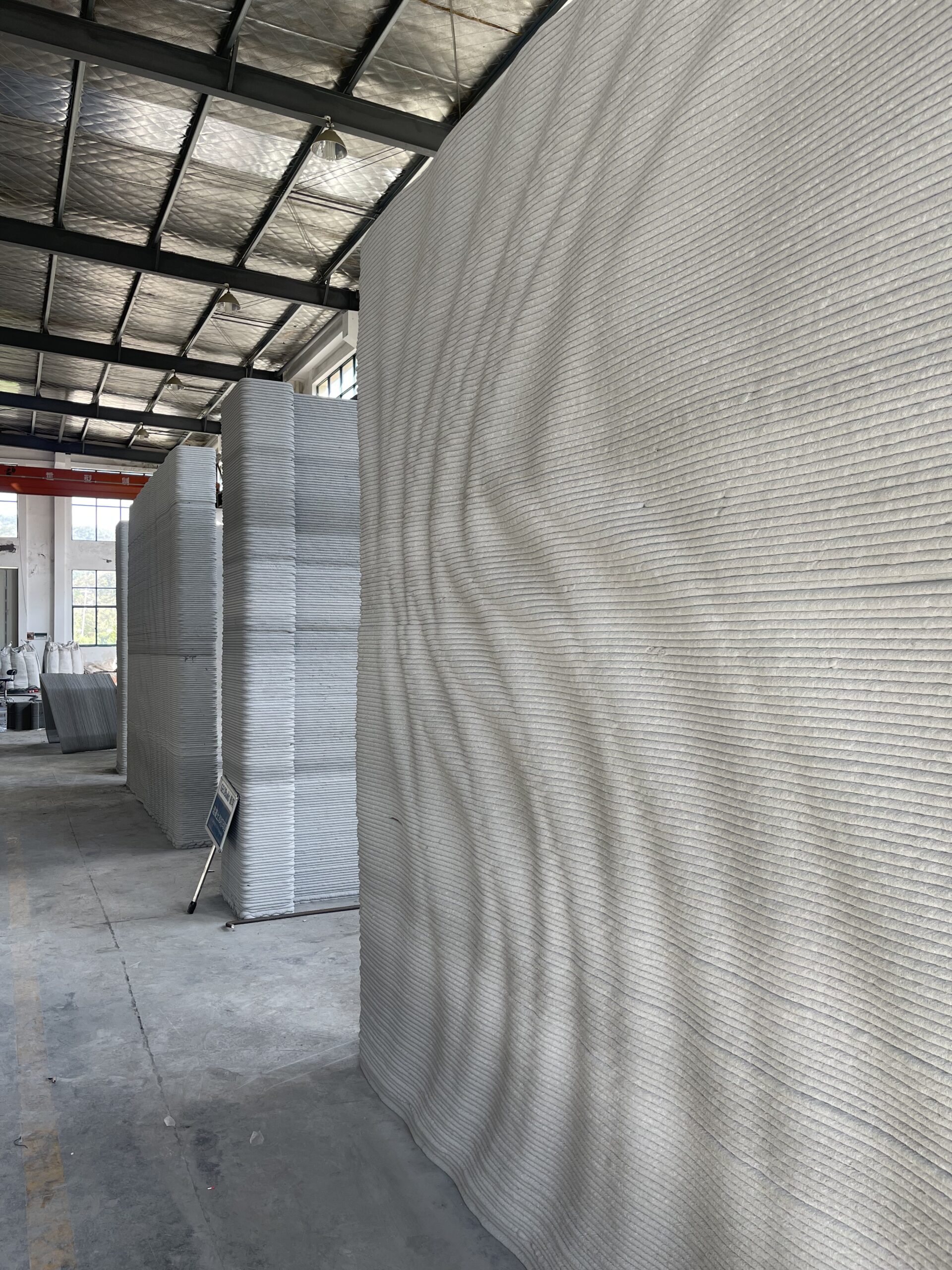
Mounted on a mobile platform, the high-precision robotic arm follows digital instructions from BIM models to extrude specially formulated concrete layer by layer on-site, constructing walls, columns and even complete building structures.
Different from precast construction (where PC components are factory-produced and transported for on-site assembly), AiUltraProd delivers true in-situ construction. It eliminates transportation costs, formwork expenses and component assembly work. Traditional procedures including construction drawing optimization, formwork erection and concrete curing are removed from the workflow, connecting digital models directly to physical buildings.
3.2 Core Technological Breakthroughs: Solving Traditional Pain Points
| Traditional Construction Pain Points | AiUltraProd’s Solutions |
|---|---|
| Each project is custom-made and hard to standardize | Adjust BIM models to adapt to different projects, no repeated production line programming required |
| Uncontrollable outdoor working environment | Mobile robotic platforms with automatic leveling and real-time error compensation, adapting to complex terrain |
| Heavy reliance on a large number of skilled workers | 1 set of equipment plus 2–3 operators can replace the workload of over 20 masons |
| Complicated procedures and unstable construction quality | Fully digital construction with millimeter-level precision for interlayer bonding |
3.3 Product Lineup: Four Models for Diverse Scenarios
AiUltraProd has developed four types of equipment covering a full range of application scenarios:
- RC1-3100: Tracked concrete 3D printing robot. The tracked chassis enables rapid relocation on complex sites, ideal for continuous printing across multiple work areas in large-scale projects.
- RF1-3100: Flagship in-situ concrete 3D printing robot. Designed for high-speed construction of main structures including residential buildings, commercial properties and public landscape facilities.
- RF1-2700: Compact polymer in-situ 3D printing robot. Suited for interior decoration, small structures and landscape architecture, featuring flexible deployment and ultra-high precision.
- RT1-2700: Rail-mounted polymer 3D printing robot. Tailored for special-shaped structures, non-load-bearing components, exhibition installations and mold manufacturing.
All devices follow the same core workflow: Digital Model → Robotic Printing → Finished Structure, which greatly shortens the lengthy process from design and construction preparation to final acceptance in traditional construction.
IV. Field Applications: From Curved Coastal Buildings to Landscape Bridges in Dali
Beyond theoretical innovation, AiUltraProd’s technology has been proven reliable in real-world complex construction projects.
4.1 Ningbo Bay Clover & Cloud-Shaped Buildings: Complex Curves Made Cost-Effective
Located along the coast of Ningbo Bay, this landmark project features two buildings inspired by clover shapes and natural cloud forms. Adopting fluid geometry and organic structures, the buildings are covered with intricate curved surfaces and interconnected spatial modules. Such designs are either nearly impossible to realize with traditional formwork construction or come with exorbitant costs.
AiUltraProd’s concrete 3D printing robotic system undertook the core structural construction. Driven by parametric modeling and intelligent production workflows, design data directly guides robotic arms to extrude special concrete layer by layer, with no wooden formwork needed. Material waste is controlled below 3%, compared with 10%–15% for conventional cast-in-place construction. Optimized printing parameters and material formulas ensure long-term durability even in Ningbo Bay’s harsh coastal environment with high humidity, strong winds and drastic temperature changes.
4.2 Dali Wanhua Stream Bridge: Automation Applied to Mountainous Infrastructure
The Wanhua Stream Bridge in Dali demonstrates the great potential of 3D printing in municipal infrastructure. Traditional bridge construction involves extensive formwork support, steel bar binding and high-altitude operations, leading to high safety risks and long construction cycles in mountainous valley terrain.
Deploying the tracked RC1-3100 3D printing robot, AiUltraProd completed the one-piece forming of the main bridge structure by precise layered concrete extrusion. The construction cycle was cut by over 50%, with only 3 on-site operators required.
4.3 Design Shanghai Art Installation: Validation for Rapid Commercial Construction
Cooperating with universities for industry-university-research collaboration, AiUltraProd completed a full structural installation at Design Shanghai within a tight exhibition schedule. A complete architectural structure was built from scratch in just a few days — a speed unattainable for traditional construction methods. This case verifies the unique advantages of 3D printing for non-standard and fast-track construction projects.
These three projects prove that AiUltraProd’s 3D printing robots are not just conceptual products, but mature construction solutions tested under diverse and challenging on-site conditions.
V. Data Comparison: Efficiency, Precision and Cost Restructuring
| Evaluation Dimension | Traditional Construction | AiUltraProd 3D Printing Construction |
|---|---|---|
| Construction Speed (100㎡ single-story building) | 45–60 days | Around 9–12 days (400% speed increase) |
| Labor Requirement (same floor area) | 15–20 workers | 2–3 workers (70% labor cost reduction) |
| Material Waste Rate | 10%–15% | Below 3% |
| Standardization Level | Low (dependent on workers’ skills) | High (digital control with millimeter-level precision) |
| Design Flexibility | Limited by formwork and construction techniques | Extremely high (supports arbitrary curved and non-linear shapes) |
| Site Environment Adaptability | Good | Excellent (equipped with mobile platform and real-time compensation system) |
| Formwork Cost | Accounts for 10%–15% of total construction cost | No formwork required |
Note: The above data is compiled from actual operation records of AiUltraProd’s completed projects in Ningbo Bay, Dali and Shanghai, as well as public industry reports from McKinsey and Deloitte. Specific figures may vary slightly depending on on-site working conditions.
VI. Beyond Equipment: The Digital Construction Ecosystem Built by AiUltraProd
To fully recognize AiUltraProd’s long-term value, it is essential to view its offerings as a complete digital construction ecosystem, rather than standalone devices:
- Hardware Layer: Four core robot models (RF1-3100, RF1-2700, RC1-3100, RT1-2700) — the executive hardware for on-site construction.
- Software Layer: Path planning and printing control systems seamlessly integrated with BIM/CAD workflows — the digital brain that guides construction.
- Material Layer: Custom concrete formulas optimized for 3D printing, balancing workability, extrudability, early strength and interlayer bonding performance to meet engineering standards.
- Application Layer: A full scenario matrix covering low-rise accessory dwellings, landscape architecture, municipal facilities, cultural tourism buildings and post-disaster rapid reconstruction.
In essence, AiUltraProd delivers an end-to-end solution that paves the way for large-scale automation in the construction industry, rather than merely selling high-end printing equipment.
VII. Outlook: A Turning Point for Construction Automation
The International Federation of Robotics ranks construction automation as one of the fastest-growing application sectors for industrial robots from 2025 to 2030. Meanwhile, China’s Ministry of Housing and Urban-Rural Development has listed intelligent construction as a key industry development priority for consecutive years. 31 provincial and municipal governments have rolled out subsidies and streamlined approval procedures for 3D printing construction pilot projects.
Three driving forces — technological maturity, policy support and labor shortages — have all reached a critical turning point.
Manufacturing took four decades to evolve from manual assembly to full automation, but the construction industry will not need to wait that long. Instead of remodeling construction workflows to mimic factories, the industry is now bringing factory-level capabilities directly to job sites.
The construction sector has long been the last major industry to embrace technological transformation through the first three industrial revolutions. With AiUltraProd’s in-situ robotic 3D printing technology, this giant is now poised for a historic transformation — and the change is happening right now.
Contact Us
For more information about AiUltraProd’s 3D printing construction equipment or business cooperation opportunities, please send your project requirements to our email. We will provide targeted solution suggestions within 48 hours.
Official Website: www.aiultraprod.com
Email: info@aiultraprod.com
Data Sources
McKinsey Global Institute Construction Productivity Report; IFR World Robotics 2025; Deloitte 2026 Engineering and Construction Industry Outlook
Disclaimer
This article presents industry insights and technical analysis. Partial industry data is quoted from public research reports.