Construction 3D printing technology is moving out of laboratories and onto real construction sites, yet on-site conditions are far from ideal—undulating slopes, loose sand, muddy wetlands, narrow roadways, and more. Conventional rail-mounted or fixed-base printing equipment can barely operate in such complex terrain. The introduction of tracked mobile platforms is fundamentally transforming this situation.
This paper thoroughly explores how tracked equipment overcomes the constraints complex terrain imposes on construction 3D printing. Combined with AiUltraprod’s technical practices in tracked construction printing, it illustrates the engineering value and industry prospects of this technological route.
I. Complex Terrain: The Primary Barrier for Construction 3D Printing to Enter Job Sites
1.1 Ideal Laboratory Environments vs. Real-World Construction Sites
In laboratory or factory prefabrication scenarios, printing equipment operates on level, rigid, clean surfaces, enabling simple, predictable kinematic modeling for robotic systems. However, upon deployment to actual construction sites, the following issues emerge simultaneously:
| Type of Challenge | Specific Manifestations | Impacts on Printing Quality |
|---|---|---|
| Uneven ground | Slopes, pits, gravel piles | Position deviation of print head, layer misalignment |
| Soft foundation | Sandy land, silt, wetlands | Equipment sinking, overall tilting, printing interruptions |
| Confined space | Narrow roadways, slope-side operations | Difficult rail laying for traditional equipment, inaccessible work zones |
| Harsh environments | Rain, snow, high temperatures, dust | Fluctuations in material performance, reduced equipment stability |
1.2 Limitations of Conventional Solutions
- Rail-mounted systems: Require pre-laid rails, which are difficult, costly and time-consuming to install on unpaved ground; rails themselves are restricted by terrain conditions.
- Gantry frame systems: Limited span, unable to cope with large elevation differences, and extremely time-consuming to erect and dismantle.
- Fixed base + robotic arm systems: Working range constrained by arm reach; frequent repositioning required for large-area construction, with recalibration needed after each move.
The core contradiction lies in the fact that conventional solutions treat “equipment positioning” and “terrain adaptability” as separate problems to be addressed independently, while tracked systems integrate the two into a unified solution.
II. Tracked Platforms: An Engineering Solution for Ground Adaptability
2.1 Physical Advantages of Tracked Travel Mechanisms
Tracked travel mechanisms have undergone a century of verification in construction machinery, and their core strengths are particularly prominent in construction 3D printing applications:
- Low ground pressure: Tracks distribute the equipment’s weight over a larger contact area, preventing sinking even on soft ground such as sand and mud. A medium-sized tracked printing machine typically features a ground pressure of 30–50 kPa, far lower than the 150–300 kPa of wheeled alternatives.
- Superior obstacle-crossing capacity: Tracks can surmount obstacles with heights equivalent to 30%–50% of the track wheel diameter, easily handling common site hazards including gravel heaps, shallow trenches and small steps.
- Full-range traction: Tracks maintain stable traction on soft ground, with climbing capacity reaching 30° or higher.
- Self-paving capability: Tracks continuously form their own temporary travel paths, eliminating reliance on external infrastructure.
2.2 Closed-Loop System: From Mobility to Precision Positioning
A tracked chassis alone is insufficient. From field practice, AiUltraprod has concluded that tracked printing equipment must implement a three-layer closed-loop control system:
- Chassis control layer: An IMU sensor monitors chassis attitude angles (pitch and roll) in real time. When the machine operates on slopes, the control system automatically calculates deviation caused by terrain gradients and performs coarse leveling via adjustable outriggers. RTK positioning delivers centimeter-level absolute positioning to guarantee global positional accuracy on site.
- End-effector compensation layer: Even after chassis leveling, residual tilt remains. Laser ranging sensors mounted on the print head measure the distance between the nozzle and printed layers continuously, driving a 6-degree-of-freedom fine-tuning mechanism to limit print head pose error within ±2 mm.
- Task planning layer: Prior to printing, 3D scanning captures topographic data. Algorithm software automatically generates terrain-adaptive printing paths, including automatic layer height adjustment on slopes, intelligent obstacle avoidance around barriers, and optimized printing sequences for complicated zones.
III. AiUltraprod’s Tracked Printing Technology Practices
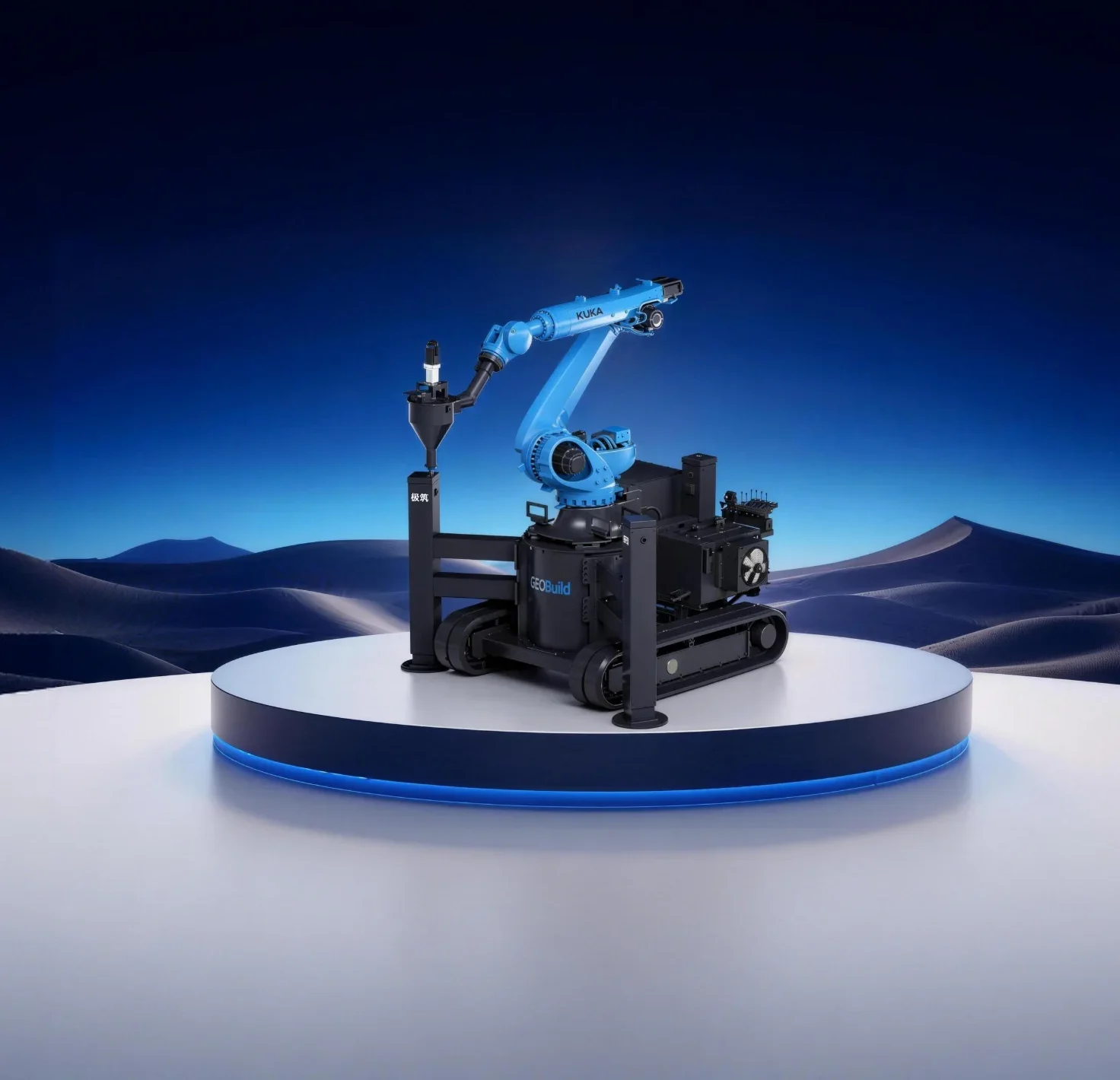
All-Terrain Tracked Construction 3D Printing System
The all-terrain tracked construction 3D printing robot is AiUltraprod’s independently developed core equipment tailored for complex construction environments. It integrates the exceptional terrain passability of tracked construction machinery with high-precision 3D construction printing technology, breaking the rigid requirement of flat ground for traditional construction 3D printing equipment. It truly realizes the concept of “equipment adapting to construction sites, rather than sites adapting to equipment”.
| Module | Functional Description |
|---|---|
| Tracked mobile chassis | All-terrain travel, automatic leveling, power output |
| Multi-axis robotic arm | 6+1 axis industrial robotic arm equipped with print head |
| Print head system | Material extrusion, layer height control, quick nozzle replacement |
| Material feeding unit | Integrated mixing, pumping and flow control |
| Onboard control cabinet | Edge computing unit, servo drives, communication modules |
| AiUltraprod Cloud Platform | Cloud platform for design, simulation, path planning and real-time monitoring |
IV. Industry Comparison and Development Trends
4.1 Comparison of Mainstream Technical Routes
| Comparison Dimension | Rail-Mounted | Gantry Frame | Wheeled Mobile | Tracked Mobile |
|---|---|---|---|---|
| Terrain Adaptability | ★☆☆☆☆ | ★☆☆☆☆ | ★★☆☆☆ | ★★★★★ |
| Deployment Convenience | ★★☆☆☆ | ★☆☆☆☆ | ★★★★☆ | ★★★★☆ |
| Printing Precision | ★★★★★ | ★★★★★ | ★★★☆☆ | ★★★★☆ |
| Large-Area Scalability | ★★☆☆☆ | ★★☆☆☆ | ★★★★★ | ★★★★★ |
| Cost Efficiency | ★★★☆☆ | ★★☆☆☆ | ★★★★☆ | ★★★☆☆ |
4.2 Future Development Trends
- Multi-machine collaborative operation: Multiple tracked printing devices operate in coordination via Mesh networks to realize synchronous printing of super-large buildings covering over 1,000 square meters.
- AI-driven terrain perception: Deep learning-based real-time terrain classification and passability prediction enable equipment to “perceive and interpret” terrain autonomously.
- Energy self-sufficiency: Integration of photovoltaic power generation and energy storage systems supports long-duration continuous field operation off-grid.
- Diversified printable materials: Material scope expands from concrete to on-site earth-rock mixtures and recycled aggregate materials, further reducing logistics dependence.
V. Conclusion
Complex terrain is not a boundary for construction 3D printing, but a starting point where it delivers maximum value.
By combining century-proven tracked construction machinery mobility technology with cutting-edge digital construction techniques, tracked mobile platforms are redefining the limits of “where buildings can be constructed and how construction can be carried out”. AiUltraprod will continue to deepen research in this field, enabling construction 3D printing to move beyond factories to open wilderness, and from ideal flat planes to real-world complex environments.
AiUltraprod – Provider of All-Terrain Construction 3D Printing Solutions. We believe the optimal construction method lies in technologies adapting to environments, not environments conforming to technologies.