
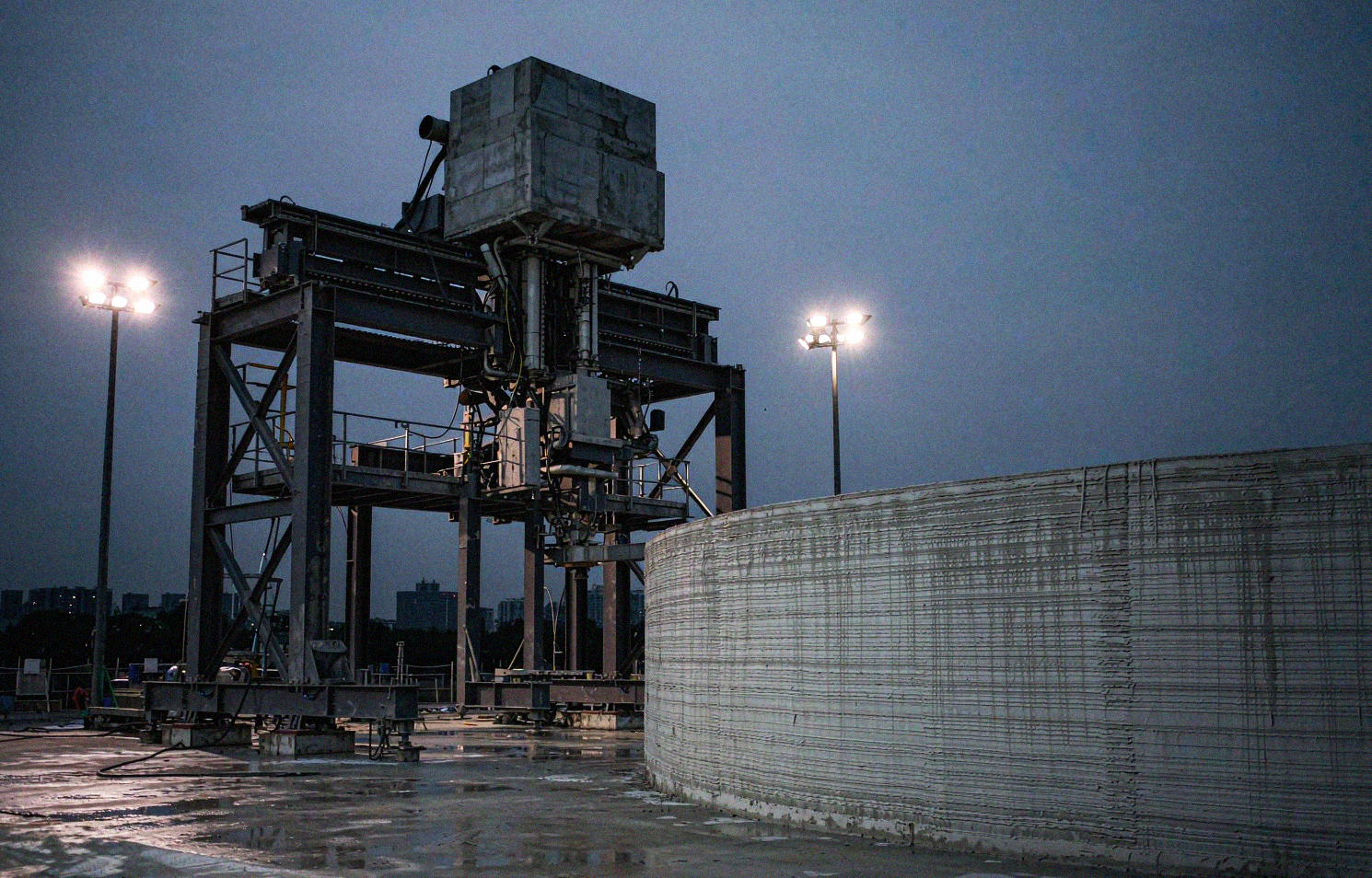
“Unattended operation” shows up more and more in project write-ups for 3D printed buildings, and it is usually read as a site with nobody on it. In practice, 3D printed construction remote monitoring looks plainer than the phrase suggests. The printer keeps laying bead through the night, the person on duty moves from the scaffold to a screen, and what gets removed is the job of standing next to the nozzle. The judgment does not leave the site.
Why 3D Printed Construction Starts With Better Data
Construction printing starts from a better position than conventional work here. On a normal site the record is filled in by hand, progress is estimated from experience, and nothing is documented until the inspector walks through. A printed wall is built bead by bead, and every toolpath, every layer’s output volume, the travel speed, the nozzle height above the previous layer, all of it is generated inside the controller before anyone thinks about monitoring. No extra instrumentation is needed to capture it. The Danish manufacturer that supplies gantry systems runs them with a three-person crew, and the reason is not that those three people are exceptional. The data lets one person’s attention cover the whole machine.
The sensor layer stacked on top of that has settled into a recognisable set, and most of it exists for quality control rather than site security. Pump pressure and flow are closed-loop through load cells and pressure sensors, which is what holds output steady when a material batch arrives slightly different from the last one. Temperature, humidity and wind decide whether to slow down or adjust accelerator dose. Acoustic and ultrasonic sensing estimates early-age stiffness and looks for voids. Cameras and laser scanning compare the section actually deposited against the design model, layer by layer. Robotic arm cells and gantries both use these, and the only real difference is where the hardware is mounted.
What a Camera Cannot Do for Remote Construction Monitoring
A live feed is the easiest thing to be fooled by. A stream with a few seconds of delay cannot see slump change, cannot smell an overheating motor, and its push notification may arrive after the incident. Remote stop depends on power and network, which are the two things most likely to fail first. What a camera does is turn an eight-hour failure into a ten-minute one. It makes failure cheaper. It does not make failure rarer.
The two-storey office building in Dubai gets cited often, and it is worth being precise about what it shows. 640 square metres, 9.5 metres tall, roughly 500 hours of printing at eight hours a day. June temperatures reached 50°C, so the team moved most of the work to night operation and lit the site with floodlights. Plenty of manual intervention remained, to work around obstacles and to install non-printed components, and the step the team proposed afterwards was machine vision. Night work and unattended work are two different things. The first moves people to a cooler shift. The second asks the machine to know when to stop with nobody watching.
The 100 square metre demonstration house in Milan supplies the other half. Thirty-five modules, 60 to 90 minutes each, a robotic arm on a mobile base pouring continuously, the whole structure done in 48 hours. That pace only holds if supply and machine state are watched continuously, because a break longer than the material’s open time breaks the layer bonding and writes off the dozens of layers beneath it, the defect every crew knows as a cold joint.
Data Management Is the Layer Most Projects Skip
The recognised problem in the industry is not a shortage of data. It is that the data does not match. Sensor readings, scan point clouds, batch records and site diaries each keep their own format, the software does not talk across, and a person ends up translating in the middle. Which is why 3D printing construction data management is less a question of storage than one of agreement. Until that is fixed, remote monitoring only moves a few screens into an office.
The architecture that actually supports unattended operation, and any serious attempt at automated construction site monitoring, has three layers. The edge layer on site makes real-time calls and keeps a local record, and it has to be able to trigger a stop with the network down, so it cannot live in the cloud. The cloud layer handles trends, cross-project comparison and alarm routing, so people are only woken for exceptions. People sit at the top, reading an exception list rather than a live feed. Writing the judgment into rules in advance is the technical substance of unattended operation.
One layer is usually skipped, which is traceability. Which batch went into which layer, which temperature and humidity window it was placed in, when someone intervened by hand. In handover and in insurance claims those records do more work than video. Some projects are building digital twins, and the motive is not only monitoring. It is to let an approving authority accept that the printed wall and the drawing are the same object.
Night Work Still Needs Conditions No Software Touches
Overnight printing carries arrangements that no monitoring platform covers. Lighting has to resolve detail down to the nozzle, or the returning image only shows that the machine is moving. Fencing, access control and guard rotas all have to change, since an unmanned site is an open equipment store. Concrete trucks have to be scheduled against continuous supply, because a break at 2 a.m. has nobody to catch it. Get these wrong and the best monitoring system can only watch an incident unfold.
Unattended Operation Is Measured in Interventions per Shift
Which returns to the original question. The measure of unattended operation is how many interventions a shift needs, not how many people stand on site. Bring that number from double digits to single digits and the claim starts to hold. For now the realistic shape is a thin day shift, an empty night, and remote involvement when something goes wrong. Codes and insurers have not caught up, so it remains an operating choice rather than a compliance default.
Frequently Asked Questions
Do 3D printed buildings need people on site?
Not in the way conventional sites do, but the site is rarely empty. What gets removed first is the position that requires someone to stand beside the nozzle for the whole print. The person in charge of the process moves to a screen, and the judgment still sits with a human, just at a distance.
Can a 3D concrete printer run overnight unattended?
Only when three conditions are met. The machine has to stop itself when material runs out, stop itself when wind, temperature or humidity leave the safe range, and hand a readable exception to someone who can respond. Without all three, a night shift is supervised work with a longer walk to the printer.
How many workers does a 3D construction printer need?
Current gantry systems are quoted with a three-person crew, and that number holds because the controller already logs toolpath, output volume and nozzle height. The crew is smaller than a conventional wall crew, not because the people are more capable, but because the machine documents itself.
What happens if a 3D concrete print stops mid layer?
A stop longer than the material’s open time breaks the bond between layers and creates what crews call a cold joint. Everything poured above it inherits that weak plane. This is why supply continuity matters more than print speed on a long run, and why restart procedures are written before the first layer.
How is the quality of a 3D printed wall checked?
Three ways, layered. Pump pressure and flow are held in a closed loop so output stays constant. Cameras and laser scanning compare the deposited section against the design model, layer by layer. And every layer is logged against its material batch and the temperature and humidity window it was placed in, which is the record an inspector or an insurer will actually ask for.