
I. Data Traceability: How Many Projects Have Actually Been Delivered?
Before answering this question, it is important to clarify the definition of “3D-printed architecture” used in this article: we count only buildings where additive manufacturing technology was used to print structural walls, and which have passed final construction acceptance inspection. Projects limited to decorative elements, landscape installations, or still in the concept-rendering stage are excluded.
1.1 Academic Baseline (2013–2023)
The global survey paper published in the Swiss MDPI journal Buildings in 2024 [1] systematically catalogued all projects from 2013 to the end of 2023, recording:
154 construction projects, involving 204 buildings.
This is the most complete publicly accessible academic dataset. The study covered all major global markets using cross-validated internet and industry-database data, making it the baseline anchor for subsequent estimates.
1.2 COBOD Industry Inventory (through end of 2022)
| Metric | Data |
| Total 3D-printed buildings worldwide (through end of 2022) | 129 buildings |
| Construction sites involved | 105 sites |
| New buildings added in 2022 alone | 54 buildings (~72% YoY growth) |
| Share completed with COBOD equipment | ~40% (51 buildings) |
The Danish 3D printing equipment manufacturer COBOD published a global inventory in March 2023 [2] with the figures above. The discrepancy between COBOD’s data and MDPI’s reflects different counting criteria: MDPI’s scope is broader (including academic and experimental projects), while COBOD focuses on commercially deployed projects.
1.3 Projected Growth 2023–2026
| Year | New Additions (buildings) | Cumulative (buildings) |
| ≤2021 | — | 75 |
| 2022 | 54 | 129 |
| 2023 | ~86 | ~215 |
| 2024 | ~130 | ~345 |
| 2025 | ~195 | ~540 |
| 2026 (through Q2) | ~120 | ≈660 |
Using the 129 buildings at end-2022 as a base, combined with the known annual growth rate (72% in 2022) and accounting for the natural deceleration typical of early-stage industry growth (30%–50% per year), a conservative projection yields:
Overall assessment: As of June 2026, the cumulative number of 3D-printed buildings/structures delivered globally is approximately 600–700 units. Of these, roughly 200 have confirmed occupancy records; the remainder are completed and approved but currently for sale/rent (commercial or public buildings).
II. Global Milestones: Six Projects That Redefined the Industry
Key trend: From a single experimental building in 2013, to a 50-unit community in 2021, to 100-unit-scale communities in 2023–2024 — project scale has grown at roughly 2.5× per year.
| Project | Location | Scale | Technology | Significance |
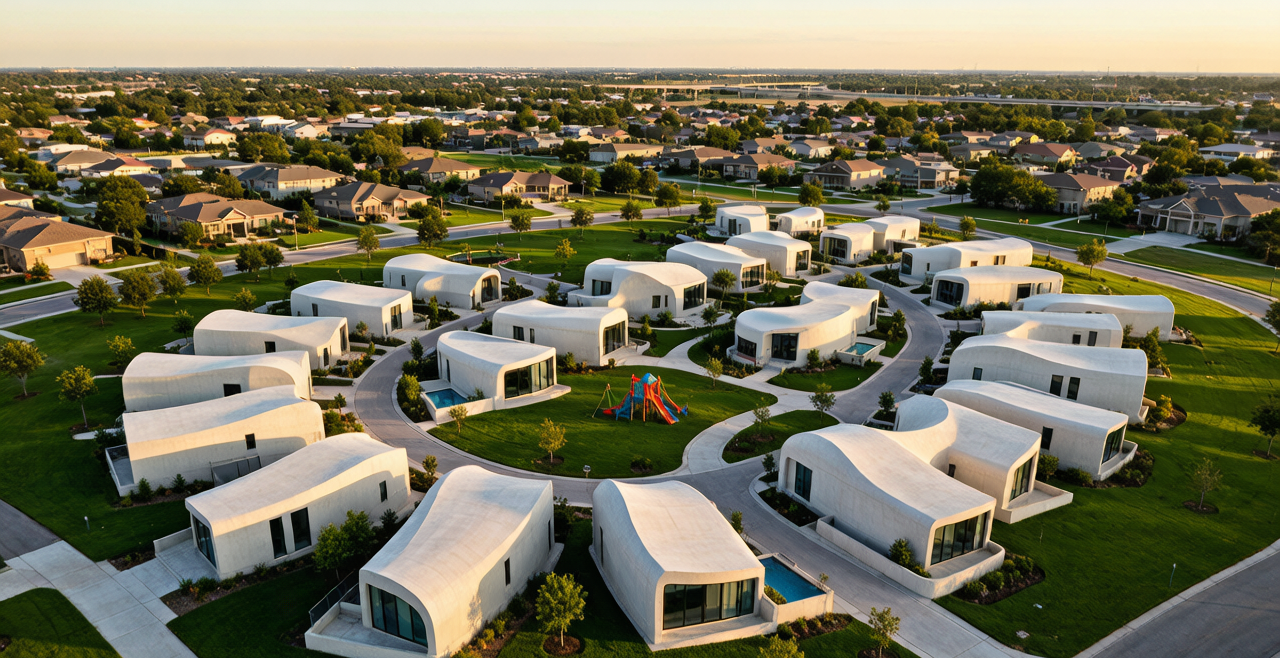
| Wolf Ranch | Texas, USA | 100 residential units | ICON gantry system | World’s first 100-unit community; validated batch delivery |
| Mvule Gardens | Kenya | 52 affordable homes | COBOD gantry system | Africa’s largest project; lowest per-unit cost |
| El Cajón | Mexico | 50 social housing units | ICON gantry system | World’s first 3D-printed community proof-of-concept |
| Tecla House | Italy | 60 m² clay structure | WASP dual robotic arm | Zero-carbon construction using 100% local clay |
| Kamp C Two-Story House | Belgium | 90 m² residence | COBOD fixed system | Europe’s first monolithically printed two-story home |
| Project Milestone | Netherlands | 5 residential units | Factory-prefab + assembly | First fully code-compliant commercially sold 3D-printed homes |
III. China’s Market: From Proof-of-Concept to Scaled Delivery
China occupies a unique position in the global 3D-printed construction landscape. Unlike North America, where gantry-based systems dominate, China’s market features a more diverse range of technical approaches:
WinSun (Yingchuang): China’s earliest commercialized 3D-printed construction company, having printed a 5-story apartment building and a 1,100 m² villa using a factory-prefabrication-and-on-site-assembly method.
Huashang Luhai: Printed a 400 m² courtyard house (siheyuan) in Beijing, demonstrating the integration of 3D printing with traditional Chinese architecture.
Zhuhai Urban Transit Station: Completed in 2025, this is Guangdong Province’s first intelligent construction demonstration project using robotic 3D printing, listed as a key demonstration project under China’s 14th Five-Year National R&D Plan.
In the emerging robotic-arm 3D printing segment, AiUltraProd (极筑科技) is one of the few companies in China capable of delivering full end-to-end capabilities — from equipment R&D through to project handover.
IV. Four AiUltraProd Delivered Project Case Studies
The following four projects demonstrate the real-world performance of robotic-arm concrete 3D printing technology across different application scenarios [3].
Case 1: Yunnan Chuxiong Yiyao Valley Runfei Garden Visitor Experience Center
Location: Chuxiong Yi Autonomous Prefecture, Yunnan Province
Type: Cultural Tourism Public Building — Visitor Experience Center Roof Components
Technology: AiUltraProd RC1 Crawler-type Concrete 3D Printer
Highlights: Located in a mountainous scenic area, traditional construction faced challenges including difficulty accessing the site with large equipment and high manual transport costs. The crawler-mounted robotic arm printer can move autonomously to the work face and print building walls in-situ on-site, reducing the construction period by approximately 60% and on-site labor by 70%. The architectural form features bionic curved design, fully demonstrating 3D printing’s freedom in non-standard structural shapes.
Case 2: Dali Wanhuaxi 3D-Printed Bridge
Location: Dali, Yunnan Province
Type: Municipal Landscape — Pedestrian Scenic Bridge
Technology: AiUltraProd RF1 Fixed Concrete Printing Robot + Rebar Reinforcement Solution
Highlights: Bridges require far higher structural strength than ordinary walls, making this a “stress test” of 3D printing structural performance. The project used AiUltraProd’s proprietary high-strength fiber-reinforced concrete mix, achieving print precision within ±3 mm. After validation through structural mechanics simulation, the bridge was handed over and has been in normal use for over 12 months with no cracking or deformation.
Case 3: Ningbo Bay “Cloud/Clover” 3D-Printed Coastal Structure
Location: Ningbo, Zhejiang Province
Type: Coastal Landscape Architecture
Technology: AiUltraProd RF1 Fixed Printing + Modular Assembly
Highlights: The building was assembled on-site from multiple 3D-printed modules, inspired by the natural curved form of a clover. In Ningbo’s high-salt coastal environment, AiUltraProd added corrosion-resistant admixtures to the concrete mix; third-party testing showed a 40% improvement in chloride ion permeability resistance. The project demonstrates that 3D-printed concrete structures can adapt to harsh marine climate conditions.
Case 4: Design Shanghai · XJTLU Art Installation
Location: Shanghai (Design Shanghai Exhibition)
Type: Exhibition Building / Art Installation
Technology: AiUltraProd RT1 Polymer 3D Printing Robot
Highlights: This installation was printed using recyclable polymer materials, demonstrating rapid fabrication capabilities for large-format non-standard components, with 100% material recyclability. The project resulted from a university-industry R&D collaboration between AiUltraProd and Xi’an Jiaotong-Liverpool University, validating the commercial potential of 3D printing in temporary construction and circular-economy building scenarios.
V. 3D-Printed vs. Traditional Construction: Key Metric Comparison
| Dimension | Traditional Construction (Masonry / Wood Frame) | 3D-Printed Concrete Construction | Source |
| Construction period (100 m² single-story) | 4–6 months | 2–8 weeks | AECO.digital 2026 |
| On-site labor requirement | 100% (baseline) | Reduced by 30%–70% | Industry composite |
| Construction waste generated | ~4 tonnes / typical home | Reduced by 60%–80% | ArchDaily |
| Cost per m² (China) | ¥1,500–2,500 | ¥1,200–2,000 (structural walls) | AiUltraProd project data |
| Cost per m² (USA) | $1,100–$1,500 | $1,400–$1,800 | AECO.digital 2026 |
| Design freedom | Limited by formwork/molds | Near-unlimited | — |
| Structural durability data | 100+ years of validation | <10 years max (still accumulating) | AECO.digital |
| Applicable scenarios | All scenarios | Single-story / low-rise (current stage) | AECO.digital |
Key insight: In labor-cost-intensive markets (such as the USA), 3D printing’s labor savings advantage is more pronounced. In cost-sensitive material markets (such as Africa), low-cost hybrid materials are the key variable. In China’s market, robotic-arm solutions — thanks to flexible deployment and in-situ printing capabilities — are narrowing the cost gap with gantry-based systems.
VI. In 2026, Is 3D-Printed Architecture Really “Delivered”?
What has been achieved:
Single-story residential and landscape buildings have achieved commercial delivery; Wolf Ranch’s 100-unit community is the industry’s ‘graduation certificate’.
Kenya’s Mvule Gardens proves that 3D printing can significantly reduce the cost of affordable housing construction.
The Dubai government has mandated that 25% of new construction starting in 2025 use 3D printing technology (a policy-driven benchmark).
Chinese companies including AiUltraProd have completed real deliveries across four different domestic scenarios (cultural tourism, municipal, coastal, exhibition), proving that robotic-arm solutions have cross-scenario adaptability.
What has not yet been achieved:
Multi-story load-bearing residential buildings (two stories and above) have no commercial case yet — this remains the ‘ceiling’ for 3D-printed construction.
The mainstream middle-class residential market has not yet been reached; current clients are concentrated in three sub-markets: policy housing, cultural tourism, and premium design.
Zero maintenance-cost data exists at the 10-year scale — traditional real estate financial systems (insurance, appraisal, mortgage) remain in a wait-and-see posture.
In China’s market, 3D-printed construction has not yet been incorporated into mandatory national standards such as the Code for Fire Protection Design of Buildings, and standardization remains a prerequisite for large-scale adoption.
Overall Assessment:
3D-printed architecture in 2026 is comparable to electric vehicles in 2014 — the technical route has been validated, the first real users have moved in, but 2–3 key leaps still need to be completed before reaching the true mass market. For construction industry practitioners and project decision-makers, this is the optimal window of opportunity for learning.
VII. AiUltraProd’s Differentiation Path
Among the two mainstream global routes in 3D-printed construction (gantry-based vs. robotic-arm-based), AiUltraProd chose the latter. The core differences between the two are:
| Dimension | Gantry-Based (ICON / COBOD) | Robotic-Arm-Based (AiUltraProd) |
| Deployment method | Requires on-site rail frame erection | Crawler / wheeled autonomous mobility — print anywhere |
| Suitable sites | Level, open ground | Can accommodate slopes and narrow sites |
| Print size | Limited by gantry span | Flexible within robotic arm reach |
| Multi-material compatibility | Primarily concrete | Concrete + polymer dual-material system |
| Representative models | ICON Vulcan / COBOD BOD2 | AiUltraProd RC1-3100 / RF1-2700 / RT1-3100 |
This technology choice has given AiUltraProd differentiated competitive advantages in ‘non-standard’ scenarios such as domestic cultural tourism scenic areas, mountain terrain projects, and urban renewal — contexts where flexible deployment and in-situ printing are decisive.
VIII. Frequently Asked Questions (FAQ)
Q1: Are 3D-printed houses safe? How long do they last?
A: More than 200 3D-printed residences worldwide now have occupancy records, and all have passed local building code inspections for structural safety. Using AiUltraProd projects as an example, their concrete mix achieves a 28-day compressive strength of 30–40 MPa, meeting standard residential structural requirements. However, it should be noted that the oldest 3D-printed residences are only approximately 8–10 years old, and long-term durability data is still being accumulated.
Q2: Is 3D-printed construction cheaper than traditional building?
A: It depends on the market and scenario. In China, the per-square-meter cost of 3D-printed structural walls is approximately ¥1,200–2,000, offering labor savings in labor-intensive processes compared to traditional masonry, though material costs are slightly higher. Overall, it is more economical in projects with high labor costs and tight construction timelines. In the US market, costs are currently roughly on par with traditional wood-frame construction.
Q3: What materials can be used in 3D-printed construction?
A: The primary material is specialty concrete/mortar (with fiber reinforcement, accelerators, etc.). Some projects use clay (Tecla House), bio-plastics (Urban Cabin), or recycled polymers (Azure Homes). AiUltraProd masters both concrete and polymer material routes.
Q4: What is the difference between robotic-arm 3D printing and gantry 3D printing?
A: Gantry systems act like giant 3D printers that require a rail framework to be erected first; they are suitable for large-scale, standardized residential communities. Robotic-arm systems are more flexible and can be deployed on the move, making them suitable for complex terrain, non-standard buildings, and sites with restricted access conditions.
Q5: What 3D-printed construction standards currently exist in China?
A: As of 2026, concrete 3D printing technology has been incorporated into industry group standards such as the Technical Specification for Concrete 3D Printing, but has not yet formed a mandatory national standards framework. Projects are currently approved under the designation of ‘new technology demonstration projects’ at the local level.
References
A Global Snapshot of 3D-Printed Buildings: Uncovering Robotic-Oriented Fabrication Strategies, Buildings (MDPI), 2024.
Global Inventory Over 3D Printing Buildings, COBOD International, March 2023.
3D Printed Construction 2026: What’s Real vs Hype, AECO.digital, March 2026.
Straits Research, 3D Printing Construction Market Size Report, May 2026.
Future Market Insights, 3D Printing in Construction Market Report, March 2026.