
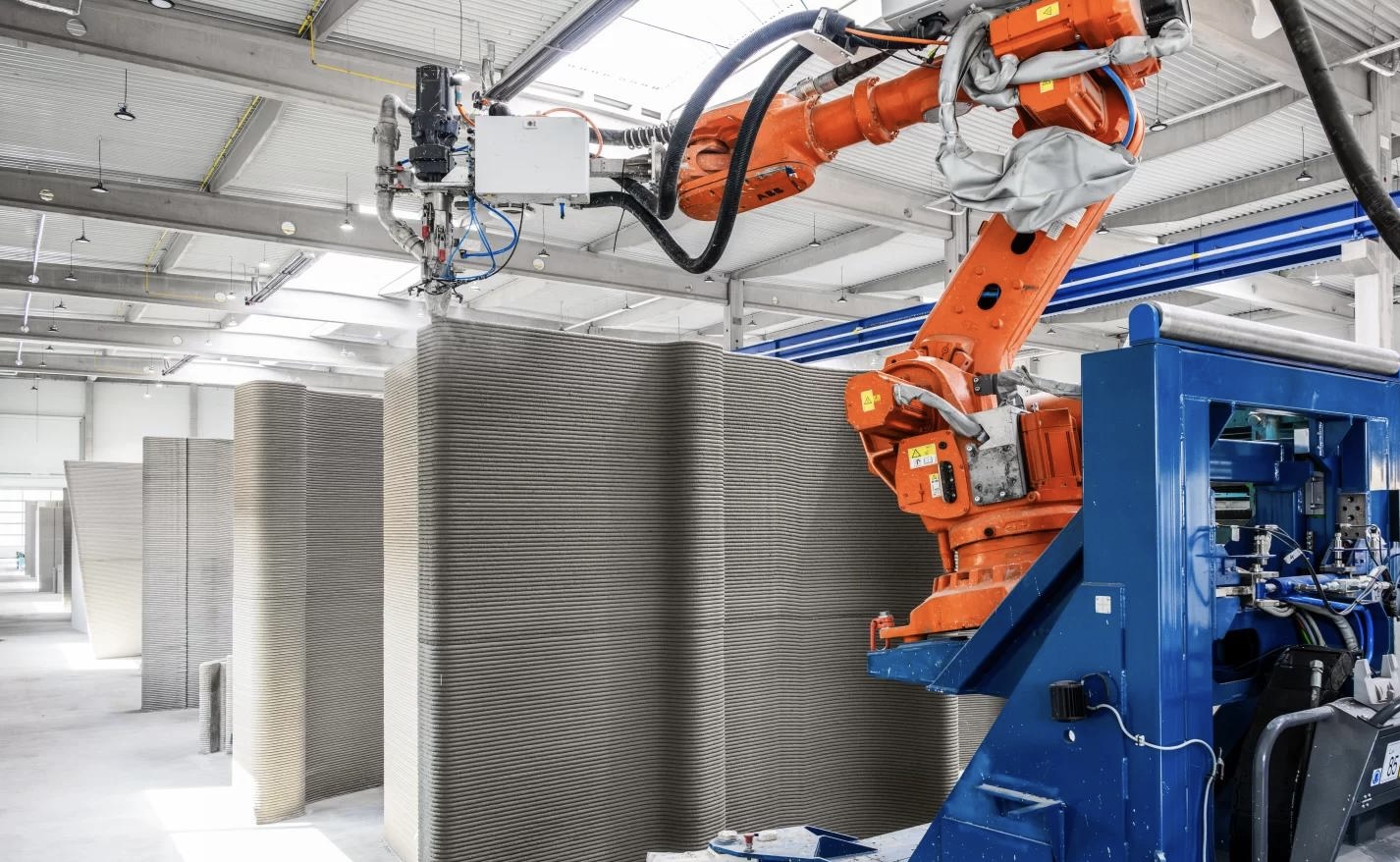
Quick Overview of Key Points
- Path accuracy reaches ±2 mm: AI enables real-time path planning and dynamic deviation correction, controlling the positioning error of robotic arm nozzles within the millimeter range, far exceeding the traditional construction accuracy limit of ±10 mm.
- Greatly enhanced defect detection rate: Computer vision monitors printing layer height, width and straightness in real time. AI models such as YOLO-v5 issue early warnings and automatically adjust printing parameters before defects expand.
- Approximately 30% improvement in material consistency: Physics-Informed Machine Learning predicts the fluidity and initial setting time of concrete, and dynamically regulates extrusion speed to avoid inconsistent material states.
- Transition from open-loop printing to closed-loop intelligent manufacturing: Integrated digital twins and multi-modal sensors create real-time digital replicas for each printed layer, capturing and correcting deviations within milliseconds.
1. Precision: The Fundamental Requirement for 3D-Printed Concrete
Many people focus on the curved shapes, construction efficiency and labor savings of 3D-printed buildings. However, industry practitioners regard precision as the core challenge.
Concrete differs from printing plastics. Its state changes the moment it exits the nozzle: self-weight deforms lower layers, water content affects fluidity, and ambient temperature alters the setting speed. Minor deviations of 2 mm will accumulate across 20 or 50 printed layers, eventually triggering structural risks for entire walls.
According to GB 50203 Code for Acceptance of Construction Quality of Masonry Structures, the allowable deviation of traditional masonry walls is ±10 mm. Without AI intervention, open-loop 3D concrete printing relying on preset paths typically has a deviation of ±5–8 mm. Though better than traditional construction, it is still far from tapping the full potential of 3D printing technology.
AI is not an optional add-on, but a core enabler that upgrades 3D concrete printing from simple fabrication to high-precision construction.
2. Four Core AI Applications for Precision Control in 3D Concrete Printing
2.1 Path Planning: From Geometric Optimization to Physical Optimization
3D printing is essentially a continuous spatial curve. Poor path planning causes material shortage at corners due to accelerated nozzle movement, or material accumulation on straight sections caused by deceleration. Traditional CAM software only generates geometrically optimal paths that minimize travel distance, ignoring the physical properties of concrete.
AI revolutionizes this logic. As summarized in a 2024 research paper published in Virtual and Physical Prototyping, deep reinforcement learning-based path planning takes material flow characteristics, robotic arm dynamics and printing quality feedback into comprehensive consideration to formulate physically optimal paths. The AI actively avoids angles that may lead to concrete flow interruption.
In practical applications, AI path planning reduces the extrusion error at corners from ±4–6 mm (traditional methods) to ±1–2 mm, meeting the standards of precision manufacturing.
2.2 Real-Time Visual Monitoring: Equipping Printers with “Eyes”
AI computer vision is one of the most mature and widely applied technologies in 3D concrete printing.
Industrial cameras are mounted on printing heads to capture images immediately after each layer is printed. AI vision models like YOLO-v5 compare the actual printed layer with the design model within milliseconds to inspect layer height, flatness and line width. Once deviations exceed the threshold, the system automatically adjusts path offset or extrusion speed for the next layer.
A 2025 study in Materials and Structures shows that YOLO-v5-based real-time geometric inspection reduces the standard deviation of layer height deviation by 35%–45%. The AI model adapts well to different concrete formulas, delivering great practical value for frequent material replacement on construction sites.
2.3 Intelligent Material Regulation: Mastering the Properties of Concrete
A common pain point in 3D concrete printing is unstable material performance: the fluidity of the same batch of concrete varies greatly between morning and afternoon due to changes in temperature, humidity and standing time. Traditionally, workers adjust extrusion pressure and speed based on experience, which can only achieve rough control.
Physics-Informed Machine Learning (Physics-Informed ML) effectively solves this problem. A 2025 research in Automation in Construction proposed a dual-driven intelligent control framework combining physical models and measured data. The model learns the Bingham fluid characteristics of concrete and real-time monitoring data to predict yield stress and plastic viscosity, then automatically matches the optimal extrusion and printing speed.
Experimental results prove this technology cuts the coefficient of variation of material extrusion consistency by about 30%. For mass construction projects such as multiple accessory dwelling units (ADUs) in a residential community, it ensures uniform quality across all buildings.
2.4 Digital Twins & Predictive Control: Preventing Problems in Advance
The above three modules handle existing deviations, while digital twins powered by AI realize predictive control, upgrading the system from response-based to forecast-based operation.
In February 2026, the University of Michigan Robotics Institute launched the project AI-Enabled Digital Twins for Closed-Loop Robotic 3D Concrete Printing. A real-time digital replica of the printed structure is built synchronously during construction. Combined with physical models and machine learning, the digital twin predicts potential risks of subsequent layers.
For instance, the system will slow down printing or adjust paths in advance if it forecasts structural collapse at the 18th layer, rather than remedying issues after accidents occur. This predictive capability is critical to the structural safety of multi-story 3D-printed buildings.
3. Precision Comparison: Traditional Construction vs. Conventional 3D Printing vs. AI-Driven 3D Printing
| Comparison Dimension | Traditional Construction | Conventional 3D Printing | AI-Driven 3D Printing |
| Wall construction accuracy | ±10 mm (upper limit per masonry codes) | ±5–8 mm (typical for open-loop printing) | ±1–2 mm (AI closed-loop control) |
| Standard deviation of layer height consistency | N/A | 2.5–4.0 mm | 1.2–2.0 mm (35%–45% reduction) |
| Material extrusion consistency | Relies on workers’ experience | Obvious batch-to-batch differences | Coefficient of variation reduced by ~30% |
| Defect detection method | Manual inspection & post-repair | Manual observation with delayed response | Real-time AI vision & millisecond-level early warning |
| Adaptability to material changes | Depends on skilled workers’ experience | No automatic adaptation | AI automatically adjusts extrusion parameters |
| Deviation correction speed | Work suspension, discussion & rework | Manual reprinting & patching | Automatic compensation in the next layer |
Data Notes:
- The accuracy standard of traditional construction refers to GB 50203-2015 Code for Acceptance of Construction Quality of Masonry Structures.
- Data of conventional 3D printing is sourced from public technical documents and project cases of ICON, COBOD and Peri 3D Construction (2023–2025).
- Data of AI-driven 3D printing is extracted from academic papers published in Materials and Structures (2025), Automation in Construction (2025) and Virtual and Physical Prototyping (2024).
4. From Laboratory to Construction Sites: Ongoing Implementation of AI-Powered Precision Construction
Relevant AI technologies have moved beyond laboratory research and entered the initial commercial application stage.
Major global 3D construction printer manufacturers are integrating AI into their equipment. COBOD has equipped its BOD2 printers with basic real-time layer height monitoring systems. Denmark’s ODICO integrates computer vision into robotic printing units. In a residential project with 100 houses in Georgetown, Texas, U.S., ICON adopted an automatic quality data collection system to monitor the consistency of each printed layer.
In China, AiUltraProd has embedded path precision control and material adaptation algorithms into its robotic 3D concrete printing systems. The technology has been applied to projects including the special-shaped curved bridge in Dali and clustered wall construction in Ningbo. On-site geometric error and material performance data continuously feed into AI model training, forming a sustainable development mode where projects serve as data sources.
Currently, AI has evolved from academic demonstrations into practical engineering tools that solve real industry pain points. Improving printing accuracy from ±8 mm to ±2 mm brings tangible benefits: fewer reworks, less material waste, higher structural safety margin and shorter acceptance cycles.
5. Future Development Trends of AI + 3D-Printed Buildings
The integration of AI and 3D concrete printing is still in the early stage. Single technologies such as visual inspection, path planning and material prediction have been verified effective, while fully closed-loop industrial solutions are still under development. Three major trends will stand out in the next three years:
- Full-process digital twins: Real-time digital replicas will cover the entire workflow from design to completion. Every cubic centimeter of concrete will be traceable, which will profoundly impact construction quality accountability and insurance pricing.
- AI scheduling for multi-robot collaboration: AI will coordinate multiple robotic arms on large projects to divide working areas, avoid collisions and allocate materials, paving the way for fully unmanned construction sites.
- Closed-loop R&D of AI and new materials: AI will not only control printing processes but also provide optimization suggestions for concrete formulas based on printing quality feedback, greatly accelerating the iteration of special materials for 3D printing.
Conclusion
AI is not merely a decorative “intelligent label” for 3D printing. It fundamentally addresses the core engineering challenge of the industry: placing every layer of concrete in the designed position with high precision. For 3D-printed buildings, improved precision is the key to transforming the technology from feasible fabrication to reliable large-scale application.
AiUltraProd focuses on robotic 3D concrete printing technology, with delivered projects covering bridges, cultural tourism buildings, municipal landscapes and residential buildings. For construction solutions and business cooperation, please visit our official website or contact us via email.
Official Website: www.aiultraprod.com
Email: info@aiultraprod.com
References
- Cui, H. et al. Geometrical quality inspection in 3D concrete printing using AI-assisted methods. Materials and Structures, 2025.
- Tian, Y. & Li, J. AI-Enabled Digital Twins for Closed-Loop Robotic 3D Concrete Printing. University of Michigan Robotics, 2026.
- Co-driven physics and machine learning for intelligent control in 3D concrete printing. Automation in Construction, 2025.
- Jeon, I. et al. Mobile robotics and 3D printing: addressing challenges in path planning and scalability. Virtual and Physical Prototyping, 2024.
- Computer Vision and Machine Learning Approaches for Defect Detection in 3D Concrete Printed Structures. Infrastructures (MDPI), 2026.
- GB 50203-2015, Code for Acceptance of Construction Quality of Masonry Structures.
- Public project cases and technical documents of ICON, COBOD and Peri 3D Construction (2023–2025).