
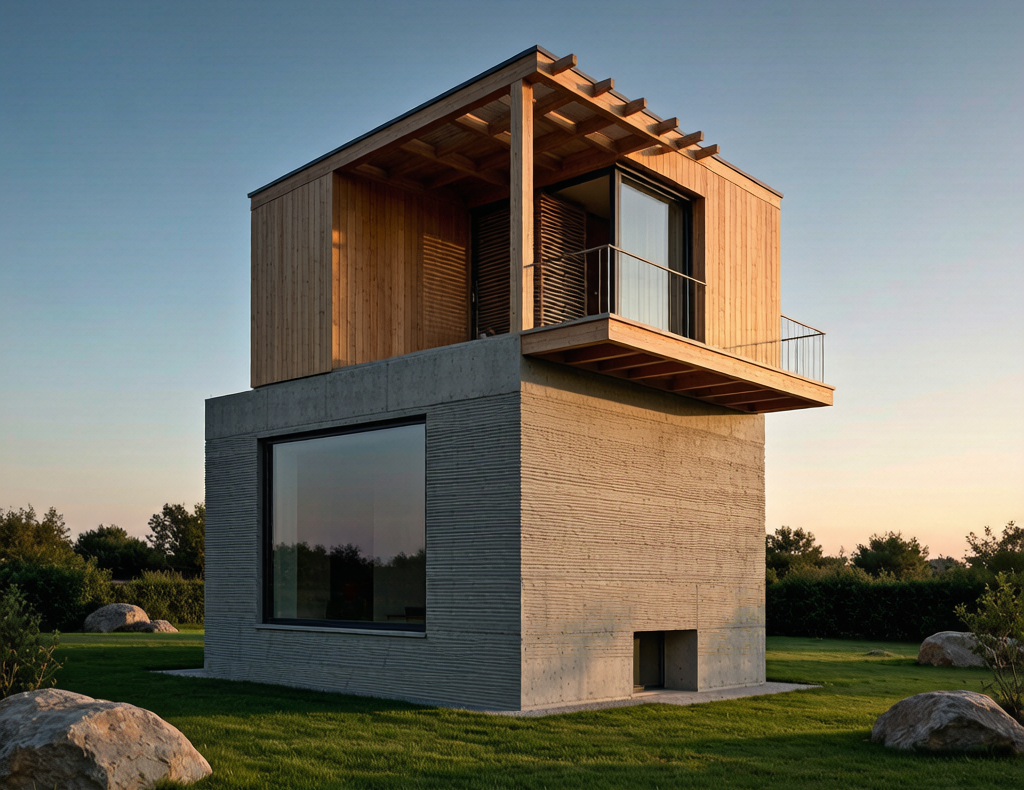
I. Background: The ADU Boom & Crossroads of Construction Methods
A global housing affordability crisis continues to escalate, with skyrocketing property prices plaguing core cities from Los Angeles to London, Sydney to Shanghai. Against this backdrop, Accessory Dwelling Units (ADUs) — small, independent residential structures built on lots with an existing primary home — have emerged as the convergence point of policy liberalization and surging market demand worldwide.
California pioneered sweeping regulatory relaxations for ADU permits, followed by the UK, Germany, and the Netherlands. The normalization of remote work further fueled demand for living spaces that offer both privacy and proximity to primary residences. Data from Freddie Mac shows that properties equipped with ADUs saw an average valuation increase of 35% during refinancing in 2023. ADUs have evolved from a niche housing supplement into a mainstream market segment.
Nevertheless, a fundamental question lingers across the construction sector: which building method delivers the optimal solution for ADU development? Three approaches each command a loyal following: conventional wood framing, modular construction, and 3D concrete printing (3DCP). This report avoids superficial, binary comparisons of pros and cons, instead dissecting each pathway based on core engineering and commercial fundamentals.
II. Overview of the Three Main Construction Approaches
1. Traditional Stick-Built Wood Frame
On-site erection of timber framing, with sequential installation of wall assemblies, floor slabs, and roofing. This is the most mature construction method across North America and numerous global regions, supported by a fully developed supply chain, readily accessible materials, and abundant skilled labor.
- Construction timeline: 12–24 weeks from foundation to final handover for typical projects
- Labor requirements: 6–12 tradespeople across all construction phases
- Material waste rate: 10%–15%
2. Modular / Panelized Construction
Standardized 3D volumetric modules or 2D wall panels are prefabricated in off-site factories, then transported to the lot for rapid hoisting and assembly. Higher prefabrication ratios minimize on-site labor and activity.
- Construction timeline: 8–16 weeks total (factory fabrication + on-site assembly)
- Labor allocation: Concentrated factory workforce; drastically reduced on-site staffing needs
- Key strengths: Consistent quality control, minimal weather disruption; constrained by shipping dimensions and crane access limitations
3. 3D Concrete Printing (3DCP)
Robotic gantries or articulated mechanical arms extrude concrete or geopolymer slurry layer by layer, guided directly by digital design models. Formwork is eliminated entirely, with structural walls formed in a single continuous process.
- Wall printing cycle: 48–72 hours
- Full project delivery timeline: 4–8 weeks (including foundation work, utility rough-ins, and interior finishing)
- On-site staffing: Only 2–3 equipment operators required
- Material waste rate: ≤3%
III. Six-Dimensional Comparative Analysis: Where 3D-Printed ADUs Stand Out
Dimension 1: Construction Speed – Quantifying Time Savings
Speed is 3D printing’s most intuitive advantage, yet it is frequently misrepresented and misunderstood.
Wall Structure Construction Timeline Comparison
| Construction Method | Wall Assembly Duration | Speed Improvement vs. Baseline |
|---|---|---|
| Traditional Wood Frame | 4–6 weeks | Baseline reference |
| Modular Prefabrication | 2–4 weeks (including factory production) | 30%–50% faster |
| 3D Printing | 48–72 hours | Over 80% faster |
Critical clarification: Wall printing constitutes just one phase of full ADU construction. Foundation pouring, roof installation, utility routing, and interior fit-out still follow conventional workflows. 3D printing drastically cuts time on the critical path structural phase, bringing total project delivery down to 4–8 weeks — a 60%–70% overall timeline reduction versus stick-built construction, not a 90% cut.
In short, 3D printing targets and eliminates schedule bottlenecks, which delivers the most meaningful value from an engineering perspective.
Dimension 2: Project Cost – Cost Premium or Savings?
Cost remains the most scrutinized metric, yet it is often oversimplified in public discourse.
Direct Hard Cost Comparison (USD per Square Foot)
| Construction Method | Estimated Unit Cost (USD/sq.ft) | Supplementary Notes |
|---|---|---|
| Traditional Wood Frame | 200–400 | Wide regional cost variance |
| Modular Construction | 180–350 | Costs rise sharply with longer transportation distances |
| 3D Printing | 140–280 | Unit costs fall significantly with production scale-up |
Four core drivers underpin 3D printing’s cost edge:
- Labor expenses: 50%–70% reduction in on-site labor outlay; this advantage expands further amid widespread construction labor shortages
- Formwork elimination: Timber or steel formwork accounts for 10%–15% of conventional concrete build costs, entirely removed with 3D printing
- Minimal material waste: Precision extrusion technology slashes waste rates from 10%–15% to under 3%
- Compressed timelines: Shorter build cycles lower soft costs including construction loan interest and project management overhead
Joint research from McKinsey & Company and the Harvard Joint Center for Housing Studies confirms that 3D-printed ADUs deliver total project cost savings of 25%–40%. This advantage is most pronounced for mid-small ADUs spanning 400–800 sq. ft (approximately 37–74 m²). Larger builds lose economies of scale due to printer size limitations, while tiny units face inflated fixed-cost amortization ratios.
Dimension 3: Design Freedom – Complexity Comes at No Extra Cost
In conventional construction, curved walls, angled corners, and non-orthogonal floor layouts trigger steep extra charges for custom formwork and extended labor hours. With 3D printing, fabricating a curved wall requires nearly identical time and material investment as a straight wall — a core characteristic coined as “complexity is free.”
This unlocks transformative design potential for ADUs:
- ADUs are no longer limited to generic rectangular boxes; they can feature organic, sculptural geometry tailored to individual lot topography
- Hollow wall cavities integrate plumbing and electrical conduits during printing, eliminating secondary wall channelling work
- Built-in seating, wall niches, and small stair components can be printed integrally alongside structural walls
That said, limitations persist: 3DCP currently excels primarily in horizontal design flexibility. Overhangs and long-span floor slabs require supplementary structural reinforcement. For single-story or two-story low-rise ADUs, this constraint poses virtually no practical barrier.
Dimension 4: Structural Performance & Long-Term Durability
Structural integrity and lifespan are the most common counterarguments raised by advocates of traditional and modular construction.
| Performance Metric | Traditional Wood Frame | Modular Construction | 3D-Printed Concrete |
|---|---|---|---|
| Maximum Build Height | Unlimited | Unlimited (joint constraints apply for stacked modules) | Self-supporting height ~9m; taller structures require hybrid framing |
| Service Lifespan | 50–100 years with regular maintenance | Matches traditional wood frame | 50–100 years with optimized material formulations |
| Seismic Resistance | Good (lightweight, flexible structure) | Good | Excellent (monolithic build eliminates cold joints) |
| Thermal Performance | Dependent on external insulation layers | Identical to wood frame | Continuous insulation can be embedded within wall cavities |
| Fire Resistance | Requires additional fireproof cladding | Same as wood frame | Inherently fire-resistant concrete substrate |
An often overlooked structural benefit: monolithic 3D-printed concrete walls contain no cold joints found in cast-in-place concrete construction, delivering superior structural continuity and theoretically enhanced seismic load resistance. Corresponding international standards including ISO/ASTM 52939 are rapidly formalizing compliance pathways for 3DCP structures.
Dimension 5: Sustainability – Beyond Reduced Material Waste
The environmental benefits of 3D printing extend far beyond minimized construction waste.
Embodied Carbon Emission Benchmarks
| Construction Method | Carbon Footprint per Square Meter | Data Benchmark Source |
|---|---|---|
| Conventional Reinforced Concrete | ~147 kg CO₂-eq/m² | Global construction industry baseline |
| 3D Printing (Geopolymer Mix Design) | ~58 kg CO₂-eq/m² | Controlled side-by-side industry testing |
Three layered mechanisms deliver substantial carbon reduction:
- Material efficiency: Topology-optimized wall cross-sections cut total raw material usage by 30%–60% while meeting full structural load requirements
- Low-carbon binder substitution: Geopolymers, fly ash, and blast furnace slag replace 50%–70% of Portland cement, drastically slashing embodied carbon
- Reduced logistics carbon: No large-scale transport of formwork, scaffolding, and auxiliary building materials lowers transportation-related emissions
With the EU Carbon Border Adjustment Mechanism (CBAM) and stricter building carbon regulations rolling out globally, sustainability is evolving from a value-added selling point into a mandatory compliance requirement for new construction.
Dimension 6: Labor Dependence – A Hidden Long-Term Competitive Moat
For the construction industry in 2026, labor shortages pose a greater existential challenge than technical limitations.
- The average age of construction workers in North America stands at 42 and continues to rise
- Japan’s construction workforce has shrunk from 5 million to 3 million workers
- The average age of construction laborers in China exceeds 45 years
Younger generations show minimal willingness to take physically intensive on-site construction roles. Where conventional builds require skilled bricklayers and formwork crews, 3D printing only demands training for specialized equipment operators. This represents a fundamental industry shift from labor-intensive to technology-driven construction, rather than simple headcount reduction.
For ADU developers and home builders, labor unavailability is emerging as a more acute risk than raw labor costs. The competitive edge of 3D printing will only widen over time as labor pools contract.
IV. Hybrid Construction: The Definitive Future Model
The preceding comparative analysis intentionally avoids a common pitfall: framing 3D printing as a direct rival to conventional building techniques.
In real-world engineering delivery, hybrid composite systems consistently deliver superior outcomes:
- 3D-Printed Core Structure + Wood/Light Steel Roofing: Leverages concrete’s compressive strength and thermal mass while retaining lightweight, fast-track roof assembly
- 3D-Printed Ground Floor Walls + Prefabricated Upper Volumetric Modules: Combines the structural flexibility and durability of printed lower levels with factory-controlled precision for second floors
- 3D-Printed Critical Structural Components + Conventional Framing: Deploys additive manufacturing for complex load-bearing elements, with traditional construction streamlining remaining scope
BIM platforms act as the unified digital backbone connecting all workflows: G-code print instructions are generated directly from the master design model, while material takeoffs for traditional building components export from the identical file. This paradigm is not linear technological replacement, but cross-method collaboration built on a shared digital foundation.
V. Decision-Making Framework for ADU Developers
Synthesizing all comparative data, we have established a streamlined project screening framework:
| Core Project Characteristics | Recommended Construction Priority |
|---|---|
| Single-story, under 800 sq. ft, tight delivery deadlines | 3D Printing |
| Multi-level, bespoke complex geometry, premium architectural design intent | Hybrid 3D Printing Composite System |
| Extreme cost sensitivity, fully standardized unit layouts | Modular Construction |
| Restricted job-site access, limited heavy transport routes | 3D Printing (eliminates bulk material shipping constraints) |
| Jurisdictions lacking formal building code coverage for 3DCP | Traditional Wood Frame / Modular (prioritize regulatory compliance) |
| Mandatory low-carbon targets, green building certification requirements | 3D Printing (geopolymer low-carbon formulations) |
VI. Conclusion: Select the Right Construction Method, Not a Single Camp
3D-printed ADUs are neither an unattainable utopian concept nor a universal one-size-fits-all solution. It represents a viable engineering alternative delivering measurable advantages across speed, cost, design flexibility, sustainability, and labor risk mitigation — specifically for ADUs within defined size brackets and market conditions.
3D printing does not replace conventional construction; it expands the industry’s toolkit. The most successful ADU developers will not rigidly commit exclusively to additive manufacturing or reject it outright. Instead, top operators will conduct granular project-level analysis to match the optimal building method to each component, floor, and design scope.
AiUltraProd specializes in end-to-end 3D construction printing technology, delivering turnkey ADU development solutions spanning custom low-carbon material formulations, tailor-made printing hardware, and integrated BIM delivery pipelines for housing developers.
If you are planning your first or next ADU development project, connect with our engineering team. Our consultation focuses not on whether to adopt 3D printing, but on identifying the optimal build strategy customized to your unique project parameters.
Notes
All data cited within this whitepaper draws from research published by McKinsey & Company, the Harvard Joint Center for Housing Studies, the ISO/ASTM 52939 Standards Committee, Freddie Mac, and peer-reviewed engineering comparative studies. Local construction pricing may fluctuate substantially based on regional market conditions, building regulatory codes, and supply chain dynamics.