
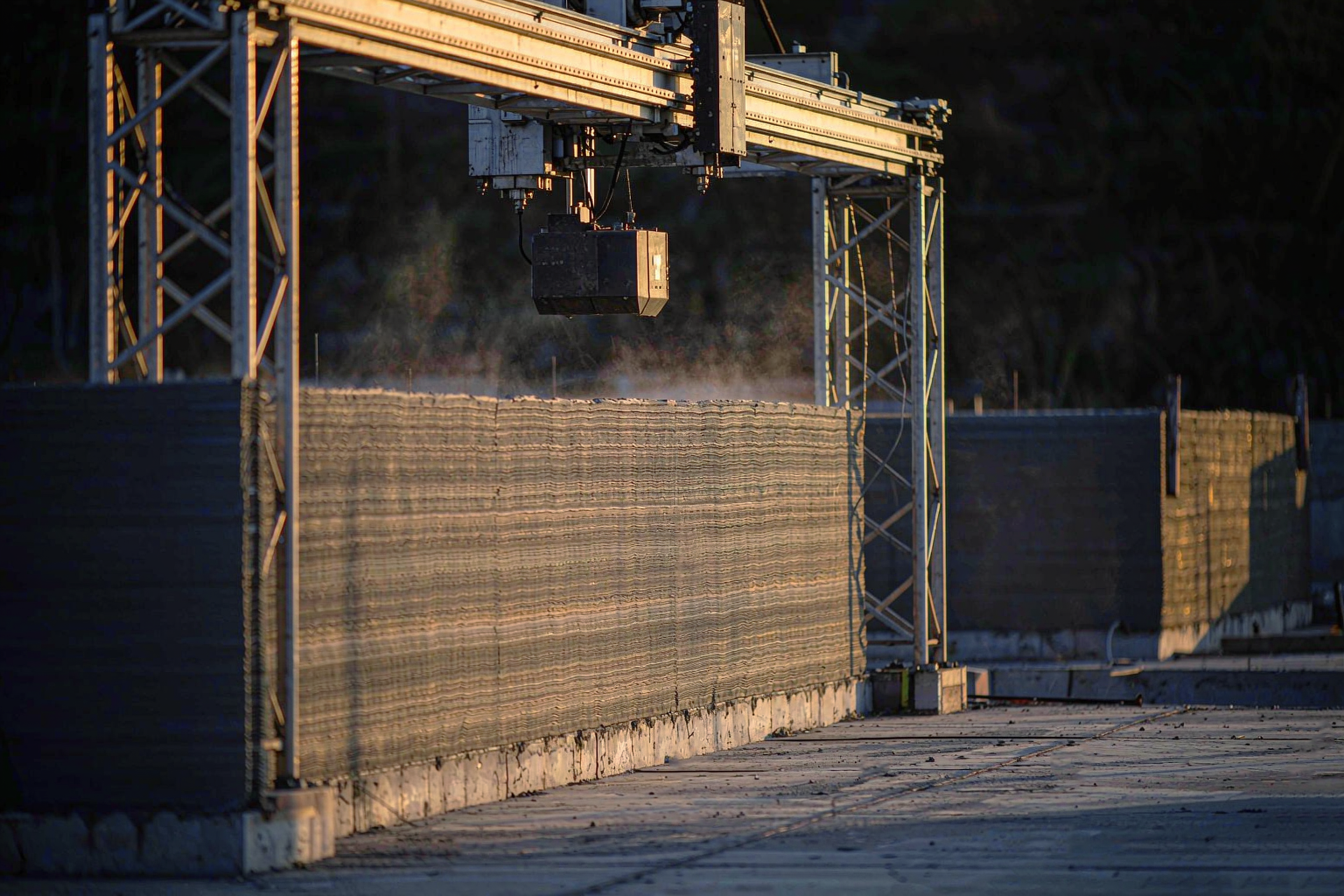
Choosing between a fixed-frame gantry printer and a tracked mobile unit comes down to one trade-off. Fixed systems win on repetition, precision, and output per hour at a single location. Tracked systems win on access, redeployment speed, and sites that were never designed around a machine. Cost, crew size, and permitting all follow from that split. This piece covers how each machine behaves after the commissioning photos are taken, the budget lines buyers tend to miss, the problems that surface in month three, and how the decision plays out under North American plan review.
What the two machine types actually are
Fixed-frame (gantry) printers
A fixed printer sits on rails or a bolted base, with a gantry spanning the build area and a carriage moving the nozzle in three axes. You level it, anchor it, calibrate it once, then run. Because the frame never moves during a print, the only motion error you fight is inside the gantry itself: rail alignment, rack wear, thermal drift over a long pour.
The catch is built into the design. You buy a print envelope, not a reach. Whatever sits outside the frame does not get printed, and moving the machine means disassembly, transport, and a fresh foundation.
Tracked and mobile printers
A tracked unit carries the print end on a crawler chassis, usually a robotic arm or a vertical mast. It drives to the work, sets outriggers, levels, prints a zone, retracts, and moves on. Reach is a function of arm geometry and how many times your crew is willing to reposition.
Mobility gets paid for in stability. Every reposition is a new calibration event. The chassis has to carry the arm, the counterweight, and the material line, which caps how much stiffness you can build into the print head.
How they differ on site, in the order problems appear
Site prep and footprint
A gantry needs a compacted, toleranced slab or rail bed, a power drop sized for the pump and drives, crane or forklift access for assembly, and typically several days of setup before the first layer. Get the slab flatness wrong and you fight layer registration for the whole project.
A tracked unit needs a driveable path and a level pad at each print station. Outrigger bearing pressure on unprepared soil is the usual failure point, and door openings, overhead lines, and turning radius decide whether the machine can reach the wall at all. Less earthwork, more per-station checking.
Precision, finish, and tall walls
Long uninterrupted runs favor the fixed frame. The reference geometry does not move, so angular error accumulates more slowly as walls rise. Tracked units produce acceptable architectural walls, but variance grows when the machine repositions mid-element, and chassis vibration shows up in surface texture at full arm extension.
On anything above roughly two storeys, the gap widens. A gantry’s stiffness is designed in. A tracked arm at extension is a lever, and wind load on the print head becomes a real constraint rather than a nuisance.
Build envelope vs working reach
Print area and reach are not the same specification, and buyers confuse them constantly. A gantry might cover 10 by 15 meters with a fixed height ceiling. A tracked arm covers a radius of a few meters per station, so a long wall becomes a leapfrog sequence. Each leap introduces a cold joint, and cold joints are where structural review gets uncomfortable.
Throughput and relocation math
One setup, continuous output: that is the gantry’s argument. It gets stronger as your element count rises. Twenty identical wall panels off one frame will beat any mobile unit on labor hours.
Tracked systems lose hours to setup and teardown at every station. They win when the work is scattered: six sites a year, small footprints, occupied buildings, backyards.
What each option costs, and the lines buyers forget
Purchase price sits in different bands. Gantry systems generally run higher on capital cost because of the steel, foundations, and rail work, Tracked units enter lower, and that entry price is what sells them in a first meeting.
Budget the rest, though. Power service upgrades, a concrete pump and hopper sized to the print rate, accelerator dosing equipment, spare nozzles and delivery line, a rigging plan for the initial install, an insurance rider, and operator training that runs weeks rather than days. Add the cost of a failed print: material, pump time, crew time, and disposal.
Then add site works. A rail bed is a construction package. A leveling pad per station is a smaller but repeating cost. Neither shows up in the machine quote.
Where projects go wrong
The most common mistake is sizing the envelope to the biggest job in the pipeline instead of the repeatable job. A machine bought for one showcase build sits idle for a year afterward.
The second is assuming tracked means no site preparation. It means different preparation, not none.
Third, treating the print mix as a separate purchase. Machine and material behave as one system. Pumpability, open time, and buildability window have to be matched to the deposition rate, and a mix that prints beautifully in a lab can fail on a hot afternoon with a 90 minute transit.
Fourth, wind. A gantry is a sail and a tracked arm is a lever. Neither tolerates an optimistic reading of the site’s exposure.
Fifth, inspection access. Embedded conduit, vertical reinforcement, and the way an inspector verifies layer bond all need to be designed before the first layer, not discovered during the framing inspection.
A five-step way to decide
- Count your repeating element. If you have fewer than ten, mobility matters more than throughput.
- Walk the site with the machine’s turning radius and outrigger footprint in hand.
- Price the site works, not just the hardware.
- Confirm the permitting route with the local building department before you commit.
- Run one paid print trial with the actual mix and crew.
Who should pick which
Fixed frames fit producers running repeat wall elements, panel lines, and yard-based fabrication with a dedicated slab and a pipeline that justifies the capital. If your output is measured in elements per month at one address, buy the gantry.
Tracked units fit renovation and retrofit work, tight urban lots, remote sites, and contractors who need one machine to travel. If your output is measured in sites per year, buy the tracked unit.
Limits nobody should gloss over
Height ceilings are real on both platforms. Reinforcement integration is still largely manual, which caps the labor savings people expect. Surface finish needs post-processing in most architectural applications. And no machine solves the weather.
Local conditions that change the answer
In North America, there is no prescriptive chapter for printed concrete walls in the model codes. Projects typically route through an ICC Evaluation Service report under the acceptance criteria for 3D printed concrete wall systems, or through an alternate-means approval with the engineer of record carrying the load. Building department familiarity varies enormously between jurisdictions, so a plan review that takes three weeks in one county can take three months in the next.
Labor is the other local factor. With masonry and framing crews tight in most metros, printing shifts the workforce from laying units to operating and finishing. That shift favors whoever can staff a machine operator, not whoever can staff a gang.
Accessory dwelling units are a genuine use case in many jurisdictions, and a tracked unit can work in a side yard where a gantry simply cannot be assembled. Wind zones, seismic detailing, and freeze-thaw exposure also push design decisions that affect which platform is viable.
FAQ
Can a tracked printer build a whole house? Yes, in zones. A single-storey structure usually needs several repositioning cycles, and each one creates a joint the structural design has to account for.
Do I need a separate concrete pump? Almost always. Most printers take material from an external pump or mixer, and the pump’s output has to match the print rate.
Is 3D printed construction code approved in the US? Not through a prescriptive code chapter. Approval runs project by project, through an evaluation report or an alternate-means path with a licensed engineer.
How long does setup take? A gantry typically needs several days including foundation work. A tracked unit can be printing within hours of arrival, provided the pad and access are ready.
Next step
If you are weighing a fixed frame against a tracked platform for a specific project, send us the site plan and the element count. We will tell you which configuration the geometry supports, and which one it does not.