

Where Does the Material for 3D Printed Buildings Come From?
3D concrete printing technology is reshaping the construction industry — from landscape fixtures to public buildings, digital fabrication is rapidly moving toward large-scale application thanks to its efficiency, flexibility, and labor-saving advantages. Yet an unavoidable question arises: if this technology scales up, how staggering will the consumption of concrete raw materials become?
The traditional concrete industry is already one of the largest sources of global carbon emissions, and its critical raw material — natural river sand — faces increasingly severe resource depletion. According to industry statistics, approximately 50 billion tons of sand and gravel are consumed globally each year, a substantial proportion of which comes from unsustainable riverbed mining.
Can 3D printed concrete use recycled materials? The answer is a resounding yes — and it is rapidly becoming the industry consensus.
This article provides a comprehensive analysis of recycled materials in 3D printed concrete across three key dimensions — material feasibility, mechanical strength, and total cost. Using AiUltraprod’s G02 Circular Ink solution as a case study, we demonstrate how this technology pathway has achieved real-world commercial deployment.
Part 1: Materials — What Makes Recycled Materials Viable?
1.1 Recycled Sand — From Construction Waste to Printing Feedstock
Concrete, bricks, and masonry from construction and demolition waste (C&DW) can be processed through crushing, screening, and washing to produce recycled sand, which replaces natural river sand as the aggregate in 3D printed concrete.
In 2025, a study published in the Springer journal Materials and Structures delivered a key conclusion: 3D printed mortar prepared with 100% recycled sand as a replacement for natural sand showed only “little effect” on mechanical strength compared to the natural sand control group. In other words, under appropriate mix design, recycled sand is fully capable of fulfilling structural functions.
An earlier study (2023, ScienceDirect) found that the incorporation of recycled sand actually promotes early-age structural formation in 3D printed concrete — an additional process advantage for the layer-by-layer deposition method.
1.2 Not Just “Usable” — but “Printable”: Material Printability
3D printed concrete imposes strict rheological requirements on materials. The fresh material must simultaneously satisfy three seemingly contradictory performance criteria:
| Performance Requirement | Definition | Challenge from Recycled Materials |
| Pumpability | Material flows smoothly through the delivery pipeline | Recycled sand has angular particles and high water absorption |
| Extrudability | Material can be continuously extruded while maintaining shape | Unstable gradation may cause clogging |
| Buildability | Extruded layers support their own weight and subsequent layers | Early-age strength development requires precise control |
The AiUltraprod team’s solution is the G02 Circular Ink — not simply “mixing recycled sand in,” but a systematic design approach addressing the characteristics of recycled aggregate at three levels: gradation optimization, cementitious material system, and admixture synergy.
1.3 G02 Circular Ink: A Closed Loop from Waste to Finished Product
The core logic of G02 Circular Ink is establishing a complete material circular chain:
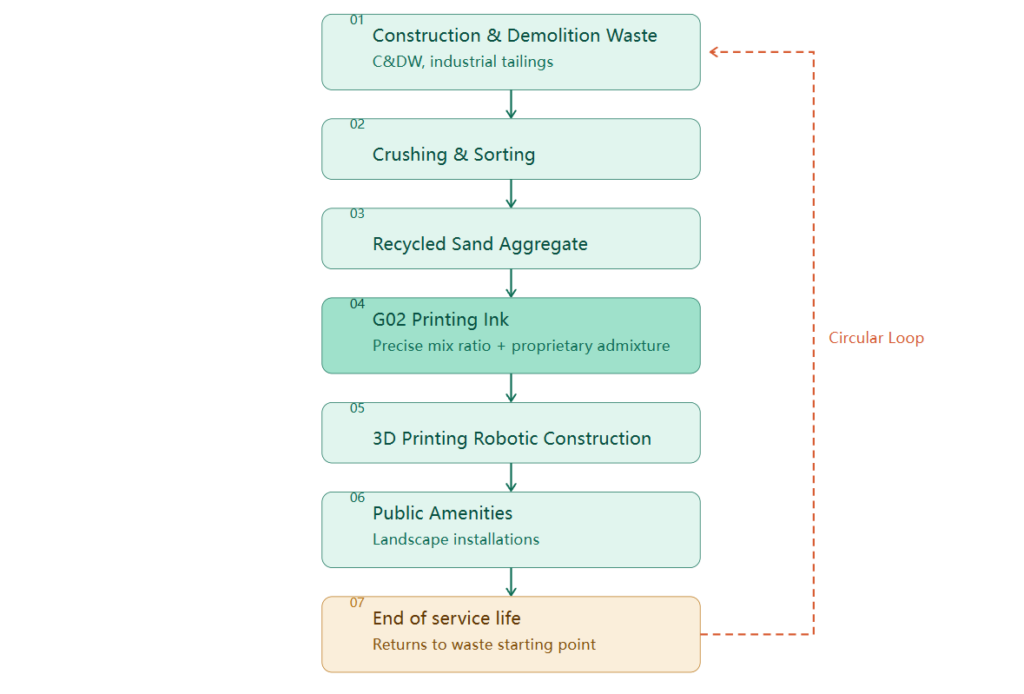
This pathway transforms building materials from the linear model of “extraction → use → disposal” into a circular construction closed loop of “recovery → regeneration → construction → re-recovery.”
Part 2: Strength — How Do Recycled Materials Perform Mechanically?
This is the question that concerns every engineer most.
2.1 Compressive Strength: Manageable Differences, Optimizable Parity
Multiple studies consistently show that when the recycled sand replacement rate is below 50%, the compressive strength of 3D printed concrete is virtually unaffected. At 100% replacement, strength reduction typically falls between 5% and 15%, and can be compensated for through the following measures:
Optimizing the water-to-binder ratio to compensate for recycled sand’s high water absorption
Incorporating reactive mineral admixtures (fly ash, slag, etc.) to improve the interfacial transition zone (ITZ)
Adjusting the admixture system to enhance the coating effect of cementitious materials
2.2 Interlayer Bond Strength: The Unique Challenge of Additive Manufacturing
The mechanical weak point of 3D printed concrete is not in the material itself, but at the interlayer interface. The incorporation of recycled sand may affect the density of the interfacial transition zone (ITZ), but research shows this effect is not significant — the 3D printing process itself often has a greater impact on ITZ density than the change brought about by recycled sand substitution.
In other words, as long as the printing process and material mix design are synergistically optimized, the interlayer strength of recycled material 3D printed concrete is acceptable.
2.3 Durability: The Key to Long-Term Service
Research on the durability of recycled sand 3D printed concrete is ongoing and deepening. Current data indicate the following:
| Durability Indicator | Research Findings |
| Drying Shrinkage | Recycled sand incorporation may increase drying shrinkage; control via fiber reinforcement or optimized curing regimes is required. |
| Freeze-Thaw Resistance | Pore structure is key; recycled sand introduces more micropores, but appropriate air entrainment can improve performance. |
| Carbonation Resistance | Correlated with compactness; after mix optimization, can match natural sand concrete. |
Key Takeaway: Strength is not the problem. The key lies in systematic mix design and process control.
Part 3: Cost — How Much Can Recycled Materials Save?
3.1 Material Cost: The Direct Bottom-Line Impact
From a direct material cost perspective, the advantage of recycled solutions is compelling. The following comparison, based on industry median data, illustrates the cost differences between the traditional natural sand approach and the G02 recycled ink solution across key cost items:
| Cost Item | Conventional (Natural Sand) | Recycled (Recycled Sand + G02 Ink) |
| Aggregate Cost | Natural river sand; price rising due to resource tax and transport distance | Sourced from C&DW; lower raw material cost |
| Transport Cost | High-quality sand sources increasingly distant from cities | Local waste sourcing, on-site processing; dramatically shorter haul distances |
| Admixture Cost | Conventional water-reducing admixture system | Specialized admixtures required, but low marginal cost at scale |
| Total Material Cost | Baseline | Reduced by 20%–35% (including comprehensive transport calculation) |
3.2 Hidden Benefits: Value Beyond the Spreadsheet
Using recycled materials also brings several easily overlooked sources of value:
Policy Incentives: Many regions have incorporated C&DW resource utilization rates into green building evaluation standards; recycled material solutions can earn policy credits.
Brand Premium: Against the backdrop of rising ESG investment, the market recognition of low-carbon construction solutions continues to grow.
Supply Chain Security: Freedom from dependence on natural sand resources means greater supply chain resilience.
Part 4: AiUltraprod in Practice — From Lab to Real-World Projects
No matter how sound the theory, it must ultimately be proven by real projects.
4.1 An End-to-End Circular Construction Platform
The AiUltraprod platform is not just about selling equipment and materials — it delivers a complete, end-to-end solution from digital design to equipment control:
SKU Model Library: Hundreds of pre-validated parametric component models, print-tested and ready to use.
Intelligent Design Engine: From input requirements to design draft in just 5 minutes.
Print Simulation & Full-Process Management: From material rheology to toolpath planning, automatically optimizing printing strategies.
3D Printing Robots: Specialized printing equipment optimized for G02 Circular Ink.
4.2 A Landscape Park: Full-Cycle Practice Across Six Types of Amenities
In a demonstration park project, G02 Circular Ink has been successfully applied to the full-process construction of six types of landscape amenities:
| Facility Type | Construction Method | Recycled Material Content |
| Landscape Walls | 3D Printed Concrete | High-proportion recycled aggregate |
| Tables & Chairs | 3D Printed Modular Assembly | High-proportion recycled aggregate |
| Water Channels | 3D Printed Custom-Shape Components | High-proportion recycled aggregate |
| Stepping Stones | 3D Printed Prefabrication + On-Site Installation | High-proportion recycled aggregate |
| Flower Boxes | 3D Printed Custom Designs | High-proportion recycled aggregate |
| Landscape Bridge | 3D Printed Structural Components | High-proportion recycled aggregate |
Every single one of these facilities validates the same point: recycled materials + 3D printing is not about “making do” — it is a genuine construction-grade solution.
Part 5: Final Thoughts — A Future Without Binary Trade-offs
In the past, when discussing sustainable building materials, there was always an implicit assumption: you cannot have both environmental performance and material performance. Use recycled materials, and strength suffers. Pursue green and low-carbon goals, and costs rise.
But the intervention of 3D printing technology is dismantling this binary opposition.
The precision of digital fabrication is precisely the “hedging tool” for the variability of recycled materials. Through precise mix design, real-time printing parameter control, and intelligent quality monitoring, recycled materials transform from a “variable” into a “controllable quantity.”
AiUltraprod’s G02 Circular Ink, together with the full range of landscape amenities in the demonstration park, responds to skepticism with one undeniable fact:
3D printed concrete can not only use recycled materials — this is the path it was truly meant to take.
From construction waste to recycled sand, from G02 ink to robotic construction, from public amenities to future large-scale buildings — this “circular construction loop” is already open. The question now is: are you ready to join this transformation?