
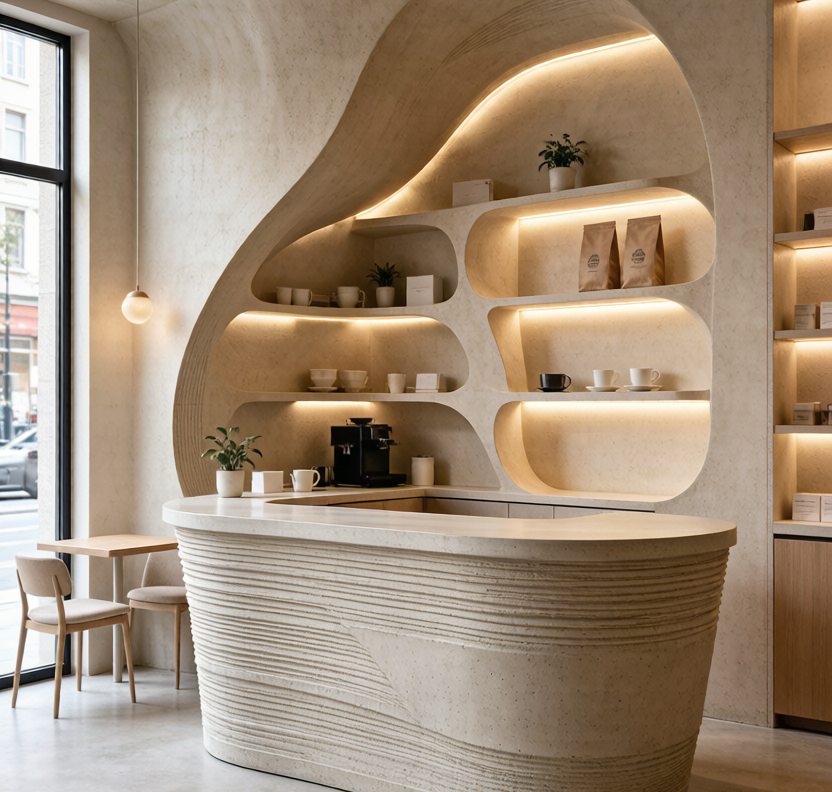
When a café wall is no longer just painted drywall, but a flowing organic form extruded by an algorithm-driven robotic arm in a single pass—that’s not a concept render. It’s what commercial construction looks like in 2026.
A Sector Being Reshaped in Real Time
Walk through any newly opened mall, flagship store, or hip coffee shop today, and you’ll notice a shift: the space itself is becoming the product.
From a cave-inspired boutique in Berlin to a 3,800 sq ft 3D-printed café next to a high-speed rail station in East Asia, commercial spaces are moving from standardized fit-outs toward installation-grade expression. The technology powering this shift is construction-scale 3D printing.
As of mid-2026, the global count of completed concrete 3D-printed building projects has surpassed 600 units, with over 60% of them completed in just the last two years (2024–2026). This isn’t a future trend—it’s happening now.
So the question is: Why are commercial spaces the most natural fit for 3D-printed installations?
1. The “Three Highs” of Commercial Spaces—and Why 3D Printing Checks Every Box
Commercial spaces differ from residential or civic buildings in one fundamental way: they’re willing to pay a premium for distinctiveness while having near-zero tolerance for delays.
Here are the three core attributes of commercial real estate:
| Attribute | What It Means | 3D Printing Fit |
| High visual distinctiveness | Spaces need Instagram-worthy moments to drive foot traffic | ⭐⭐⭐⭐⭐ |
| High time pressure | Every day of construction = lost revenue on expensive leases | ⭐⭐⭐⭐⭐ |
| High willingness to customize | Brands pay a premium for “one of a kind” | ⭐⭐⭐⭐⭐ |
Traditional construction has a structural problem across these three dimensions: the more unique you want it, the slower and more expensive it gets. 3D printing breaks this linear relationship—a complex organic curve and a plain rectangular box cost nearly the same to print.
Traditional Fit-Out vs. 3D-Printed Installation: A Head-to-Head Comparison
| Dimension | Traditional Construction | 3D-Printed Installation |
| Lead time for complex shapes | 2–4 months (incl. mold fabrication) | 7–15 days (direct print) |
| Mold/tooling costs | Custom molds for curves: 6K–6K–30K+ | Zero mold cost—design-to-manufacture |
| Design freedom | Constrained by trades’ skill & available formwork | Algorithm-driven, unlimited geometry |
| Material waste rate | 15–25% | 3–5% (additive by nature) |
| Reproducibility | Each project is a one-off; quality varies | Same digital model, consistent output |
And here’s the number that matters:
Traditional 3D printing project delivery involves 4 factory round trips and takes 3–4 weeks. Platforms like AiUltraprod have compressed the entire workflow to 3–5 days.
2. Which Commercial Scenarios Are Already Using 3D-Printed Installations?
This isn’t speculative. Here are six scenarios with real-world deployments globally:
01. Retail Stores & Brand Flagships
Core need: Make the space itself a social media destination.
3D printing creates organic forms that traditional fit-outs can’t economically deliver—fluid countertops, cave-like wall textures, sculptural display shelving. Brands no longer need to commission expensive art installations; parametric design + 3D printing generates a unique spatial language at a fraction of the cost.
02. Cafés & Dining Spaces
Core need: Fast turnaround + strong visual identity.
In 2025, a 3,800 sq ft 3D-printed café opened at a high-speed rail station, combining on-site robotic printing with prefabricated printed modules. From concept to opening, it took months instead of a year. It is now the most recognizable building in the precinct.
03. Public Plazas & Pedestrian Streets
Core need: Benches, planters, sculptures, wayfinding—site furniture that anchors a place.
The traditional approach means ordering catalog items that look the same everywhere. 3D printing lets a developer commission bespoke pieces for a specific street—flowing curves for this block, origami geometries for the next. 12 custom benches, from a single brief to a priced quote in under 20 minutes—that’s what the AiUltraprod platform delivers today.
04. Exhibition & Pop-Up Spaces
Core need: Ultra-short build cycles + reusability.
Pop-up stores, brand launches, art exhibitions—these run on days, not months. 3D-printed components can be fabricated off-site, assembled in hours, and recycled or reconfigured when the event ends.
05. Office & Coworking Environments
Core need: Break out of the cubicle grid; create spaces that inspire creativity.
3D-printed partitions, reception desks, and meeting-room installations shape flowing, open environments that turn the office itself into a talent-attraction tool and a medium for expressing company culture.
06. Hotel Lobbies & Mixed-Use Developments
Core need: Deliver a “wow on arrival” experience.
A single 3D-printed reception desk or a textured feature wall can elevate a hotel lobby from “adequate” to “memorable”—directly affecting guest satisfaction scores and online reviews.
3. Why Now Is the Right Time to Jump In
3.1 The Cost Curve Has Turned
Construction 3D printing costs have dropped significantly over the past three years:
- Materials: Printable concrete costs have fallen from the equivalent of 9–14/sqft(2022)to∗∗9–14/sqft(2022)to∗∗4–7/sq ft** (2026), driven by locally sourced material formulations.
- Equipment: Printer hardware has shifted from predominantly imported to competitive domestic alternatives—a 40%+ reduction in capital costs.
- Efficiency: AI-driven parametric design and automated print-path validation have compressed the design-to-production cycle by 80%.
Using AiUltraprod’s three-tier pricing as a reference for a commercial installation project:
- Essential: from $4,800—meets functional requirements
- Standard: from $6,500—balanced performance and budget
- Premium: from $8,500—maximum aesthetic impact
Against traditional construction plus custom mold costs, 3D printing already delivers a 30–50% cost advantage for complex geometries.
3.2 Technology Has Crossed the “Commercial-Grade” Threshold
Key maturity indicators:
- ✅ AI print-path validation: 10工艺 constraints (overhang >45°, material-specific limits) auto-checked before production—works even for first-time users
- ✅ Parametric template library: 24 pre-validated templates with a 0.92 match rate against real briefs
- ✅ Multi-material support: Printable concrete, PLA-PHA composites, terracotta, and more
- ✅ 7 CAD format compatibility: Upload .dwg, .rvt, .3dm directly from your design team
The bottom line: you don’t need to understand 3D printing technology to execute a 3D-printed project. That’s the commercialization tipping point.
3.3 ESG & Regulatory Tailwinds
- Green construction: 3D printing’s material waste rate is one-fifth that of traditional methods—a strong ESG narrative for commercial real estate brands
- Zero-inventory, on-demand production: No need to pre-order and warehouse materials; production is project-driven
- Prefabrication policy incentives: Multiple jurisdictions now offer tax credits or density bonuses for projects incorporating prefabricated and additive-manufactured components
4. AiUltraprod: Making 3D-Printed Commercial Spaces Go from “Can We?” to “How Much and When?”
All the possibilities are compelling. But for commercial owners, designers, and project managers, the real question is practical: is it fast, is it good, and is it affordable?
That’s what AiUltraprod was built to solve.
A Real-World Six-Step Workflow
| Step | What Happens | Duration |
| 01 | Describe your need in natural language: “12 sculptural benches for a commercial plaza” | 5 minutes |
| 02 | AI auto-matches your brief against a template library (0.92 hit rate) | Automatic |
| 03 | Review 3 candidate options with visual previews | 1–3 minutes |
| 04 | Parametric adjustments: dimensions, color, surface finish | Instant |
| 05 | Instant three-tier quote with full cost breakdown | On the spot |
| 06 | Place the order and track printing progress in real time | 7–30 day delivery |
From “I have an idea” to “I have a priced proposal”: under 30 minutes. Traditional 3D printing workflows take 3–4 weeks for the same stage.
Where AiUltraprod Differs
No lock-in. Use AiUltraprod for design only, or go end-to-end with design + print—your choice.
Radical cost transparency. Five cost categories (materials, machine hours, post-processing, logistics, management) are itemized. No hidden fees.
AI as a safety net. Real-time manufacturability validation ensures your design can actually be printed—before you commit. A pretty design that can’t be built is just expensive wallpaper.
An architecture graduate at Xi’an Jiaotong-Liverpool University used the platform for the first time and received an automatic alert that her PLA-PHA material choice would fail at overhangs exceeding 45°. The system saved her two critical print failures in a single session. That’s what AI process validation looks like in practice.
5. Three Trends to Watch
Trend 1: From “Buildings” to “Installations”
Over the next three years, the biggest growth in commercial 3D printing won’t be entire buildings—it will be installation-scale components: bars, partitions, façades, landscape elements, wayfinding systems. These have shorter decision cycles, faster installation, and higher visual ROI. They are the sweet spot for 3D printing commercialization.
Trend 2: From “Expert Tool” to “Everyone Tool”
Just as Canva made graphic design accessible beyond professional designers, 3D printing design platforms are making spatial construction accessible beyond those who can produce formal construction documents. Natural language interaction + AI manufacturability validation is the engine driving this shift.
Trend 3: From “Cost Line Item” to “Brand Asset”
When a 3D-printed installation is visually distinctive enough to be photographed and shared on social media, it stops being a construction expense and becomes a marketing asset. An “Instagrammable” space installation can generate media value over its lifecycle that far exceeds its fabrication cost—a return that no painted drywall can match.
Conclusion
Adopting 3D-printed installations in commercial spaces isn’t about chasing a trend. It’s about a construction paradigm shift that is already underway.
When design freedom is no longer constrained by formwork costs or trades’ skill ceilings, and when unique geometry no longer means double the budget and timeline, commercial spaces gain a level of expressive freedom they’ve never had. And for brands competing in an era where every retail corridor looks the same, a space people remember is the strongest competitive advantage there is.
AiUltraprod is a full-chain service provider specializing in construction-scale 3D printing. Its AiUltraprod AI cloud platform digitizes the entire workflow—from brief input and scheme matching, through parametric adjustment and pricing, to delivery tracking—compressing the design-to-delivery cycle for 3D-printed installations from 3–4 weeks to 3–5 days. The platform currently serves architects, designers, and commercial developers across multiple global markets.