
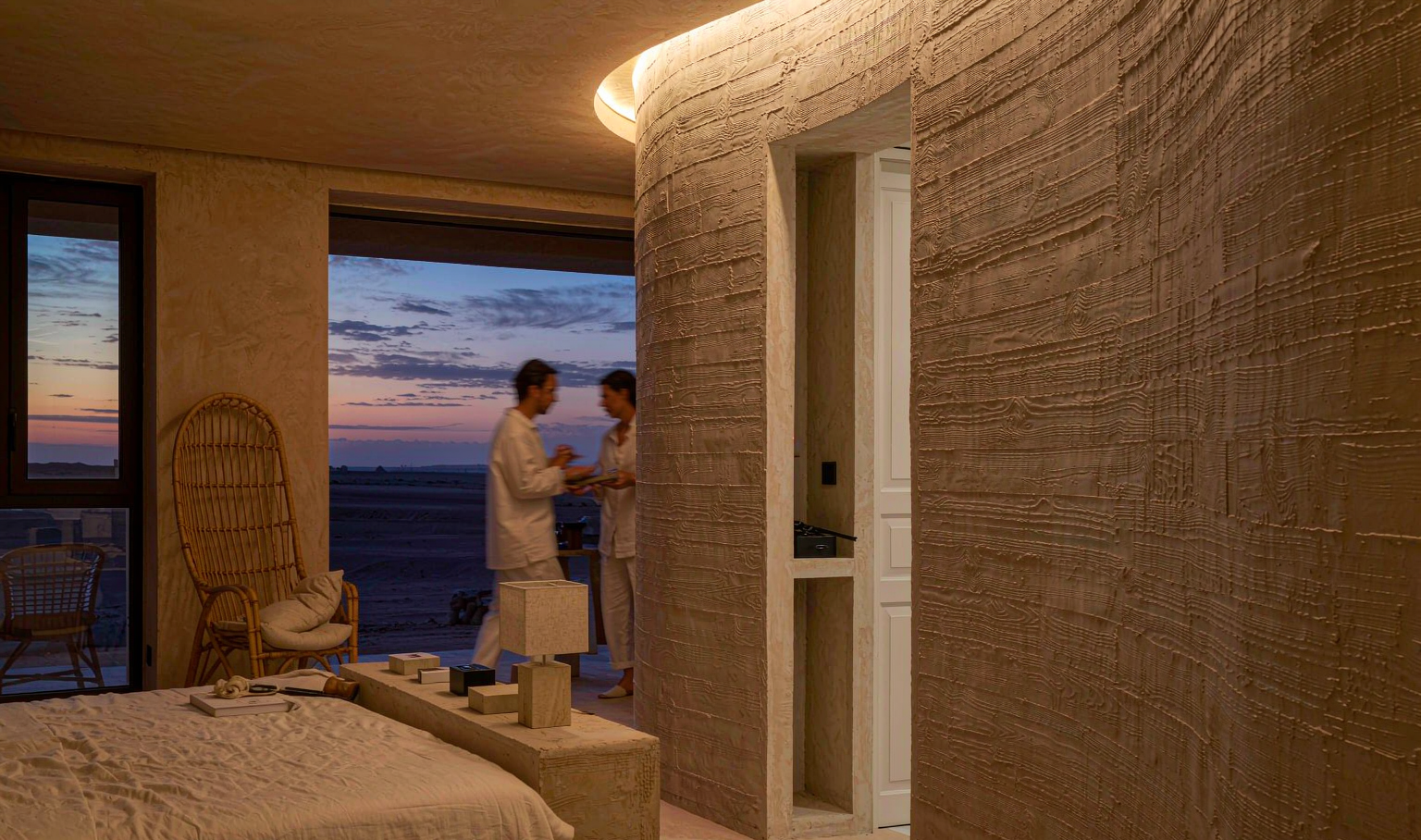
Staying in a 3D‑printed guest room is an entirely different experience from purchasing a 3D‑printed residential building. Buying a home involves contracts, mortgage financing, and asset valuation. By contrast, accommodation consumption only requires guests to complete a booking. This core distinction explains why 3D‑printed construction technology has seen slow adoption in the residential housing sector yet achieved early real‑world implementation in hotels and homestays.
Traditional construction drives up costs for lodging projects along three dimensions: complex forms demand expensive formwork; remote sites create challenges in sourcing materials and deploying labour; construction delays directly postpone project opening dates. 3D‑printed construction mitigates the latter two pain points, while turning complex architectural shapes from high‑cost custom solutions into viable design options.
Shapes No Longer Cost Extra Based on Complexity
On construction sites, curved forms carry a clear price tag. Standard formwork works for straight walls, but parabolic surfaces require custom‑built steel moulds used only once. Arches, domes and cave‑like interior spaces each call for one‑off tooling, alongside labour for formwork installation and removal. Many hotels stick to simple four‑wall layouts not because designers lack creativity, but because curved geometries prove prohibitively costly in project quotations.
Extrusion‑based 3D printing operates on a different logic. Print heads follow digitally‑defined paths encoded in software. Adding a dome does not require new moulds — it only increases printing time. For the first time, integrating intricate forms across multiple building units becomes a replicable process.
El Cosmico in Marfa, Texas serves as one of the best‑documented case studies. The project expanded an existing 21‑acre campground to over 60 acres, adding 43 hotel units and 18 residential structures, all built using gantry‑style 3D printers. Single‑storey walls reach 12 feet in height, defined by domes, arches and parabolic curves, with room rates ranging from USD 200 to 450 per night. Owner Liz Lambert put it plainly: most hotels are built by repeating identical units over and over.
A Chilean study of 75 test subjects found that curved wall surfaces and visible print layers can evoke emotional resonance and a sense of comfort, with higher acceptance reported among female participants. This finding carries greater weight in hospitality than in housing, given that guest rooms are products for sale. According to project disclosures, constructing these forms using conventional building methods would result in substantially higher costs.
Guests Book for Their Stay, Not for the Technology
The residential market hits obstacles at the point of property transfer. One of the largest‑scale U.S. surveys (3,026 respondents, ±1.8 % margin of error) showed that 66 % of participants would consider living in a 3D‑printed home, rising to 75 % among millennials, while only 16 % explicitly rejected the idea. Top motivations included lower costs (54 %), improved energy efficiency (51 %), and enhanced disaster‑resistance (42 %). Significant concerns remained: 36 % of respondents wanted to observe long‑term performance first; 22 % questioned structural durability; another 22 % preferred traditional appearances; and 18 % worried about identical‑looking neighbouring buildings.
Hotel guests face none of these considerations. They bear no liability, conduct no asset appraisal, and have no stake in property resale. They stay for a few nights and depart. Technical risks do not factor into their decision‑making, which centres on one simple question: is this stay worth booking and sharing online?
Practical, tangible details shape the real‑world guest experience. Visitors at Wolf Ranch reported that thick 3D‑printed concrete walls weakened Wi‑Fi signals, requiring additional mesh routers. If services are not embedded at the design stage, even well‑built printed walls may trigger negative guest reviews. Visible print layers represent a double‑edged feature: some visitors view the textured finish as an intentional stylistic element, while others perceive it as rough and unfinished. Within boutique homestays and resorts, this texture can function as built‑in decoration, eliminating the need for extra cladding and helping guests perceive value for money.
A fundamental trade‑off remains. Cost‑efficiency through unit replication relies on printing twenty identical rooms. At the same time, guests genuinely value uniqueness. Developers either create differentiation through landscape and location outside individual rooms, or accept reduced individuality in exchange for construction efficiency.
Opening Dates Are the Urgent Target
Within lodging project budgets, construction timelines translate directly into revenue. Peak travel seasons cannot be delayed; a three‑month opening postponement can wipe out an entire year’s profit.
Wall construction speeds show clear improvements: building single‑storey walls via 3D printing takes 2‑7 days compared with 15‑30 days for masonry. Complete exterior walls for a residential building can be printed in roughly 20 days. On‑site formwork, scaffolding and tower cranes become unnecessary, simplifying site logistics significantly.
Limitations must also be acknowledged. 3D printers produce walls and floor slabs. Mechanical‑electrical systems, interior fit‑outs, curtain walls and soft furnishings still follow conventional construction timelines — and these elements account for the bulk of project time and expenditure. Within hard construction costs, structure and facades represent 30‑40 %, while mechanical‑electrical installations make up 25‑35 %. When measured against total investment, structural and civil work only accounts for one‑quarter to one‑third of overall spending.
Meaningful total‑schedule reduction is achievable under one key condition: repeated identical units. Once the twentieth identical guest unit is printed, print paths, material mix proportions and operator expertise are fully refined, lowering marginal time expenditure and trial‑and‑error costs.
Constraints on Site Conditions and Labour
Islands, mountainous terrain and desert locations represent highly desirable destinations for hospitality projects, yet notoriously difficult environments for construction. Transporting building materials to islands by sea can increase costs by 20‑40 %, pushing total project costs 25‑40 % higher than equivalent mainland builds, while skilled tradespeople must be brought in from elsewhere.
3D‑printing technology reshapes supply‑chain requirements rather than simply replacing workers. Traditional construction transports prefabricated components, bulk bagged materials and full on‑site work crews. By contrast, 3D‑printed construction delivers printing equipment and pumping systems, while locally‑sourced aggregates are used. Manufacturers recommend an on‑site crew of three personnel with general construction experience, though this is advisory rather than a legal requirement.
Kisawa Sanctuary on Benguerra Island in Mozambique demonstrates this principle to an extreme. Located roughly 14 kilometres offshore, the resort is accessible only by boat or helicopter. Developers deployed custom‑patented sand‑printing technology, using local island sand and seawater to produce mortar for printed masonry, flooring and tile components. Project stakeholders clarify that the finished buildings are not entirely 3D‑printed monolithic structures, but assemblies built from 3D‑printed components.
Labour shortages create additional pressure. According to 2026 industry association labour models, the U.S. construction sector needed roughly 499 000 additional workers, with 94 % of contractors reporting unfilled job openings. Globally, a 2026 survey covering 112 markets across 44 countries found labour shortages reported in 71 % of markets, with 87 % experiencing shortages in mechanical, electrical and plumbing trades. Hospitality projects are particularly vulnerable: cost inflation for high‑end hotels has been separately estimated at 5‑7 %.
Occupational safety requirements also shift. Under U.S. OSHA regulation 29 CFR 1926, provisions governing formwork load capacity and strength verification before form removal do not apply to 3D‑printed workflows. However, one key clause remains relevant: construction loads cannot be applied to concrete structures unless a qualified structural engineer confirms load‑bearing capacity. Layer‑by‑layer extrusion continuously adds load onto incompletely hardened material, and existing regulations contain no explicit guidance for such equipment.
Compliance Pathways Exist, Though Not Through Prescriptive Codes
Most hospitality buildings are commercial structures, often multi‑storey, governed by the International Building Code (IBC). 3D‑printed wall assemblies are not pre‑defined structural systems within standard codes. Instead, projects follow the alternative materials‑and‑methods pathway defined under IBC Section 104.11, evaluated against ICC‑ES AC509 criteria, to obtain assessment reports tied to specific material mixes and fabrication processes.
Clear performance thresholds apply. Material specifications require a minimum 28‑day average compressive strength of 2 500 psi. Testing under ASTM E518 assesses how time intervals between printed layers affect inter‑layer bond performance. For structural validation, full‑scale axial‑load, bending and in‑plane shear tests must be conducted for each wall configuration and material mix; characteristic strength values are calculated by dividing average peak strength by a safety factor of three. Provisions for multi‑storey applications were only added in April 2021; prior to that, standards applied solely to single‑family residential buildings.
Fire‑resistance represents another area of technical progress. Third‑party testing shows load‑bearing 3D‑printed walls achieve 178 minutes fire‑resistance under ASTM E119 testing, enabling a 2‑hour design rating. Non‑load‑bearing interior walls achieve 117 minutes, supporting a 90‑minute rating. Fire‑resistance classifications influence insurance categorisation and enable multi‑storey deployment.
Important limitations apply to AC509: wall assemblies lacking ASTM E119 fire testing can only be used in non‑fire‑rated construction. When deployed as lateral‑force‑resisting systems, usage is restricted to Seismic Design Categories A and B. Common misunderstandings persist: Appendix BM of the 2024 International Residential Code addresses 3D‑printed construction yet explicitly excludes concrete‑based 3D printing, and its adoption remains optional for local jurisdictions. Conversely, Dubai introduced regulations via Decree No. 24 of 2021 requiring registration and licensing for entities conducting 3D‑printing construction work.
Why Small‑Scale Vacation Properties Lead Early Adoption
Hospitality segments differ widely in capital‑expenditure profiles. Capital costs per room range from USD 150 000‑400 000 for boutique hotels and resorts, compared with USD 35 000‑120 000 for glamping and wilderness lodging units. Prime locations support premium pricing, with high‑end wilderness resorts commanding nightly rates between USD 400‑1 500 during 2024‑2025.
These economic parameters align closely with the practical capabilities of 3D‑printed construction. Small unit counts, predominantly single‑storey layouts, dispersed placement and design‑driven aesthetics define the product value, while timely opening directly determines cash flow. 3D printing delivers its three core strengths in this context: customised forms, repeatable unit fabrication and constructability in remote sites.
By contrast, high‑rise urban business hotels are not suitable for early‑stage 3D‑printing adoption. Tall buildings feature dense mechanical‑electrical layouts, strict brand‑mandated interior standards, and limited accumulated test data and real‑world track records for multi‑storey printed construction. Fundamentally, 3D printing primarily produces wall elements within building structures; structural work itself accounts for only one‑quarter to one‑third of total hospitality investment. Expecting 3D printing to resolve overall project costs misidentifies where cost drivers lie.
Outstanding Unresolved Challenges
Significant limitations remain. While printers build walls and floor slabs, mechanical‑electrical installations and interior fit‑outs follow conventional timelines, placing an upper bound on total schedule reduction. Real‑world service records for these systems span fewer than ten years; insurers, property evaluators and lending institutions are still developing frameworks for assessing 3D‑printed assets.
Constructability faces material‑driven constraints. Modelling predicts critical buckling lengths of approximately 0.276 metres for 30‑storey structures, with experimental values reaching roughly 0.304 metres for 33‑storey test assemblies. Inter‑layer bond strength reaches only 60‑85 % of monolithically cast concrete. Compressive‑strength variations of 20‑30 % arise depending on print orientation.
Hotels and homestays emerged as early adopters not primarily because printed walls are cheap, but because hospitality sells three core attributes — distinctive forms, timely project delivery and buildability in remote locations — exactly matching current strengths of 3D‑printed construction. Project success hinges on how effectively building units can be standardised at the design phase, and whether mechanical‑electrical systems are fully integrated alongside wall geometry during early drafting.