
Rural construction faces distinct challenges compared with urban projects. Works are scattered across natural villages, most single‑unit buildings cover around 100 m², materials need to be transported over long distances, yet property owners cannot afford higher costs. In urban contexts, 3D‑printing is widely celebrated for design freedom and short construction cycles; when deployed in rural settings, however, its practical strengths lie elsewhere: formwork‑free construction, minimal material waste, simplified workflows operable by only a small crew, and on‑site deployment of construction equipment.
Constraints of Rural Application Scenarios
Project stakeholders mostly adopt 3D‑printing out of practical needs rather than mere technical preference. Madagascar is estimated to require approximately 22 000 newly‑built schools. Two relevant precedents illustrate its potential. Community housing projects in Tabasco, Mexico, were completed with Vulcan II printers, where each building required merely a handful of workers. In Kilifi, Kenya, one printing system finished wall structures for 10 housing units within 10 weeks. Wall printing eliminates formwork and generates far less stockpiled surplus and construction waste.
Rural Community Housing: Measured Costs and Construction Cycles
Led by New Story, ICON and ÉCHALE, the Tabasco housing initiative in Mexico planned 50 residential units of roughly 46.5 m² each, with net printing time of about 24 hours per house. Resident households had a median monthly income of approximately USD 76.5, repaying zero‑interest loans at 400 pesos per month over a seven‑year term. Though overall construction costs were not disclosed, the original target was to erect a 600‑800‑square‑foot dwelling for under USD 4 000.
Mvule Gardens in Kilifi, Kenya, delivered 52 housing units: two‑bedroom homes of 56 m² and three‑bedroom homes of 76 m². Wall printing took 18 hours for a two‑bedroom unit, plus an additional 10 hours for a three‑bedroom one. A single printing device completed wall assemblies for 10 dwellings in 10 weeks. Construction costs stood at 30 000‑31 000 Kenyan shillings per square metre. Developers noted that current costs are broadly comparable to conventional building methods; a 20 % cost reduction remains a target rather than an achieved outcome.
An alternative material approach avoids cement entirely. TECLA, a prototype raw‑earth‑printed residential building in Massa Lombarda, Italy, spans 60 m² and took around 200 hours to print. It consumed roughly 60 m³ of locally excavated soil and remains a research‑oriented demonstration project.
Schools and Public Facilities: Cost Amortisation through Repetitive Construction
Rural public buildings rely heavily on repeated implementation of identical architectural blueprints. The world’s first 3D‑printed school was built in Malawi by 14Trees. Its wall printing phase lasted 18 hours, and mass‑production projects aim for a 20 % reduction in total construction costs. Malawi faces a shortage of about 36 000 classrooms. Proponents estimate that 3D‑printing could shorten the traditional 70‑year construction timeline to merely 10 years. Material consumption for walls falls by around 50 %, and carbon emissions per building can drop by up to 70 %.
Despite the identical 18‑hour wall‑printing duration, the cost structure differs greatly for the project in Fianarantsoa, Madagascar. Thinking Huts and 14Trees constructed a single‑storey 71‑m² campus building with a total expenditure of approximately USD 300 000, more than half of which covered equipment rental and transportation. In Guntur district, Andhra Pradesh, India, pilot large‑scale development is underway: 177 housing units across two villages are budgeted at 1.393 billion rupees.
Cultural‑Tourism Nodes and Special‑Shaped Structures
Extreme examples of geometric freedom appear in India. A 3D‑printed temple in Bhulugupalli village, Telangana, covers 3 800 square feet and rises 30 feet. It features 51‑degree outward overhangs and 32‑degree inward overhangs — configurations that incur extremely high costs using conventional formwork systems.
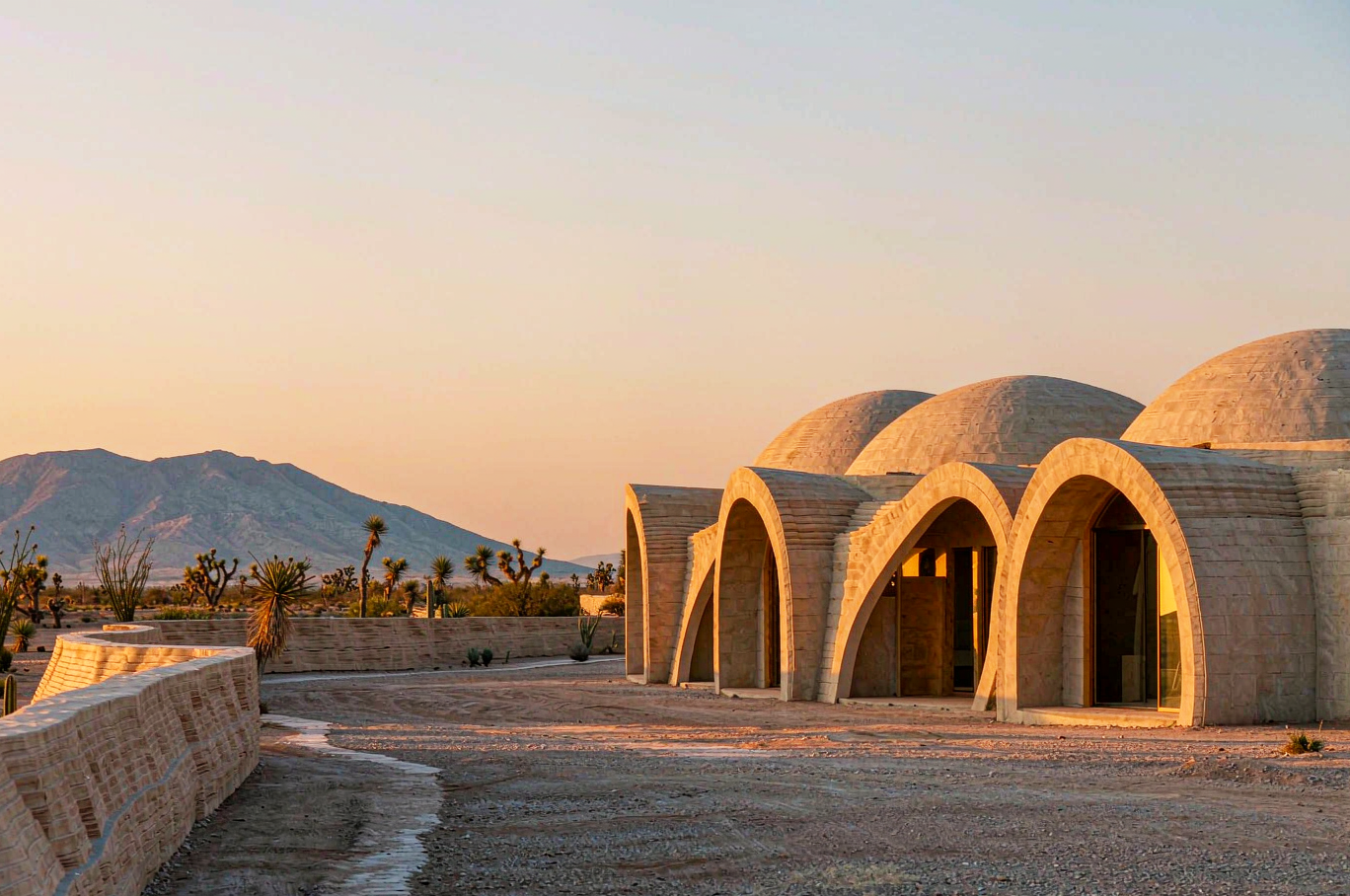
El Cosmico campground in Marfa, Texas, USA, is expanding into a 3D‑printed building complex comprising 43 guest rooms and 18 residences. Construction draws on local sand, soil and native colour palettes. Night‑time room rates range from USD 200 to 450. While its price bracket is distinct from affordable mass housing, it leverages the same geometric advantages of 3D‑printing.
Local‑Sourced Materials and Prefabricated Transportable Components
14Trees produces printing materials at regional local factories. The TECLA project pushes on‑site sourcing to its limit by printing walls directly with soil excavated from the building plot. Recycled aggregate technology is comparatively immature. At a Milan exhibition, the 3D Housing 05 prototype built a 100‑m² wall using recycled concrete derived from demolition waste. Developers reported costs of roughly EUR 1 000 per square metre, about half the cost of conventional construction. Recycled aggregates exhibit different water‑absorption behaviour from virgin aggregates, which alters print‑mix viscosity and inter‑layer structural stability.
The 8‑metre‑long, 3.5‑metre‑wide 3D‑printed bicycle bridge in Hemert, the Netherlands, exemplifies transportable components. It was printed in eight segments off‑site and assembled on location, with a design service life of at least 30 years. For retaining walls and drainage channels with regular cross‑sections, reusable formwork already performs well, leaving limited competitive advantage for 3D‑printing. The technology excels for custom‑manufactured single‑piece elements and components with irregular cross‑sections.
Implementation Barriers: Regulatory Approval, Site Access, Equipment Utilisation and Acceptance Testing
Regulatory approval and engineering acceptance constitute major bottlenecks. Due to its layered fabrication, 3D‑printed structures display directional mechanical properties, meaning type‑approval certification must be obtained for each individual project. Two sets of performance benchmarks require prior clarification: bonding strength between successive printed layers typically reaches 60‑85 % of monolithic cast concrete and declines as the time interval between layers increases. Compressive‑strength variations induced by printing orientation fall within a 20‑30 % range. These figures are literature‑derived intervals from process reviews and not measured values for one specific material mix.
Site access and equipment amortisation pose practical challenges. The Mexican housing project suffered unstable on‑site power supply, and seasonal rains blocked access roads to construction sites. Over half the total expenditure for the Madagascar project went toward equipment rental and freight. In Malawi, by leveraging local material plants and sustained order volumes, construction costs managed to achieve a 20 % reduction versus conventional builds.
Conclusion
Rural scenarios where 3D‑printing can achieve practical deployment share common characteristics: accessible construction sites, repeatable architectural drawings, and locally available construction materials. Community‑scale mass housing satisfies the latter two criteria; schools and healthcare facilities meet the first two. Bridges, culverts and custom‑shaped landscape structures fulfil all three conditions yet remain limited in project quantity.