
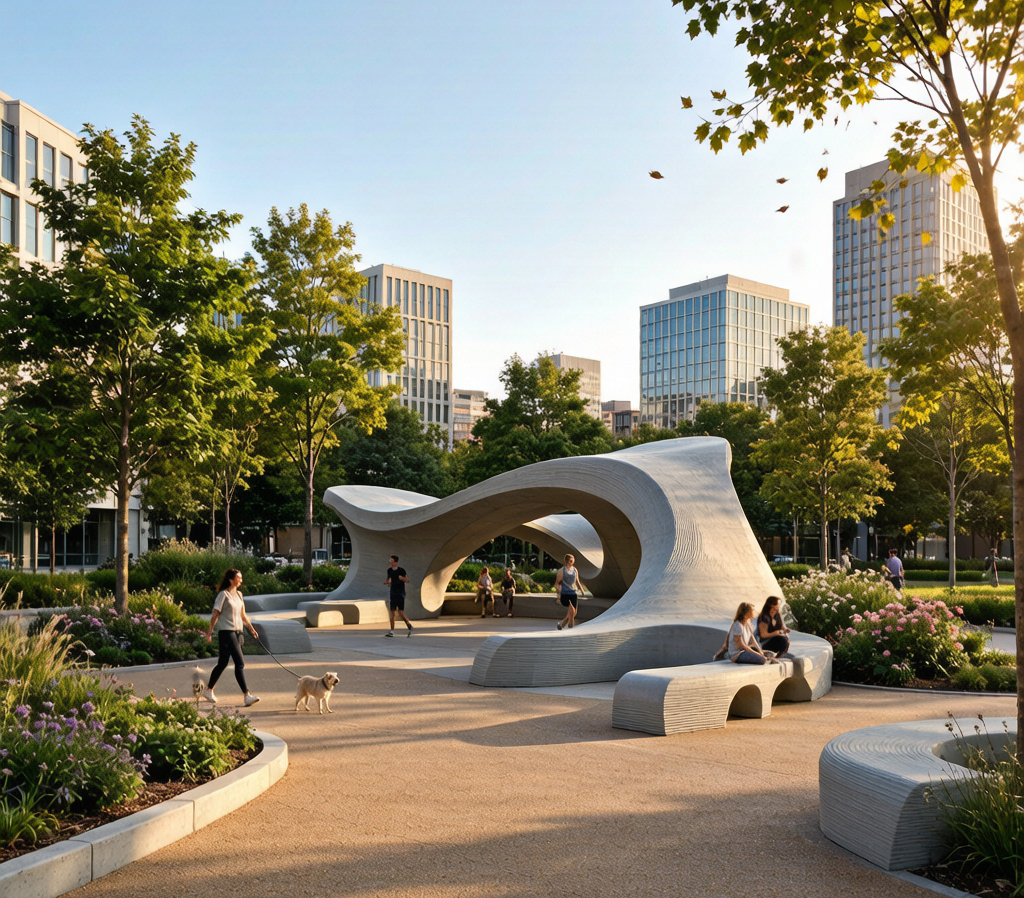
When a six-meter sculpture covered in intricate filigree patterns is unveiled in a city square, few passersby would guess that it didn’t come from a stonemason’s chisel or a foundry’s crucible — but rather “grew” out of a massive 3D printer.
In recent years, from Milan Design Week to the Shenzhen Public Art Center, from Art Basel to permanent installations in metro stations around the world, 3D printing has moved from behind the scenes to center stage, becoming an unmistakable force in public art. This is no accident. It’s the convergence of a series of technological, economic, and aesthetic shifts.
1. The Ceilings of Traditional Craft Are Exactly Where 3D Printing Begins
Public art installations face three inherent challenges: large scale, complex forms, and demanding environmental durability.
Each traditional approach has its own shortcomings:
| Craft | Strengths | Limitations |
| Stone carving | Monumental presence, durability | Extremely high labor costs, limited in complex curves, irreversible |
| Bronze / iron casting | Fine detail | High mold costs, long modification cycles, enormous weight |
| Stainless steel welding | Structural strength | Organic forms hard to achieve, visible seam lines |
| FRP (fiberglass) | Lightweight, cost-controllable | Mold-dependent, limited curve complexity |
3D printing flips this logic to a meaningful degree: as form complexity increases, costs don’t spiral exponentially the way they do with traditional methods. Additive manufacturing’s layer-by-layer deposition is inherently more accommodating of curves and irregular geometries — though it is, of course, no magic wand: overhangs, extreme cantilevers, and certain geometries still require support structures or segmented fabrication. But compared to traditional paths, designers gain substantially more freedom across a far wider range of forms. They are no longer blocked by the wall of “can it even be made?” and can more calmly ask themselves, “what should it be?”
2. Design Freedom: Unlocking Topology Optimization and Biomimetic Form
This is the core driving force. 3D printing essentially unlocks three design dimensions that were previously locked down:
(1) Internal structure
In traditional craft, “solid” is the default; hollowing is an added process. 3D printing can generate lattice structures, honeycomb infill, and gradient density directly during the print — much like the internal architecture of bone. The result: a 40%–70% weight reduction at the same volume, while maintaining or even improving structural integrity.
(2) Surface complexity
Hyperbolic surfaces, non-Euclidean geometries, fluid-dynamic forms — shapes that are routine in the digital models of Zaha Hadid Architects but historically came at enormous cost to realize. 3D printing allows the full information of a digital model to flow directly into the physical world, without the need to break molds, segment parts, or conceal seams.
(3) Micro-texture
Public art is viewed from distances ranging from one centimeter to fifty meters. The tactile quality up close matters just as much as the silhouette from afar. High-precision 3D printing can produce sub-millimeter surface textures that no human hand could replicate — wood grain, water ripples, cellular structures — giving the work a multi-layered viewing experience.
In a sentence: a designer’s vision on screen can be translated into a physical object with far lower “translation costs.” Constraints still exist, but the chasm between concept and execution has narrowed dramatically.
3. Restructuring Costs: From Amortized Molds to One-Shot Printing
To understand the cost of traditional public art, focus on one number: the mold.
For a three-meter traditional bronze sculpture, mold costs typically eat up 30%–50% of the total budget. And the mold is single-use — once the sculpture is installed, it’s scrap metal. Need to revise? Re-cut the mold. Need a duplicate? Make another set.
3D printing’s cost structure is fundamentally different:
- No mold concept at all. Data drives the equipment directly; revisions require only updating a file.
- Exceptionally high material utilization. Additive manufacturing deposits material only where needed, typically yielding under 5% waste — far better than subtractive methods (CNC, etc.) at 50%–70%.
- Dramatically reduced manual intervention. Large-format 3D printing can run unattended overnight, compressing production timelines significantly.
For a typical four-meter public art piece using large-format additive manufacturing (LFAM), the total timeline from design freeze to installation can be compressed to one-third to one-half that of traditional methods.
4. Material Evolution: From “Plasticky” to Architectural-Grade
Early 3D printing earned a reputation for “cheap plastic” — a fatal perception in the world of public art. But the past five years have brought a qualitative transformation on the materials front:
- Large-format additive manufacturing (LFAM / BAAM): Uses recycled PETG, ABS pellets, or even carbon-fiber-reinforced composites. Single parts can reach several meters in size, at roughly a tenth of the cost of traditional FDM. Ideal for large sculpture substrates.
- Concrete 3D printing: Directly extrudes specialized concrete, capable of producing permanent, architectural-scale installations. Dubai already has 3D-printed office buildings; the public art world is following suit.
- Metal 3D printing (WAAM / powder bed): Wire arc additive manufacturing can print stainless steel, titanium alloys, bronze, and more. Fully 3D-printed metal public sculptures have already appeared.
- Bio-based materials: Beyond PLA, materials like lignin composites and mycelium-based composites are entering exploratory application.
The key trend: 3D printing materials are moving from “replacing traditional materials” to “inventing new ones” — gradient transparency, programmable textures, composites with embedded electronics — things traditional processes simply cannot achieve.
5. Real-World Cases: From Experiment to Norm
Case 1: Nervous System’s “Floraform” Series
The American design studio Nervous System uses algorithms to simulate the differential growth process of flower petals, generating forms impossible to draw by hand, then fabricates them as large-scale hanging installations via selective laser sintering (SLS) nylon printing. The formal language of these works depends entirely on the closed loop of computation and 3D printing.
Case 2: MX3D’s 3D-Printed Metal Bridge (Amsterdam)
This 12-meter stainless steel pedestrian bridge spanning a canal was entirely 3D-printed by MX3D using WAAM (wire arc additive manufacturing) technology. It is simultaneously infrastructure and public artwork — its organic curved form was drawn in mid-air by robotic arms, a perfect illustration of the dissolving boundary between engineer and artist.
Case 3: Large-Scale Concrete 3D-Printed Landscape Installations (Multiple Cities in China)
Parks, commercial complexes, and public spaces across China have seen the emergence of 3D-printed concrete benches, pavilions, and landscape walls. The advantages are clear: complex curved surfaces with zero molds, rapid dry-assembly installation, and material longevity matching that of the surrounding architecture.
6. Caveats and Boundaries: What 3D Printing Cannot Do
Let’s be honest: 3D printing is not a universal solution.
- Surface finish still requires post-processing. Layer lines are an unavoidable characteristic of large-format FDM/LFAM. Most public installations require sanding, painting, or cladding after printing.
- Size is constrained by equipment. While large-format printers exist, truly massive installations still need to be printed in segments and joined — the logic of segmentation and seam treatment is an art in itself.
- The “digital feel” debate. Critics argue that certain 3D-printed works lack the warmth and serendipity of the handmade. This is a debate of aesthetic philosophy, not a question with a right answer, but it is one creators should take seriously.
- Long-term outdoor durability is unproven. Compared to stone carvings that have lasted millennia or bronze casts that endure centuries, 3D-printed polymer materials under outdoor UV exposure, temperature cycling, and humidity are still in the data-gathering phase.
7. Three Directions for the Future
- In-situ printing: Instead of printing in a factory and transporting, deploy large-format printers directly to the installation site. Eliminate transport size limits and make “as big as you want” a reality.
- Multi-material collaborative printing: Metal, ceramic, and polymer in a single piece, with different regions serving different functions (structural, conductive, translucent) — the sculpture is no longer a static object of a single material.
- AI generation + 3D printing closed loop: Designers provide concepts and parametric constraints; AI generates hundreds of candidate forms; selections are made and directly output as print paths. The pipeline from idea to physical object is being compressed to an unprecedentedly short length.
Conclusion
The rise of 3D printing in public art is not, at its core, a simple story of “technology replacing craft.” It is a liberation of design thinking — when “how to make it” ceases to be the bottleneck, “what to make” becomes the real question.
The next time you come across a public sculpture that is strikingly strange yet perfectly resolved, take a step closer and look at its surface. Those fine layer lines are not defects — they are the signature of a digital-era way of making.