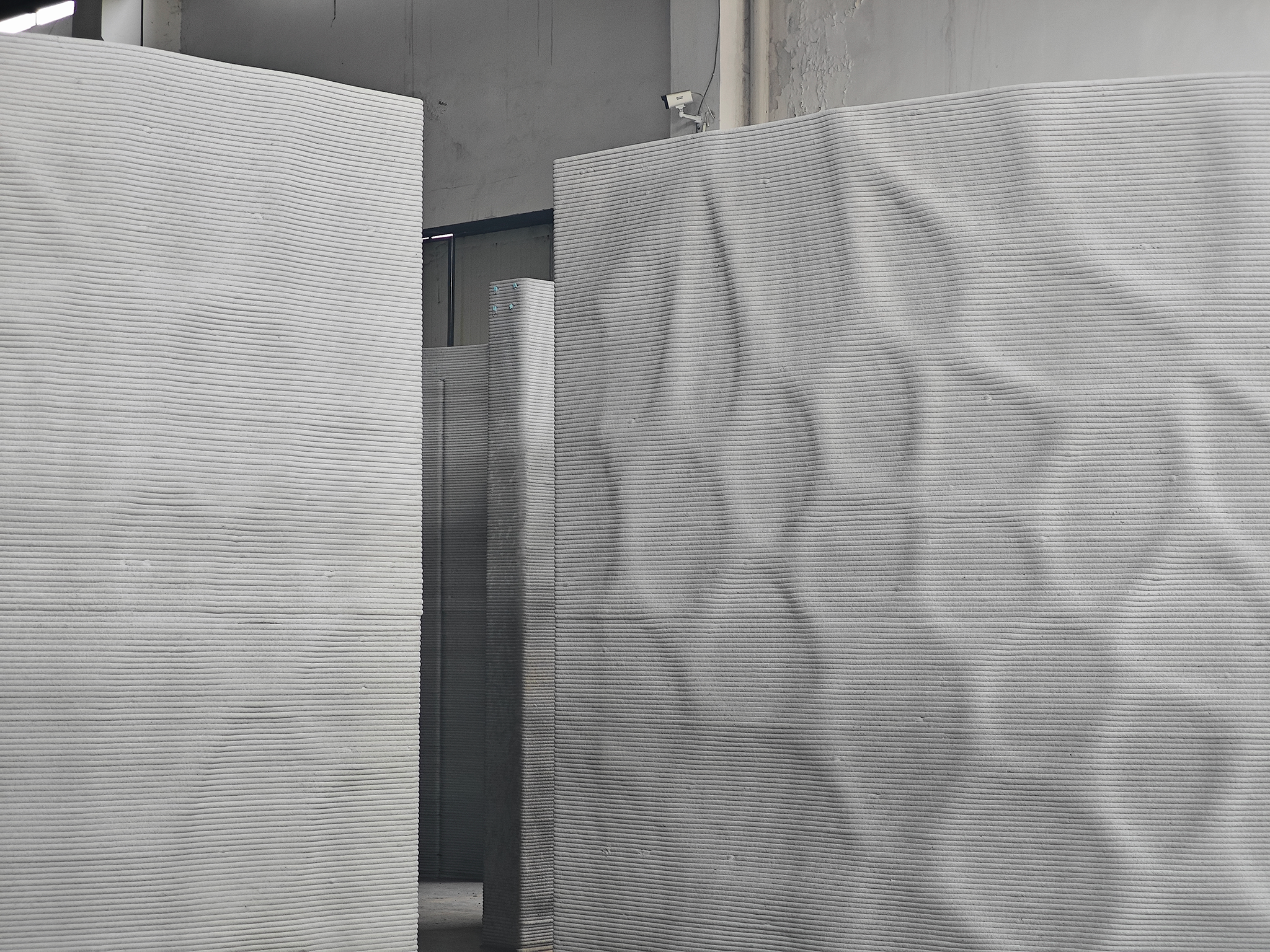
From coastal cultural tourism towns and affordable housing clusters to emergency shelters in remote areas, 3D-printed construction worldwide has evolved from conceptual demonstrations to mass delivery. Its appeal is self-evident: shorter construction cycles, reduced labor demand, flexible architectural forms, and controllable material usage. These strengths become even more prominent in markets plagued by high labor costs and lengthy building material supply chains.
Nevertheless, for property owners, developers and general contractors, the core bottleneck in decision-making lies not in the technology itself, but in the cooperation model: should enterprises purchase or lease printing equipment to carry out in-house production, or outsource the entire design and printing workflow as a full-service package for asset-light project delivery? This paper compares the two cooperation models and introduces the integrated one-stop solution of a professional 3D construction printing service provider.
Core Takeaway: Adopting a service-first approach for initial project rollout followed by long-term equipment deployment delivers the lowest-risk market entry path; self-owned equipment becomes the ultimate solution for large-scale, long-term industrial layout.
Model 1: Equipment Purchase & Leasing – Bringing Production Capacity to Project Sites
1.1 Definition of the Model
The equipment model allows clients to purchase or lease 3D construction printing equipment, deploy the machinery at project locations, and establish on-site printing production lines for independent manufacturing. The mainstream equipment supports modular split transportation, alongside flexible short-term rental, long-term rental and rent-to-own schemes, supplemented by remote commissioning, on-site operator training and spare parts supply.
1.2 Ideal Clients for This Model
Long-term developers and general contractors with consistent project pipelines aiming to build sustainable production capacity and cost advantages;
Public sector project operators undertaking government-led affordable and low-cost housing programs characterized by tight deadlines, large construction volumes and repetitive unit layouts;
Engineering firms seeking to differentiate their service offerings via in-house 3D printing capabilities;
Local enterprises and institutions looking to master core manufacturing processes and build indigenous technical teams.
1.3 Advantages and Drawbacks
Advantages
Once equipment is owned, the unit printing cost decreases with growing project volume, with particularly pronounced savings for repetitive housing developments. Enterprises gain full control over production capacity without relying on external service providers’ scheduling. Localized equipment deployment and process refinement over long-term regional operations create substantial competitive moats.
Drawbacks
Significant upfront entry costs include equipment shipping expenses, import tariffs and local compliance certifications (such as CE marking and regional safety standards). Clients must recruit and train local operational teams, incurring coordination costs stemming from language barriers and skill gaps. Spare parts and technical support depend on cross-border supply chains, which can lead to weeks-long production halts in the event of equipment breakdowns.
Model 2: End-to-End Printing Service – Asset-Light, Rapid Deployment
2.1 Definition of the Model
Under the service model, clients entrust professional 3D construction printing service providers with the full project lifecycle covering design, structural detailing, on-site printing, site construction and final handover. Projects are delivered as a full turnkey package or through joint execution with local construction partners. Clients make milestone-based payments with zero equipment procurement obligations and no need to assemble in-house technical teams.
2.2 Ideal Clients for This Model
First-time entrants testing the market viability of 3D-printed construction locally;
Time-critical emergency projects including disaster relief housing, post-disaster reconstruction and temporary facilities with extremely tight delivery windows;
Operators managing diverse, variable-scale projects unwilling to tie up capital in heavy fixed assets for single developments;
Joint venture consortia aiming to integrate local resources while relying on specialized technical partners for core manufacturing and quality assurance.
2.3 Advantages and Drawbacks
Advantages
No upfront equipment investment eliminates logistics and certification burdens, delivering an ultra-low market entry threshold. Professional teams guarantee delivery quality and on-time completion, making this model ideal for first-time collaborators. Professional service teams possess in-depth knowledge of regional construction codes and cross-disciplinary project coordination, and can assist with design reviews and construction permit negotiations.
Drawbacks
Service fees embed equipment, labor and technology overheads, resulting in higher per-unit costs compared to self-operated production lines for sustained development. Project timelines are subject to the service provider’s schedule. Long-term reliance on outsourcing prevents enterprises from building proprietary production capacity.
Comparative Table of the Two Cooperation Modes
| Comparison Dimension | Model 1: Equipment Purchase / Leasing | Model 2: End-to-End Printing Service |
|---|---|---|
| Upfront Investment | High threshold: equipment cost + ocean freight + import duties + certification fees | Zero equipment expenditure; milestone-based installment payments |
| Deployment Timeline | Extended lead time covering shipping, customs clearance, installation, commissioning and staff training | Immediate project initiation post-contract signing for fast results |
| Local Regulatory Compliance | Client undertakes CE and regional certification for equipment | Service provider coordinates design reviews and construction permit applications |
| Operation & Maintenance Support | Reliant on cross-border spare parts supply chains and remote technical assistance | Full accountability assumed by the service team with clear liability clauses |
| Internal Team Requirements | Mandatory recruitment and training of local operational staff | No in-house technical team required |
| Cost Trajectory | Economies of scale reduce unit costs with more projects; idle equipment generates sunk costs | Stable fixed unit pricing with linearly rising cumulative expenses |
| Applicable Scenarios | Long-term market cultivation within a single region | First market trials, emergency construction, rotation of diverse small-to-medium projects |
Four Core Strategic Considerations Before Project Launch
Evaluate demand sustainability: Without a pipeline of projects spanning over three years, equipment investment will face severe payback pressure.
Calculate full-lifecycle costs: Equipment certification, customs clearance, local labor and permit expenses often exceed the base equipment quotation and must be incorporated into total cost assessments.
Verify operation and maintenance commitments: Owning equipment without trained operators poses greater risks than outsourcing production; formal training and maintenance guarantees must be stipulated in contracts.
Assess delivery track records: Construction codes vary drastically across regions; the service provider’s proven track record of comparable projects directly determines delivery success.
Answering these four questions will clarify the optimal path: start with full-service delivery for market validation, then transition to equipment ownership for long-term industrial expansion.
AiUltraprod’s Integrated One-Stop Cooperation Solutions
AiUltraprod uniquely enables flexible mixing of equipment and service solutions to match project-specific needs:
Equipment Division: Complete machine delivery, modular split transportation, dedicated support for local certification and customs clearance guidance;
Leasing Division: Customizable short-term, long-term and rent-to-own arrangements to accelerate market entry and offset equipment costs via project revenue;
Service Division: Full turnkey solutions covering conceptual design, structural optimization, on-site printing and joint construction handover, with collaborative execution alongside local builders;
Support Ecosystem: Remote fault diagnosis, on-site hands-on training and regional spare parts warehouses to minimize production downtime losses.
Whether you are a property owner, general contractor or enterprise seeking to introduce in-house 3D printing capacity, you may begin with a full-service engagement to test market potential with minimal risk before gradually scaling into self-owned equipment production.
Different Models, Limited Market Windows
The construction industry’s urgent demand for efficiency is transforming 3D-printed construction from an optional innovation into a core competitive advantage. Equipment procurement secures long-term production capacity and enduring market barriers, while service procurement delivers speed, delivery certainty and risk mitigation. Neither model is inherently superior—their suitability hinges on individual business objectives.
If you are currently evaluating a development project, contact AiUltraprod today. We will deliver data-backed comparative financial projections for both equipment and service solutions tailored to your project location, timeline and budget, enabling objective, fact-based decision-making rather than speculative assumptions.