
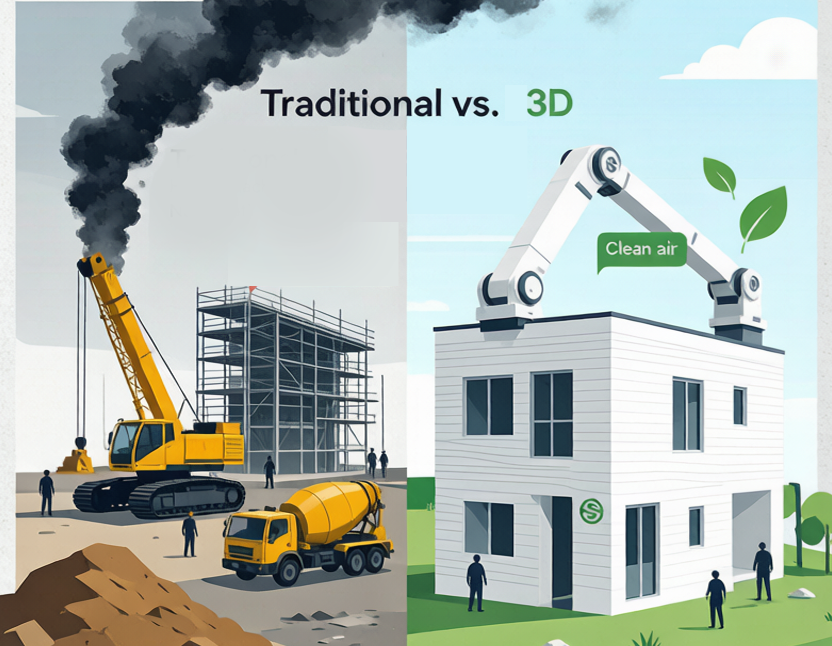
One-sentence conclusion: Yes, and the emission reduction margin far exceeds expectations. In terms of full-life-cycle carbon emissions, 3D-printed buildings deliver a 25%–60% reduction compared with conventional construction methods. This is not merely incremental improvement, but a fundamental paradigm shift in the construction industry.
I. The Construction Sector: An Overlooked Major Carbon Emitter
Before analyzing whether 3D-printed ADUs can slash carbon output, we must first grasp the scale of the problem.
Data from the United Nations Environment Programme (UNEP) indicates construction and building operations account for roughly 37% of global CO₂ emissions. Cement production alone contributes 8% of worldwide carbon emissions—if the cement sector were a sovereign nation, it would rank as the world’s third-largest carbon emitter, trailing only China and the United States.
As a critical supplement to global housing supply in recent years, ADUs (Accessory Dwelling Units) stand out as the most promising application scenario for 3D printing technology. They feature moderate volume, relatively standardized structures, and high sensitivity to construction speed and cost—areas where the strengths of 3D printing perfectly align with carbon reduction logic.
| Emission Source | Share of Construction Carbon Emissions | Substitution Potential of 3D Printing |
| Building material production (cement/steel) | ~80%–90% | ★★★★★ Extremely High |
| Energy consumption during construction | ~5%–10% | ★★★★ High |
| Material transportation | ~5%–10% | ★★★ Medium |
| Construction waste generation | 600 million tons annually across the U.S. | ★★★★★ Extremely High |
II. Where Do Carbon Emissions from Traditional Buildings Originate?
To understand carbon mitigation, we first identify carbon emission hotspots.
2.1 Building Material Production: The Largest Hidden Carbon Source
80%–90% of carbon emissions from conventional buildings stem from the production phase of construction materials, also known as embodied carbon. Taking a 100 m² residential unit as an example:
- Conventional construction: Total emissions of 50–70 tons CO₂eq
- Optimized-formula 3D printing: Only 20–30 tons CO₂eq
- Up to 60% carbon emission reduction
2.2 Construction Phase: Low Efficiency Equals High Carbon Footprint
- Material waste: Traditional construction generates 25%–30% material waste on average; precision extrusion in 3D printing keeps waste below 5%
- Construction timeline: Conventional builds take 4–8 months; 3D-printed wall assemblies are completed in just 2–4 weeks
- On-site energy use: 3D printing can cut construction energy consumption by up to 50%
2.3 Formwork and Design Limitations
Traditional construction relies heavily on timber and steel formwork, whose manufacturing and disposal generate substantial carbon emissions while restricting geometric design flexibility. 3D printing eliminates the need for formwork, meaning curved and linear geometries consume identical volumes of materials and labor hours.
III. Four Dimensions of Carbon Reduction via 3D-Printed ADUs
Dimension 1: Material Innovation – Carbon Reduction at the Source
This constitutes the most fundamental carbon-cutting advantage of 3D printing. Printable mortar (“ink”) enables flexible formula tuning, a capability unavailable to conventional concrete.
| Innovative Material Solution | Carbon Emission Reduction Margin | Technical Maturity | Representative Cases |
| Fly ash/blast furnace slag as cement replacement | 10%–30% reduction | Commercially Mature | Commercialized globally |
| Recycled glass powder replacing 60% of cement | 52% reduction | Pilot Testing Stage | National University of Singapore (compressive strength > 50 MPa) |
| Geopolymer concrete | 70% reduction | Early Commercialization | Chinese enterprise WinSun |
| Biochar-reinforced concrete | 8%–18% reduction via formula + 25% operational emission cut | Research Stage | Pacific Beach, California, U.S. |
| Recycled concrete powder replacing 50% of cement | Significant emission reduction | Experimentally Validated | 2025 experimental data |
AiUltraprod’s G02 Circular Ink Solution
- Technical pathway: Industrial & construction solid waste → recycled sand → G02 printable ink
- 61% lower carbon emissions compared with traditional cement-based materials
- Each structural component avoids 504 kg of CO₂ emissions
- Annual emission reduction potential of 98,000 tons at scale
Dimension 2: Precision Construction – Eliminate Material Waste
Traditional construction adopts subtractive manufacturing: large concrete pours are cut and polished post-cast, inherently generating massive waste. 3D printing employs additive manufacturing, extruding material only where structurally required.
Real-world project data:
- France’s ViliaSprint² Project: Material waste dropped from 10% to under 5%, with optimized curved geometries cutting total concrete consumption by approximately 10%
- Industry average benchmark: 3D printing waste <5%, versus 25%–30% for traditional construction
Material waste reduction alone cuts the embodied carbon of 3D-printed buildings by roughly 20%.
Dimension 3: Structural Efficiency – Less Material, Superior Performance
The design freedom of 3D printing enables topology-optimized structures that place material precisely at high-stress zones, unconstrained by conventional formwork limitations.
- Conventional rectangular design logic wastes material on non-load-bearing sections
- Biomimetic hollow structures (e.g., honeycomb infill) reduce material usage by 30%–40% while maintaining equivalent structural strength
- Research data from Southeast University: 3D-printed buildings emit approximately 190 kg CO₂ per square meter, compared with 313.7 kg for cast-in-place homes and 267.73 kg for prefabricated residential buildings—a 39% reduction against cast-in-place construction
Dimension 4: Full-Life-Cycle Energy Efficiency – Emission Cuts Beyond Construction
Carbon mitigation must be evaluated through a full Life Cycle Assessment (LCA).
Comparative 50-year full-life-cycle emissions for an 800 sq ft (~74 m²) ADU:
| Emission Source | Conventional Construction | Low-Carbon Formula 3D Printing | Emission Reduction |
| Embodied carbon from building materials | 5,230 kg CO₂eq | 8,135 kg CO₂eq* | N/A |
| 50 years of operational energy consumption | 31,350 kg CO₂eq | 23,512 kg CO₂eq | -25% |
| Mid-lifecycle maintenance | 2,500 kg CO₂eq | 0 kg CO₂eq | -100% |
| Total 50-year emissions | 39,080 kg CO₂eq | 29,147 kg CO₂eq | -25.4% |
*Note: This low-carbon formula incorporates biochar and other innovative materials, resulting in higher initial embodied carbon yet substantial operational energy savings. For real-world projects utilizing AiUltraprod’s G02 Circular Ink (61% carbon reduction), embodied carbon will also be drastically lower than conventional builds.
What does a 25.4% full-life-cycle carbon reduction mean for a single ADU?
- Equivalent to removing carbon emissions from passenger vehicles traveling 24,700 miles
- Equivalent to avoiding the combustion of 4.5 tons of coal
- Equivalent to carbon sequestration from 164 saplings growing over a decade
IV. AiUltraprod: Rebuilding Construction Logic via Circular Economy
If 3D printing cuts carbon emissions through construction methodology, AiUltraprod’s G02 Circular Ink delivers deeper transformation by redefining raw material sourcing.
4.1 Closed-Loop Circular Construction Value Chain
Solid waste (construction debris, industrial waste)
↓
Recycled sand (mechanical crushing & sorting)
↓
Formulated G02 printable ink
↓
3D printing construction (AiUltraprod Platform + all-terrain tracked construction robots)
↓
Public facilities / commercial installations (landscape walls, furniture, drainage channels, planters, pedestrian bridges, etc.)
↓
(Post-end-of-life: reintroduced back into solid waste recycling loops)
4.2 Validated Carbon Reduction Data
- 61% lower carbon emissions: G02 Circular Ink vs. conventional cement-based materials
- 504 kg CO₂ avoided per standard landscape wall component
- 98,000 tons of annual CO₂ emission avoidance potential at full commercial scale
4.3 All-Terrain Tracked Construction 3D Printing Robots
The foundational prerequisite for carbon reduction is buildability. AiUltraprod’s self-developed all-terrain tracked construction 3D printing robots feature:
- Three-layer closed-loop attitude compensation: Ensures printing precision and minimizes rework and material waste from dimensional errors
- Integrated perception positioning: Intelligent path planning to cut idle travel energy consumption
- Terrain-adaptive slicing: Eliminates the need for site grading, reducing carbon emissions from site preparation activities
4.4 AiUltraprod Platform: Cutting Carbon Footprints Starting at the Design Stage
AiUltraprod’s AiUltraprod Platform generates preliminary design drafts from project requirements in just five minutes. Beyond efficiency gains, this delivers tangible carbon benefits:
- Printing simulation and full-process management: Precisely calculate material volumes at the design phase to eliminate overstocking common in traditional construction
- Standardized SKU component library: Reduces repetitive design work and improves material reusability
- Digital collaborative workflows: Cut rework and material waste stemming from communication gaps
V. Comparative Carbon Emission Overview: 3D-Printed ADUs vs. Conventional Builds
| Comparison Metric | Conventional Construction | 3D-Printed ADU | Reduction Margin |
| Total carbon emissions for a 100 m² residence | 50–70 tons CO₂eq | 20–30 tons CO₂eq | 40%–60% |
| Carbon emissions per square meter | ~314 kg CO₂eq | ~190 kg CO₂eq | ~39% |
| Carbon emissions during material production phase | Baseline | -15.97% | ~16% |
| Material waste rate | 25%–30% | <5% | >80% |
| Construction timeline | 4–8 months | 2–4 weeks | >75% |
| On-site construction energy consumption | Baseline | -50% | ~50% |
| Formwork usage | Heavy timber/steel consumption | Zero formwork | 100% elimination |
| Labor demand for complex components | Baseline | -40% | ~40% |
| 50-year full-life-cycle carbon reduction | Baseline | -25.4% | ~25% |
| Carbon reduction via optimized low-carbon material formulas | Baseline | -52% to -70% | 52%–70% |
VI. A Real-World Carbon Reduction Case Study
Let us quantify the carbon balance of a real-scale ADU project:
- Project scope: 74 m² (800 sq ft) 3D-printed ADU
- Construction material: AiUltraprod G02 Circular Ink (61% carbon reduction vs. traditional cement)
- Construction equipment: All-terrain tracked 3D printing robot
Embodied Carbon Calculation
- Conventional construction embodied carbon (walls + foundation): ~5,230 kg CO₂eq
- Embodied carbon after applying G02 ink’s 61% emission cut: ~2,040 kg CO₂eq
- 3,190 kg CO₂eq eliminated solely from material selection
Construction-Phase Carbon Savings
- Zero formwork + precision printing cuts material waste by over 20%
- 75% shorter construction timeline reduces carbon emissions from equipment operation
- Minimal on-site labor requirements cut indirect carbon output from personnel transportation
Operational Carbon Savings
- Superior thermal performance of 3D-printed wall assemblies
- 15%–25% reduction in annual operational energy consumption
Comprehensive estimation: A 3D-printed ADU constructed with AiUltraprod’s G02 Circular Ink achieves a 35%–50% total carbon reduction across its 50-year service life.
VII. Challenges & Future Outlook: Beyond Carbon Reduction – What Remains to Be Proven?
Frankly speaking, the carbon reduction journey for 3D-printed ADUs faces notable hurdles.
| Challenge | Explanation | Mitigation Strategies |
| High upfront capital costs | 3D printing equipment investment ranges from 180,000 to 400,000+ currency units | Equipment mass production + equipment rental models |
| Lack of standardized printing mortar specifications | No unified industry standards for printable construction ink | Industry alliance coordination + policy standardization initiatives |
| Incomplete building code certification | Global building regulatory frameworks have not fully incorporated 3D printing construction | Accumulate performance data via pilot demonstration projects |
| Insufficient long-term structural durability data | Limited multi-decade performance testing records | Accelerate long-term material and structural aging tests |
| Unstable low-carbon ink raw material supply chains | Inconsistent access to solid waste feedstock for circular printing mortar | Develop regional closed-loop raw material supply chains |
Key Industry Trends for 2026
- California has pioneered mandatory embodied carbon disclosure for new construction under CALGreen, with targets of 20% emissions reduction by 2030 and 40% by 2035
- The National University of Singapore has validated the technical feasibility of replacing 60% cement with recycled glass powder
- France’s ViliaSprint² multi-unit residential project demonstrates the potential for ~60% on-site energy self-sufficiency via 3D printing
- LCA research from Southeast University confirms a 39% carbon reduction for 3D-printed buildings versus cast-in-place construction
- The global 3D construction printing market is projected to reach $1.5 billion by 2030
VIII. Conclusion: From Technical Feasibility to Industry Adoption
Returning to the core question: Can 3D-printed ADUs truly lower building carbon emissions?
The answer is not a simple yes or no, but quantifiable proof of transformative carbon mitigation:
- At the material level, innovative printable formulations deliver 52%–70% carbon emission cuts
- At the construction level, precision extrusion and formwork-free workflows reduce emissions by 15%–40%
- Across the full building life cycle, integrated carbon reduction ranges from 25% to 60%
More importantly, AiUltraprod’s G02 Circular Ink proves carbon reduction does not demand performance tradeoffs. Instead, it establishes an entirely new technical pathway: leveraging industrial and construction solid waste as feedstock, centered on circular economy logic, and powered by digitalization—turning every 3D-printed building into a net-positive contribution to carbon accounting.
The global construction sector consumes over 60 billion tons of building materials annually, nearly one-third of which ends up landfilled or incinerated as waste under the prevailing linear economic model. Against this backdrop, the carbon reduction value of 3D-printed ADUs extends far beyond marginal emission cuts; it fundamentally reimagines the circular material flow of “construction – occupancy – recycling.”
The industry is shifting from debating whether 3D-printed ADUs can cut carbon to proving they are worth widespread adoption—and the data delivers an increasingly compelling case.
This whitepaper is compiled by the AiUltraprod research team based on public academic literature, industry reports, and proprietary project datasets. Data sources include the United Nations Environment Programme (UNEP), Southeast University LCA research, National University of Singapore (NUS) 3D concrete printing studies, Potsdam Institute for Climate Impact Research (PIK), California CALGreen building codes, France’s ViliaSprint² project, Holcim TectorPrint technical whitepapers, and U.S. EPA construction waste reports. For citation requests, contact AiUltraprod to obtain the full reference bibliography.
About AiUltraprod
AiUltraprod specializes in digital construction platforms for 3D printing and commercial space installation applications. Core products include the AiUltraprod digital construction platform, standardized SKU component library, G02 Circular Ink, and all-terrain tracked construction 3D printing robots. The platform generates preliminary design drafts from project requirements in five minutes, integrating printing simulation and full-process project management to deliver a complete closed-loop circular construction chain: solid waste → recycled sand → G02 printable ink → 3D printing construction → public infrastructure.