
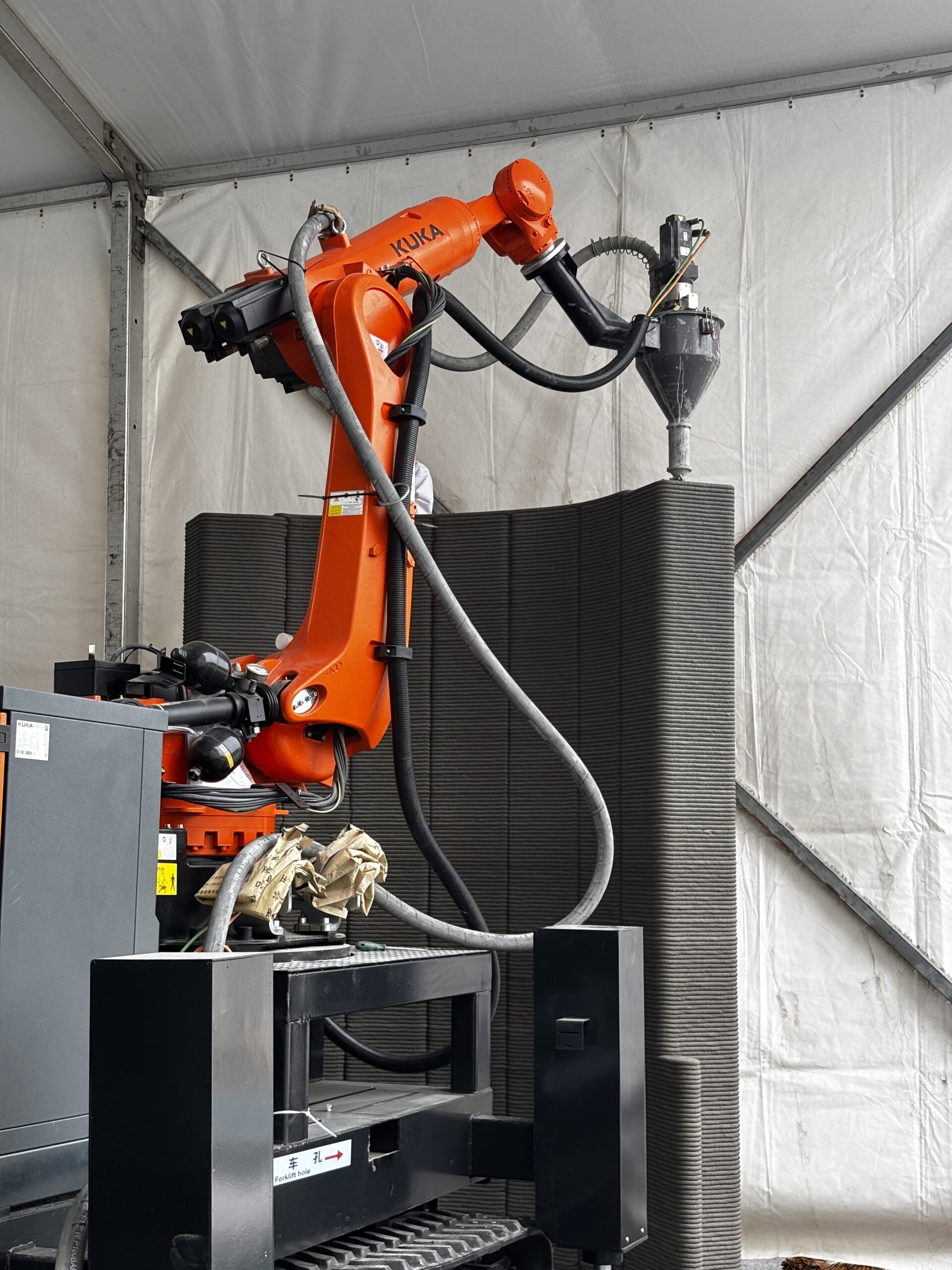
Quick Key Takeaways (30-second Overview)
- 25%–40% lower overall costs: For an 80㎡ single-family home, total construction cost of 3D-printed structures (walls + foundation) is RMB 120,000–160,000, saving RMB 50,000–80,000 versus traditional brick-concrete buildings.
- 50%–70% shorter construction timeline: Wall printing only takes 24–48 hours; full project handover is compressed from 3–6 months to 30–60 days.
- Material waste below 3%: Conventional construction generates 15%–25% material waste on-site, while precision extrusion of 3D printing cuts scrap rate to under 3%.
- Over 60% less on-site labor: One set of printing equipment plus 2–3 workers can complete wall construction work that otherwise requires 10–15 laborers.
Cost Breakdown: Where Exactly Does 3D Printing Deliver Cost Savings?
A prevalent question is whether 3D-printed housing costs less than conventional builds, and savings can be itemized clearly. The cost comparison below references single-story brick-concrete residential buildings, split into core expense categories:
| Cost Component | Traditional Brick-Concrete Construction | 3D Concrete Printing | Cost Variation |
| Wall Material Cost | Red bricks/blocks + mortar: RMB 180–250/㎡ | Specialized concrete/mortar: RMB 120–180/㎡ | Down 25%–35% |
| Labor Cost | 10–15 masons & plasterers over 15–30 working days | 2–3 equipment operators & assistants over 2–3 days | Down 60%–80% |
| Formwork & Auxiliary Materials | Large quantities of disposable/low-reuse timber or steel formwork | Formwork-free construction, near-zero expenditure | Down over 90% |
| Construction Machinery | Batch billing for concrete mixers, hoisting equipment by working shifts | Fixed leasing cost for core 3D printing unit & pumping system | Flat or slightly higher |
| Waste Disposal Cost | Rubble & leftover mortar haulage: RMB 15–25/㎡ | Minimal leftover materials, negligible disposal fees | Down over 80% |
| Total Wall Construction Cost | RMB 500–750/㎡ | RMB 300–480/㎡ | Down 30%–40% |
Two Critical Preconditions for Cost Savings
- The aforementioned savings apply primarily to wall fabrication. Foundation, roofing, doors & windows, plumbing & electrical fitting and interior decoration incur nearly identical costs as traditional construction; these items account for most total project spending. Therefore, overall building cost only drops by 20%–30% (varying with wall cost proportion), rather than a full 40% discount.
- 3D-printing construction equipment represents reusable high-value assets instead of one-off capital outlay for contractors. Equipment depreciation is spread across successive projects, driving down marginal unit costs. This cost-reduction trend has been proven on projects including Ningbo Bay Building Cluster and Dali Wanhuaxi Bridge completed by AiUltraProd, with falling incremental expenses from continuous equipment deployment.
Construction Cycle Comparison: From Months to Days with 3D Printing
Schedule gaps stem from inherent bottlenecks in conventional building workflows instead of raw printing speed.
Traditional construction follows sequential processes where subsequent work waits for prior procedures: wall masonry cures before plastering, and plaster dries for inspection. Wall work alone takes 15–30 days; rainfall, labor shortages or material delays easily hold up the whole schedule.
By contrast, 3D printing equipment supports uninterrupted continuous operation, based on AiUltraProd’s field-proven construction system:
- Exterior & partition wall printing for an 80㎡ house: 5–6 consecutive days
- Post-print material curing: 3–7 days (roof installation and embedded MEP prefabrication proceed concurrently during curing)
- Full project handover: 40–75 days for 3D printing vs 90–180 days for traditional construction
| Construction Stage | Traditional Duration | 3D Printing Duration | Timeline Reduction |
| Foundation | 7–15 days | 7–15 days | No change |
| Wall Erection | 15–30 days | 6–7 days | Down 80%–90% |
| Roof & Structural Works | 10–20 days | 10–20 days | No change |
| MEP & Interior Finishing | 30–60 days | 25–50 days | Down 15%–20% |
| Total Project Period | 90–180 days | 40–75 days | Down 50%–70% |
Conventional construction is highly weather-sensitive with suspended work during rain or low winter temperatures, whereas 3D printing proceeds uninterrupted under controlled ambient conditions. The advantage is prominent in rainy regions such as Yunnan, Sichuan and Chongqing, verified via multiple AiUltraProd projects across Yunnan Province.
Material Waste Rate: 3% vs 20% – The Overlooked Hidden Expense
Uncontrolled construction material waste creates persistent invisible financial losses industry-wide. While China’s Ministry of Housing and Urban-Rural Development (MOHURD) codes set regulated concrete waste at 1.5%–2%, actual on-site wastage hits 15%–25% due to excess concrete mixing, broken bricks and discarded fallen mortar.
3D printing limits waste below 3% via computerized precision material extrusion, dispensing concrete strictly per pre-programmed layout with no surplus mixing, unused brick cutoffs or wasted plaster.
| Waste Category | Traditional Construction Rate | 3D Printing Rate | Remarks |
| Concrete & Mortar | 15%–20% | 2%–3% | Precise on-demand extrusion eliminates excess mixing waste |
| Bricks & Blocks | 5%–8% | 0% | Brick-free construction |
| Timber Formwork | Single-use or 3–5 recycling cycles | 0% | Formwork-free technology |
| Other Auxiliary Supplies | 3%–5% | <1% | Dramatic material cutback |
| Overall Material Waste | 15%–25% | <3% | Over 80% reduction in construction scrap |
Beyond cost savings, low material wastage boosts environmental performance aligned with China’s dual-carbon goals and green building standards, offering inherent merits for projects pursuing LEED or Chinese Green Building certification.
Data sources for waste comparison: McKinsey’s The Next Normal in Construction, MOHURD’s Guidelines for Green Construction Technology and official industrial whitepapers on construction 3D printing.
Comprehensive Comparison Table
| Comparison Item | Traditional Brick-Concrete Build | 3D Concrete Printed Build | Core Conclusion |
| Unit Wall Construction Cost | RMB 500–750/㎡ | RMB 300–480/㎡ | 30%–40% cost cut |
| Total Building Cost | Baseline reference | Down 20%–30% | Excludes foundation and interior finishing |
| Wall Construction Duration | 15–30 days | 6–7 days | 55%–80% schedule reduction |
| Full Delivery Timeline | 90–180 days | 40–75 days | 45%–65% shorter |
| Overall Material Waste | 15%–25% | <3% | Over 80% waste reduction |
| Required On-site Manpower | 10–15 workers | 2–3 workers | Over 60% labor cut |
| Design Flexibility | Restricted by formwork & masonry limits | No extra cost for curved/free-form facades | Significant edge for 3D printing |
| Applicable Scenarios | All conventional buildings | Residential, landscape, municipal engineering & post-disaster emergency housing | Rapidly expanding application scope |
Supplementary Notes on Statistical Data
Construction 3D printing is an evolving fast-growth sector with continuous upgrades in material formulations, equipment efficiency and project scale; current industry benchmarks will likely become outdated with ongoing technological progress.
Should you require customized project costing and technical assessment for construction planning, submit land area and functional requirements via email: info@aiultraprod.com. Our engineering team delivers targeted calculation reports within 48 working hours.
Data Citation List
- Grand View Research – 2025 Global Construction 3D Printing Market Report
- McKinsey & Company – The Next Normal in Construction
- MOHURD PRC – 2024 Edition Construction Cost Index
- MOHURD PRC – Standard Bill Quantity Valuation Specification for Construction Projects
- MOHURD PRC – Guidelines for Green Construction Technology
- Dubai Municipality – 2023 Report on 3D Printing Application in Dubai’s Construction Sector
- COBOD Official Technical Documents
- China Green Building Evaluation Standard
- LEED (Leadership in Energy and Environmental Design) Certification System