
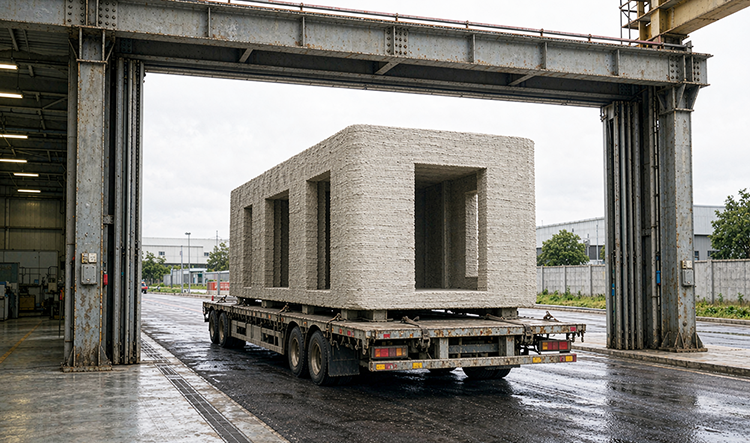
In the first days after a disaster, emergency housing is constrained by time rather than floor area. The claim that circulates most widely, “a printer delivers a shelter in 72 hours”, conflates four clocks: printing, on-site finishing, approval, and machine access. Checking each against published project data shows which one the 72 hours belongs to.
Single-Storey Wall Printing Lands Between 18 and 40 Hours
Published figures agree closely. The community housing programme in Tabasco, Mexico, built by New Story with ICON and ÉCHALE, prints a 46.5 m² unit in about 24 hours of net printing. The two-bedroom houses at Kilifi, Kenya, print their walls in 18 hours. At Lviv, Ukraine, a single-storey school building initiated by Team4UA and printed by 3DCP Group on a COBOD machine ran 40 hours of continuous facade printing.
The run that comes closest to 72 hours happened in a military setting. In January 2023 the US Marine Corps, the Defense Innovation Unit and ICON demonstrated the technology at Camp Pendleton: eight Marines with almost no engineering background were trained and then operated a Vulcan printer independently, completing a 26 ft by 13 ft by 15 ft vehicle hide in 36 hours. What they produced, however, was a hide, not a dwelling.
Extrusion of single-storey walls therefore falls within an 18 to 40 hour band, and that is the segment the 72-hour figure describes.
The Fit-Out That Follows Is Still Measured in Weeks
Printing is not the same as handing over a key. At Fianarantsoa, Madagascar, the walls went up in 18 hours, after which finishing and installation took 12 days, for three weeks in total from site access to delivery. The Lviv school is clearer still: printing ended within three days, and doors, heating and painting followed, a stage the project team described as requiring several months. In that same project the printed walls are not load-bearing; vertical loads are carried by columns built conventionally. The arrangement is part of why printing is fast, and it also shows how much conventional work sits between a printed wall and a habitable room. Modular printed housing follows the same shape: roughly one day of printing, then four to fifteen days of interior fit-out.
Emergency Units Are Far Smaller Than Conventional Homes
Whether a shelter unit is adequate has a published benchmark. Sphere’s Humanitarian Charter and Minimum Standards and UNHCR’s shelter guidance use the same indicator: a minimum of 3.5 m² of covered living space per person in warm climates, rising to 4.5 m² in cold climates, excluding cooking, bathing and sanitation areas. Set against that, the Mexican units measure 46.5 m², the Kenyan two-bedroom houses 56 m², and two villages in Guntur district, Andhra Pradesh, are planned at 25 m² and 32 m². Emergency shelter is small and its drawings repeat, which is where printing performs well. Shrink a unit to 20 or 30 m², though, and the fixed trades of foundations, services and fit-out do not shrink proportionally, so the share of programme time that printing saves falls with it.
Three Routes That Make 72 Hours Possible
The first is to print components in a factory and assemble on site. The bicycle bridge at Gemert, in the Netherlands, was printed as eight one-metre segments and assembled on arrival, which allows transport and printing to overlap. The second is to run printing in parallel with foundations and services: modular printed projects substitute screw piles for conventional footings, so site work and factory production proceed together. The third is to repeat the same drawing, which dilutes the fixed cost of calibration, trial runs and operator training. One machine in Kenya printed ten units in ten weeks; in Denmark the last of thirty-six apartments across six buildings took five days. Lviv shows the same fixed cost from another angle: three trucks carried the printer from Denmark to Ukraine.
Approval, Site Access and Verification: Three Thresholds You Cannot Skip
Approval comes first. The established US route is ICC-ES Acceptance Criteria AC509, handled as an alternative means and method under Section 104.11 of the International Building Code, with full-scale testing for each wall configuration and mix. UL 3401 is an outline of investigation and carries less weight than a full standard; Appendix BM of the 2024 International Residential Code explicitly excludes concrete printing; ISO/ASTM 52939 omits the safety and environmental aspects of operating the equipment. Every project still needs its own approval, and the time that consumes is what an emergency response does not have.
Site safety and structural limits impose two more. OSHA 29 CFR 1926.706 requires a restricted zone around masonry walls equal to the wall height plus 4 ft (about 1.22 m), a rule that covers green printed walls. Suiker’s 2018 critical buckling length, 0.276 m in the model and 0.304 m in the experiment, sets a ceiling on how fast a wall can rise. Dubai remains the only jurisdiction that certifies the printer itself as well as the building, requiring registration and machine certification. Verification figures are equally fixed: interlayer bond strength typically reaches 60% to 85% of monolithic concrete and declines as the interval between layers lengthens, while print direction shifts compressive strength by 20% to 30%.
Conclusion
Seventy-two hours can produce the walls of a single-storey emergency unit, and the 36-hour run stands as a reference ceiling, even though what it produced was a vehicle hide rather than a dwelling. Under a habitable-delivery definition, three conditions have to hold at once: the printed elements must not occupy site time, the drawings must be reusable, and the approval and verification route must already be open before the disaster occurs. Miss any one of them and the extra time does not sit with the printer.