
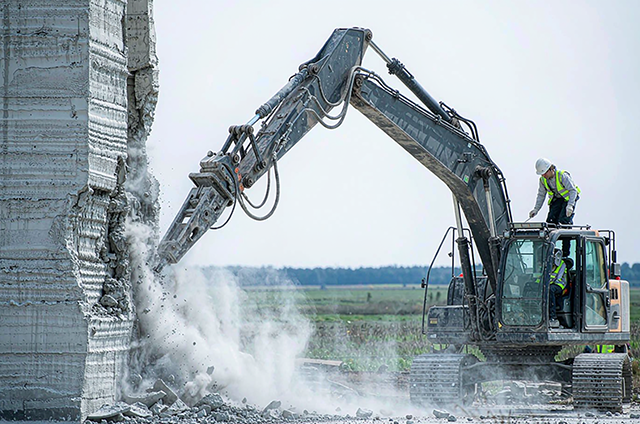
When a 3D‑printed building reaches the end of its service life, its demolition waste differs from that of conventional masonry buildings. There are no bricks or mortar joints; instead, walls are monolithic units formed by layer‑by‑layer extrusion. While this delivers advantages during construction, it poses challenges at the demolition stage: how should such material be dismantled, what can be produced from demolished debris, and can it be reused in new printing mixtures?当一座3D打印建筑达到其使用寿命的终点时,其拆除废弃物与传统砌体建筑截然不同。其中既没有砖块,也没有砂浆接缝;取而代之的是通过逐层挤出成型的整体现浇墙体。这种建造方式在施工阶段颇具优势,但在拆除环节却带来了诸多挑战:这类材料应如何拆解?拆除后的废料又能制成哪些产品?又能否将其再用于新的打印混合料中?
Waste Generation Starts Even Before Demolition
Waste from 3D‑printed buildings does not emerge only upon demolition. A field‑test study tracked material flows for three printed panels weighing 250 to 300 kilograms each across different work phases. Total waste accounted for 11 %‑14 % of input materials, and could drop to 7 %‑10 % under optimal operating conditions. Discarded material consists purely of printing mortar, free of formwork residues or mixed foreign waste, which facilitates on‑line reuse or on‑site crushing. Nevertheless, total waste volume is not inherently low; waste rises alongside trial‑and‑error efforts before process stabilisation.3D打印建筑的废弃物并非仅在拆除时产生。一项现场试验研究追踪了三块单重250至300千克的打印构件在不同施工阶段的材料流动情况。总体废弃物占投入材料的11%至14%,在最佳运行条件下可降至7%至10%。废弃材料仅由打印砂浆构成,不含模板残留物或混入的其他杂质,便于在线再利用或现场破碎。然而,总体废弃物量并未因此显著降低;在工艺稳定化之前,随着反复试验与摸索,废弃物量仍会持续增加。
Demolition Challenges: Monolithic Printed Walls
Conventional masonry or frame buildings are demolished component‑by‑component, with bricks, blocks and doors‑windows removable along existing joints. Printed walls have no such joints. Formed through in‑situ layer‑by‑layer extrusion, they form continuous monolithic structures, so demolition resembles cutting and crushing solid concrete. Reinforcing elements such as steel bars, mesh or steel sections embedded in walls must first be separated. As of 2024, roughly 150 buildings worldwide have been constructed using printed concrete. Therefore, demolition‑related findings are mostly derived from laboratory tests and small‑scale pilot projects. Tests confirm that adding lime plaster at a volumetric ratio of approximately 7 % can reduce the compressive strength of recycled concrete by up to 15 %.
Two End‑Use Pathways for Crushed Material
The first pathway feeds waste into conventional concrete. In experiments, crushed printed‑concrete waste was processed into recycled aggregate using jaw crushers and incorporated into C30/37 and C40/50 concrete at replacement ratios of 50 % and 67 %. For C40/50 concrete, both replacement ratios yielded better performance than zero‑replacement mixes. For C30/37 concrete, the 67 % replacement outperformed the reference mix, whereas the 50 % replacement produced inferior results. Another study offers more cautious observations: strength declines at a 100 % replacement ratio, yet increases as replacement rises within the 0‑20 % range.
The second pathway reintroduces crushed material into new printing formulations. This carries higher technical barriers but delivers greater significance. On‑site crushed and screened recycled aggregate can be custom‑tailored for new mixes, lowering demand for virgin aggregate. Mortar prepared with 100 % recycled fine aggregate can still achieve print‑suitable consistency and meet 28‑day strength requirements. However, printing imposes strict constraints: water absorption fluctuates across batches, particle‑size distribution must remain stable, and admixtures need adjustment according to replacement ratios. Note: the above‑mentioned performance data applies to converting printing waste into aggregate for ordinary concrete, not to direct reuse within new printing mixtures.
Carbon Accounting Must Extend Beyond Demolition
The decarbonisation potential becomes conditional once the assessment boundary includes demolition. A cradle‑to‑grave life‑cycle assessment shows that optimised schemes can cut total‑life‑cycle carbon emissions by up to 53.1 %. Recycled materials can offset up to 21.8 % of process‑related CO₂, and carbonation during service life can deliver an additional emission reduction of 3.92 %‑7.69 %. Another full‑building assessment reported a smaller margin: embodied carbon of printed walls is roughly 10 % lower than that of blockwork walls. One frequently overlooked point relates to structural composition: printing‑process energy consumption accounts for less than 1 % of wall embodied carbon, while cement contributes approximately 90 %. Hence the climate benefit of end‑of‑life recycling mainly stems from substituting virgin raw materials rather than the demolition process itself.
Half of Recyclability Is Determined at the Drawing‑Board Stage
Recycling potential is often limited not by demolition equipment but by connection details and component partitioning adopted during design. International standards govern design for disassembly and adaptability, covering principles such as easy access, independent components, simple construction, standardised dimensions and connections, as well as material registration via material passports. Three design options are specific to 3D‑printing technology: segment‑by‑segment component printing, reserved cavities and detachable connections at joint zones; adopt post‑installed and removable reinforcement; leverage the natural digital‑traceability capacity of digital construction. At the regulatory level, the updated EU Construction Products Regulation covers 3D‑printed components, taking effect in phases starting January 2026. It requires verified environmental‑performance disclosure and the implementation of digital product passports.
Gaps Preventing a Full Closed‑Loop System
Barriers lie in regulations and market mechanisms. The EU Waste Framework Directive set a target of achieving no less than 70 % weight‑based recycling for construction and demolition waste by 2020. The Sustainable Finance Taxonomy mandates that at least 90 % by mass of non‑hazardous demolition waste (excluding backfilling) must be reused or recycled. Two major bottlenecks persist. First, “end‑of‑waste” criteria for construction‑demolition waste remain under development, and formal pathways for incorporating recycled aggregate into new formulations are not yet institutionalised. Second, procurement clients hesitate due to cost disadvantages and perceived risks associated with recycled materials.
Closed‑loop applications will first materialise in two scenarios: high‑value non‑structural reuse, for example street furniture printed from demolition‑derived material; and pilot modular systems designed for disassembly. Concrete itself can almost entirely be reprocessed into aggregate, and laboratory evidence supports its reintroduction into printing mixes. Nevertheless, “technical recyclability” and “practical implementation of recycling” are distinct concepts. Practical recycling depends on demolition methods, formulation tolerance and connection‑system choices made in design — decisions finalised before building printing commences.