
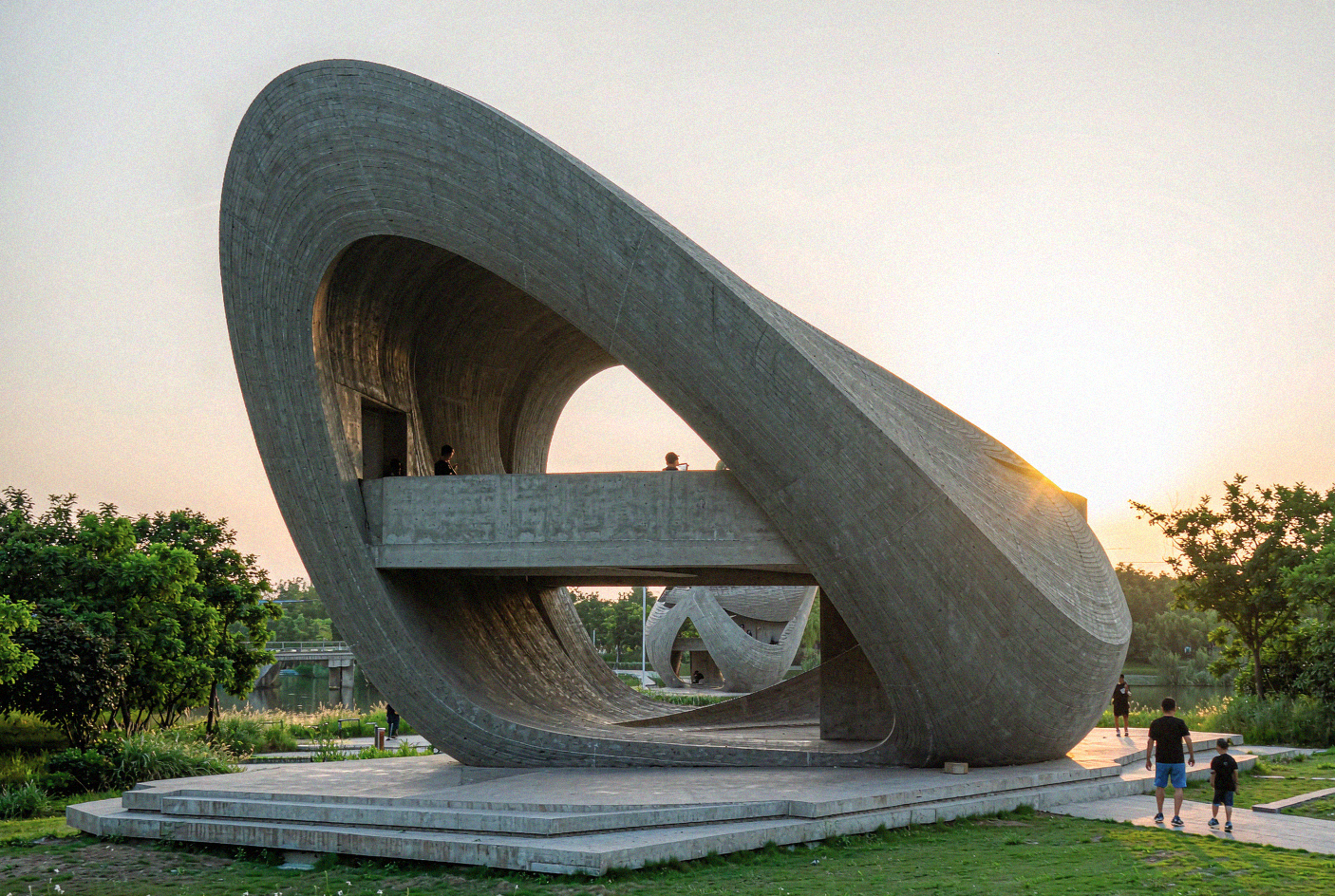
Cast‑in‑place concrete has dominated construction sites for more than a century. Reinforcement binding, formwork erection, concrete pouring and compaction, and curing — this workflow still underpins most projects worldwide. Yet its cost structure is being reshaped: qualified labour is increasingly hard to source, construction schedules are harder to control, and carbon‑emission pressures keep mounting. Meanwhile, 3D‑printed construction is evolving from an experimental concept into a viable construction method, finding its foothold across three major sectors: infrastructure, cultural‑tourism, and real estate.
Long‑standing Drawbacks of Cast‑in‑place Construction Turning into Industry‑Wide Risks
Consider construction schedules first. The pace of cast‑in‑place work is governed by formwork and curing cycles: both erecting and stripping formwork take time. After concrete pouring, strength gain requires waiting, and curing periods double in low‑temperature conditions. Delays in any single link ripple through the whole workflow. Unplanned downtime constitutes a major hidden cost on construction sites.
Next is labour. Labour shortages are no longer a regional issue. A 2025 survey by the Associated General Contractors of America (AGC) showed that 92% of construction firms struggle to recruit qualified workers, and nearly half of contractors cite labour shortages as the leading cause of project delays. Around 41% of the existing construction workforce will reach retirement age by 2031. The industry needs hundreds of thousands of new workers annually, yet young people show little growing interest in site‑based jobs. Shrinking labour supply pushes up wages, which in turn blows project budgets — a cascading chain of consequences.
Material waste is another concern. Cast‑in‑place construction heavily relies on consumable formwork. Materials are over‑procured “just in case”, while disposal costs for surplus and damaged materials are frequently overlooked. It is widely acknowledged across the industry that material utilisation under cast‑in‑place methods falls far short of the ideal “use‑exactly‑what‑is‑needed” standard.
Finally, the environmental footprint. According to the 2025‑2026 Global Status Report for Buildings and Construction published by the United Nations Environment Programme and the Global Alliance for Buildings and Construction, the building and construction sector accounts for approximately 37% of global carbon emissions, 28% of global energy consumption, and nearly half of global raw‑material extraction. The sector is notoriously hard to decarbonise, and cast‑in‑place processes represent one of its most carbon‑intensive segments — cement production itself generates massive emissions.
3D‑Printed Construction: Re‑organising the Building Process
3D‑printed construction operates on a fundamentally different logic from cast‑in‑place work. Instead of erecting formwork, machinery directly extrudes material layer by layer to build wall components based on digital models. The path from design drawing to finished product is shortened, and many labour‑intensive intermediate steps are eliminated.
Formwork and curing‑related waiting are largely eliminated. Printing equipment can operate continuously. Once wall printing is complete, subsequent construction phases can start immediately, with no downtime for formwork removal or curing‑driven hold‑ups. Schedule‑saving margins vary across projects, yet time savings measured in weeks have been repeatedly demonstrated for landscape components and small‑scale buildings.
Material waste is also greatly reduced. Robotic arms extrude materials along pre‑programmed paths with quantities determined by digital models, drastically cutting off‑cuts and leftover waste. Printing mixes incorporating recycled aggregates and industrial solid waste can lower cement consumption at source — a key reason why 3D‑printed construction draws attention for carbon mitigation. Tests by one equipment manufacturer recorded around 61% carbon reduction for certain wall components, equivalent to a cut of approximately 504 kg of carbon emissions per component. Industry research indicates carbon‑reduction rates for 3D‑printed components generally range from 25% to 55%, subject to material formulations and component geometries.
Mechanical performance meets practical requirements. 3D‑printed concrete achieves compressive strengths of 25‑50 MPa, comparable to conventional structural concrete. With integrated reinforcement or pre‑stressing techniques, printed components are now deployed in load‑bearing structures. That said, 3D‑printable concrete requires mix designs distinct from cast‑in‑place concrete, placing higher demands on material engineers — a point elaborated below.
Three Sectors, Three Modes of Market Penetration
Infrastructure Sector: Addressing Hard‑to‑Construct Sites
Linear infrastructure works such as bridges, retaining walls, drainage facilities and slope protection are often located on complex terrain inaccessible to large‑scale plant. Track‑mounted 3D‑printing robots can operate on uneven ground, printing components including culverts and retaining walls on‑site, bypassing prefabrication yards and long‑distance transportation. Multiple completed projects, including landscape and pedestrian bridges, have adopted 3D‑printing for main structural elements, substantially shortening timelines from design to commissioning.
Cultural‑Tourism Sector: A Natural Fit for Custom‑Built Forms
Cultural‑tourism projects thrive on uniqueness: art installations, landscape structures, visitor centres and sun‑shade shelters gain publicity through distinctive shapes. Curved geometries are precisely where cast‑in‑place and brick‑laying become costly and cumbersome: custom‑made special‑shape formwork is required, followed by labour‑intensive post‑casting repairs. 3D‑printing imposes almost no limits on curvature. Walls take shape exactly as modelled, and complex geometries no longer command extreme cost premiums. Small‑scale elements such as landscape benches, planters and water‑feature fittings can be printed individually and deployed rapidly, perfectly matching the fast‑track delivery needs of cultural‑tourism developments.
Real‑Estate Sector: From Auxiliary Dwelling Units to Complete Residential Buildings
Low‑cost housing represents one of the most promising real‑estate applications for 3D‑printing. Dubai targets 25% of all new buildings in the city to adopt 3D‑printing technology by 2030. In the United States, entire residential neighbourhoods have been built using 3D‑printing, where wall assemblies for hundreds of homes are printed unit‑by‑unit. For real‑estate, the value of 3D‑printing lies not only in cost savings but also in delivery certainty and speed. In markets plagued by labour shortages and schedule overruns, “on‑time delivery” itself becomes a competitive advantage.
Realistic Limitations Remain
3D‑printed construction is not a universal solution. Reinforcement placement still largely relies on manual installation or post‑tensioning. Fully 3D‑printed load‑bearing structures for high‑rise buildings await further advances in codes and structural design. 3D‑printable concrete demands specialised mix designs, with far stricter controls over aggregate‑particle size and workability compared with cast‑in‑place concrete. These technical challenges are being actively addressed and partly explain the higher costs seen in early‑stage projects.
Nevertheless, market penetration is underway. Ranging from landscape ornaments to bridge‑culvert structures, from auxiliary housing to complete low‑rise buildings, 3D‑printing is transitioning from a technical showcase to a bona‑ fide construction alternative. Faced simultaneously with labour shortages, schedule pressures and decarbonisation mandates, the construction industry has strong reasons to take seriously any building method that mitigates all three pain points.
Cast‑in‑place technology will not disappear overnight, nor will 3D‑printed construction fully replace it. A more plausible future is coexistence: conventional cast‑in‑place will remain dominant for standardised high‑rise residential blocks, while 3D‑printing will be increasingly adopted for custom‑shaped components, landscape structures, emergency shelters and works on complex terrain. Pioneering projects across infrastructure, cultural‑tourism and real‑estate sectors have illustrated this trend: the transformation of construction begins with niche applications and is gradually moving into the mainstream.