
The market is taking shape — yet critical gaps remain before it becomes an industry‑wide default solution.
Several developments over recent months mark the evolving position of 3D‑printed construction. In May 2026, Wells Fargo announced a partnership with ICON to offer preferential mortgage terms for buyers of 3D‑printed homes. A public‑sector social‑housing operator in France completed Europe’s largest 3D‑printed apartment complex, and Japan’s first two‑story 3D‑printed house has been sold. These are no longer laboratory prototypes. Banks will not lend against an unproven asset class, nor will public‑sector bodies erect demonstration‑only buildings for novelty’s sake. These represent genuine commercial bets.
For every project that makes headlines, however, hundreds of permitting authorities lack clear protocols for approving walls built via additive manufacturing. The core question is no longer “can this technology work?” Instead, it asks: what systemic changes must happen before 3D‑printed construction becomes a default building option?
A Decade of Demonstrations: The Emergence of an Early‑Stage Market
Hard numbers illustrate where the industry truly stands. 2025 market‑size estimates range from roughly USD 120 million (equipment‑only) to nearly USD 1 billion (including construction services). Wide discrepancies stem from differing statistical scopes, yet all analyses point to one consistent trend: growth.
Key milestones worth noting:
- ViliaSprint², France: A 12‑unit, 800 m² apartment complex whose structural walls were 3D‑printed in 34 days, cutting concrete consumption by approximately 10 % versus conventional construction.
- Stealth House, Japan: Japan’s first sold two‑story 3D‑printed dwelling. Its walls were completed in 14 days; hollow wall cavities were filled with reinforced concrete to meet seismic‑resistance requirements.
- Wells Fargo × ICON Partnership: A landmark signal that 3D‑printed homes are being recognized as finance‑eligible assets.
Dubai has legislated that 25 % of all new buildings shall adopt 3D‑printing technologies by 2030. Back in 2016, China released GB/T 51233, the world’s first national standard for 3D‑printed construction. The technology has long moved beyond demonstration‑project status. What remains immature are the surrounding systems: codes and standards, cost models, performance datasets, skilled labour, and the financial machinery required to turn one‑off showcase buildings into a replicable business.
Five Barriers Between Pilot Projects and Mainstream Adoption
Barrier 1: Fragmented regulatory codes
Most municipal building codes were written for timber, steel and cast‑in‑place concrete — and 3D‑printed walls fit none of these categories. Progress on standardisation is underway: ISO/ASTM 52939:2023 sets qualification principles for structural additive construction; ICC AC509 provides a framework for acceptance criteria across U.S. jurisdictions; ICC 1150 draft represents the closest existing comprehensive acceptance standard for 3D‑printed structural walls. China’s GB/T 51233 delivers advanced granular provisions.
Yet the existence of standards does not equal practical adoption. The 2021 International Residential Code added relevant appendices for the United States, but these remain ineffective unless local jurisdictions formally adopt them. In Japan, every 3D‑printed structure still undergoes case‑by‑case review. Closing this gap requires cross‑jurisdictional alignment, prescriptive acceptance provisions, and unified material‑testing methodologies so that test‑lab certifications gain mutual recognition across regions.
Barrier 2: Cost‑efficiency only scales with high‑volume, repetitive production
The marginal‑economic advantages of 3D‑printing are tangible. Structural shells account for 40‑50 % of residential‑building labour costs; 3D‑printing can reduce masonry crews to merely two or three technicians, roughly halving labour outlay. Upfront capital expenditure, however, is steep. Industrial‑grade printers cost between USD 180 000 and well over USD 1 million, while full on‑site turn‑key systems range from USD 500 000 to USD 1.5 million.
The emerging market solution relies on specialisation: dedicated 3D‑printing subcontractors own hardware, and general contractors procure printing services per‑project. Cost‑improvement pathways include transparent pricing, equipment leasing, “print‑as‑a‑service” delivery models, and, fundamentally, repeated deployment. The economic benefits of printers materialise only when hardware operates continuously.
Barrier 3: Material‑science challenges and missing long‑term durability datasets
The “printing ink” — printable concrete — constitutes one of the hardest technical challenges. It must be pumpable yet fast‑setting, while resolving inter‑layer bonding risks that cast‑in‑place concrete never encounters. Structural design philosophies also need re‑thinking: printed walls exhibit anisotropic behaviour, with differing strength properties across axes. Clever engineering can derive structural performance from geometry rather than material mass, delivering genuine material‑reduction advantages.
The bigger gap lies in long‑term performance data. Banks, insurers and valuers demand answers: how will these walls perform after 50 years of service, or following fire exposure? For conventional cast‑in‑place concrete, a century‑worth of real‑world evidence exists. For 3D‑printed concrete, such long‑term records are absent. Progress depends on standardised accelerated‑durability testing, open‑sharing of performance data from completed projects, and refined reinforcement strategies to build equivalent engineering confidence as for conventional concrete.
Barrier 4: Not fewer workers — but new‑skill workers
The claim “printers replace construction labour” holds partial truth. One printer operated by two technicians can substitute an entire masonry crew, and 80 % of U.S. construction firms report shortages of skilled tradespeople. That said, the technology creates new‑skill vacancies that the labour market cannot currently fill: specialists conversant in material rheology, robot motion control, print‑path planning, in‑situ quality monitoring, and BIM‑to‑print workflow integration.
Solutions include operator‑certification systems tied to formal standards, shared curricula between manufacturers and educational institutions, and professional‑career framing that positions “3D‑printing technicians” as peer‑level trades alongside electricians and plumbers.
Barrier 5: Gaps in financing, insurance and property valuation
Even perfectly‑built, code‑compliant 3D‑printed homes face hurdles accessing mortgages, insurance and formal valuation. These three financial systems currently operate without established reference benchmarks. Lending institutions struggle to underwrite loans because comparable‑sale records, resale‑value datasets and long‑term durability archives are scarce. In Japan, major mortgage‑product minimum‑floor‑area requirements of 70 m² automatically exclude many compact 3D‑printed dwellings.
Early positive signals exist but remain limited. Mainstream residential adoption hinges on mortgage liquidity, which itself depends on data. Every successfully financed, insured and resold 3D‑printed home adds critical records to industry databases. Closing this gap requires financial‑sector education, formal valuation guidelines, government‑backed pilot financing schemes, and a growing volume of real‑world resale transactions.
Segments Where 3D‑Printed Construction Already Achieves Self‑Sustaining Commercialisation
Certain use‑cases have attained full commercial viability, offering clues for future scaling pathways.
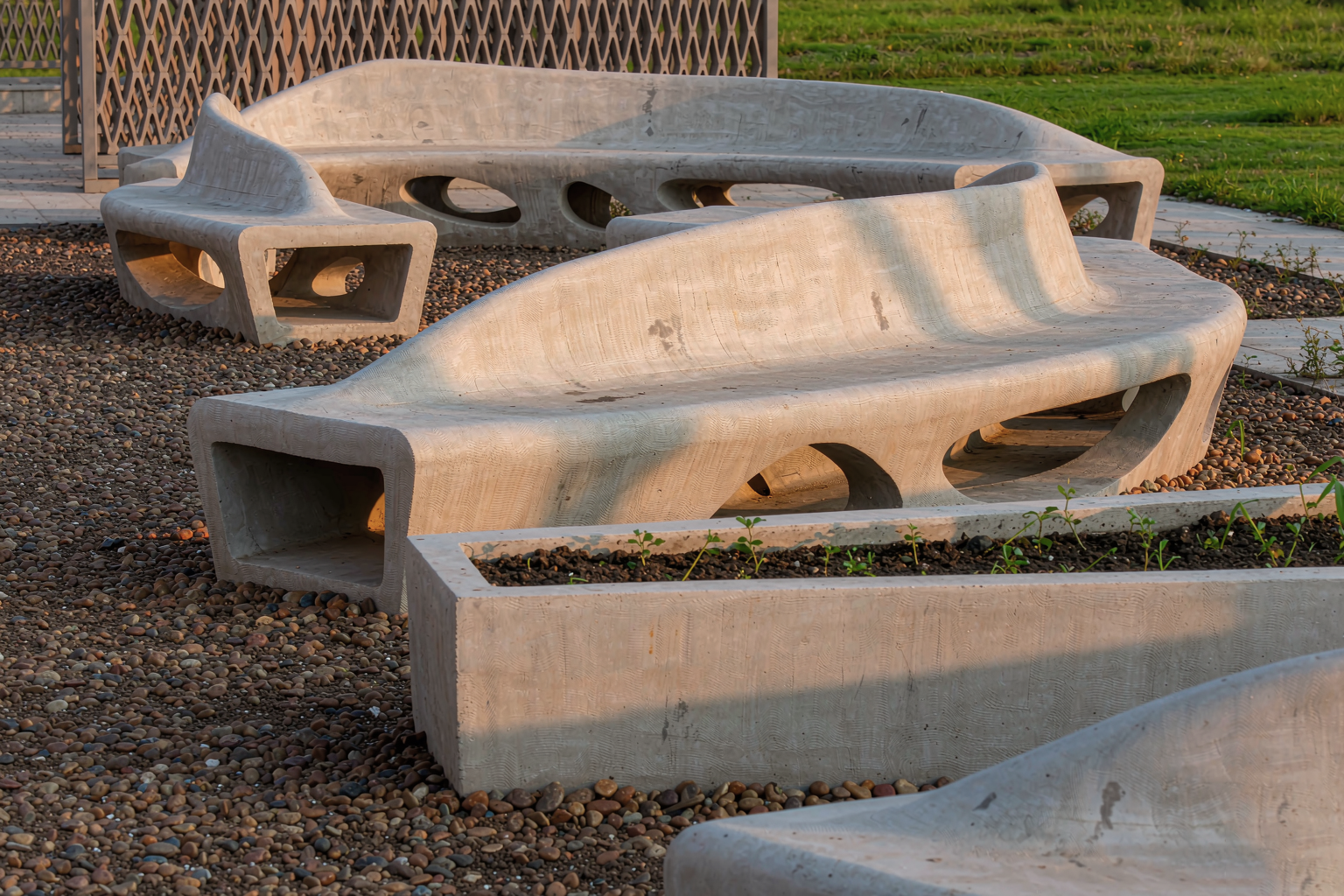
- Non‑structural components and landscape elements: 3D‑printed‑concrete outdoor furniture, planters and architectural grilles are established commercial products. Free from heavy structural‑code scrutiny, they deliver high design freedom and are commercially viable even for small‑batch orders.
- Modular prefabricated units: Factory‑printed modules (delivered with fit‑out complete) bypass site‑weather constraints, site‑logistics complexity and on‑site‑labour bottlenecks, and are widely regarded as the fastest‑scaling route forward.
- Public‑sector and emergency housing, bridges and municipal infrastructure: High‑value application domains beyond single‑family homes.
A clear pattern emerges: 3D‑printing first commercialises in sectors with low regulatory burden, high demand for geometric flexibility and high‑equipment‑utilisation repetition, before gradually ascending the regulatory ladder toward broader structural‑building applications.
Five Intentional Actions to Close Systemic Gaps
These bottlenecks will not resolve spontaneously. Convergence requires five deliberate sets of actions:
- Align regulatory frameworks: Translate standards such as ISO/ASTM 52939 and ICC 1150 into adoptable, directly‑applicable prescriptive provisions and drive formal jurisdiction‑level adoption.
- Build shared public‑data repositories: Harmonise material‑test protocols, deploy accelerated‑durability testing, and mandate open‑sharing of performance data from built assets. Without empirical evidence, mortgage‑finance systems cannot advance.
- Deploy industrialised cost‑optimisation models: Scale print‑as‑a‑service, equipment leasing, and project‑portfolio design optimised for 3D‑printing, to maintain high printer utilisation rates.
- Develop new‑generation workforces: Establish formal certification pathways, build vocational‑school and university curricula, and create clear career tracks for print‑process operators and application engineers.
- Integrate 3D‑printing into digital‑construction workflows: Adopt parametric design, AI‑driven process validation, real‑time quality monitoring and full BIM integration, treating printers as nodes within end‑to‑end digital‑construction pipelines.
AiUltraprod’s Position: Build Full‑Chain Systems, Not Just Sell Printers
Since its founding, AiUltraprod has operated from one core premise: bottlenecks lie not in printer hardware itself, but in the surrounding enabling systems. Accordingly, its roadmap is not focused on maximising printer sales. Instead, it takes a holistic view spanning codes, datasets, cost economics, labour capacity and capital.
- Digital‑first workflows: The Geobuild cloud‑based workbench unifies the full value chain from client requirements through print‑ready design to project delivery, supporting AI‑template matching, parametric adjustment and transparent quoting.
- Product focus on low‑regulation, high‑value‑density sub‑markets: Reinforced‑concrete modular units, factory‑prefabricated and fully‑fit‑out with no foundation‑works required; plus 3D‑printed‑concrete outdoor furniture and polymer‑based interior decorative components.
- Proprietary manufacturing intellectual property: In‑house innovations spanning composite‑print‑head mechanisms, robotic‑arm motion control and image‑recognition‑based quality‑inspection algorithms.
- Flexible‑manufacturing‑as‑a‑service: Zero‑inventory, on‑demand pay‑per‑use printing services.
AiUltraprod does not claim all systemic gaps are already resolved. Rather, it argues that solving them requires shifting mindsets: stop treating 3D‑printing as a technology in search of projects, and instead treat it as a production system in need of complete supporting supply chains — supply‑chains encompassing codes, data, hardware, skilled personnel and capital.
Standardisation Is Closer Than It Appears
A decade ago, 3D‑printed houses were museum exhibits. Five years ago, they were viral news headlines. Today, a 12‑unit apartment complex completes structural printing in 34 days, two‑story printed homes sell in Japan, and one of America’s largest banks underwrites mortgages for printed dwellings.
The remaining gap to mainstream‑industry‑standard status is primarily institutional, not technical: outdated codes, non‑industrialised cost models, insufficient long‑term‑material‑performance datasets, untrained workforces, and financial systems lacking established valuation benchmarks. Every one of these can be systematically constructed.
The companies and cities that simultaneously resolve all five systemic barriers will do more than simply “build houses with 3D‑printing”. They will redefine what “construction” means for decades to come.