
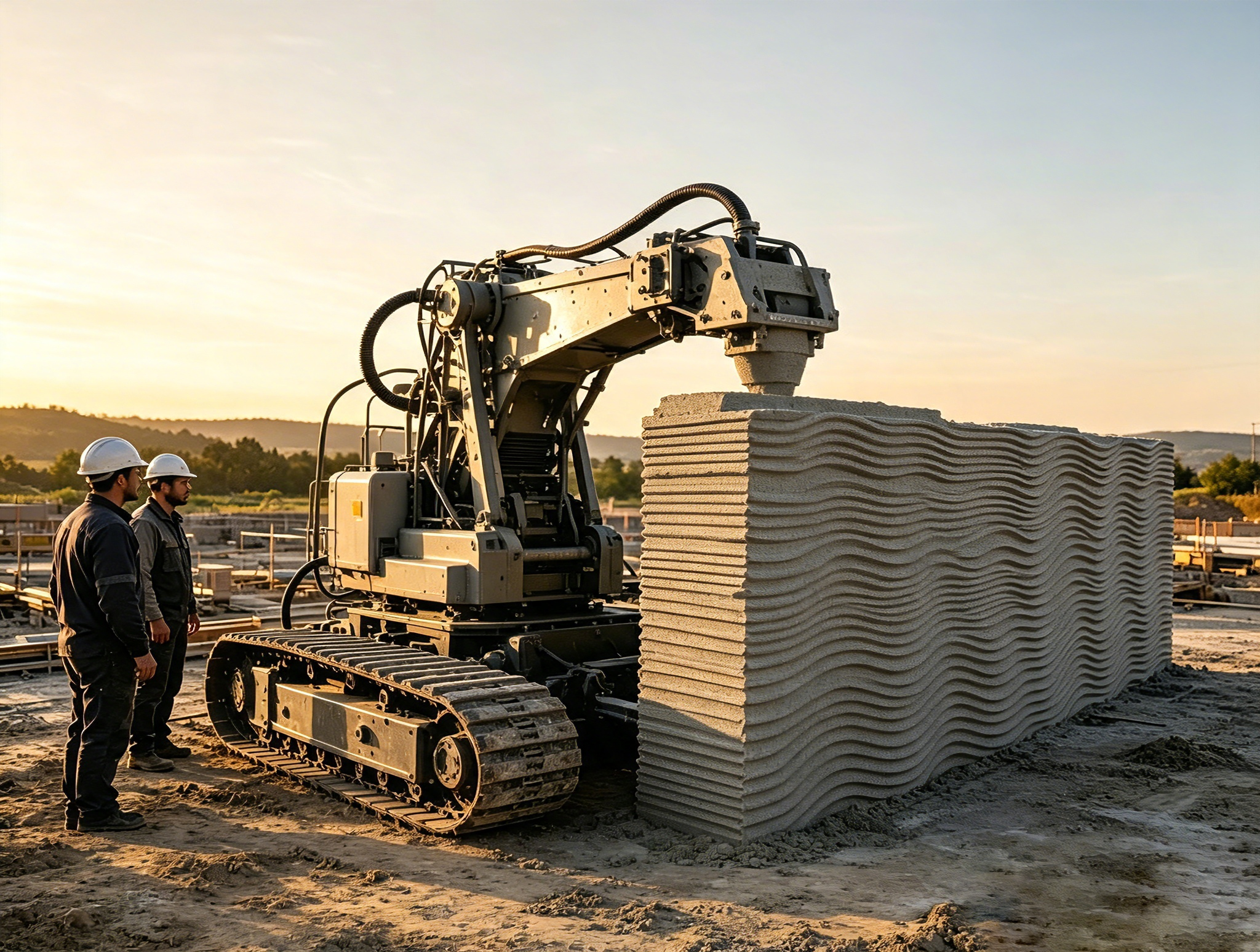
In the construction industry, “formwork” is the most silent cost killer. It is inconspicuous and receives far less attention than rebar and cement, yet it can silently consume 35% to as much as 60% of the entire concrete structure budget for a project.
Today, let us do the math: when 3D concrete printing technology eliminates formwork from the construction process, exactly how much material and cost can be saved for a project?
1. Formwork: The Construction Industry’s Most Expensive “Disposable Tableware”
Let’s start with some baseline data:
In traditional cast-in-place concrete construction, formwork costs typically account for 35%–54% of the total concrete structure cost, and 50%–75% of concrete construction labor hours. For complex shapes such as curved or irregular surfaces, the cost of custom formwork is even higher—sometimes the mold cost alone can exceed 30% of the total cost.
And that is just the direct cost. Formwork also brings a cascade of hidden expenses:
Material waste: the waste rate for traditional concrete pouring generally ranges from 10%–30%, and the formwork itself is a single-use or low-turnover consumable;
Labor intensity: erecting, stripping, and repairing formwork requires a large number of skilled carpenters and rebar workers;
Extended construction period: formwork operations alone account for more than half of the total concrete construction time;
Design compromises: many excellent design proposals are abandoned because “the formwork can’t be built” or “the formwork is too expensive.”
In other words, the traditional construction industry burns enormous sums of money every year on “use-and-discard” molds.
2. Formwork-Free Construction: Where Are the Material Savings?
The core logic of 3D concrete printing technology is additive manufacturing—precisely extruding exactly as much material as needed, with no formwork and no offcuts.
2.1 Concrete Material Consumption
According to multiple empirical studies:
Taking the measured data from the Shanghai Wisdom Bay Pedestrian Bridge project as an example, 3D printing reduced the material loss rate from 21.5% for cast-in-place methods to 4.2%—on this item alone, roughly 100 kg of material is saved per cubic meter of concrete.
The actual construction data from AiUltraprod is even more impressive: thanks to its AI + digital construction capacity platform, high-precision path planning, and proprietary material system, material waste can be controlled to within 5%. Compared with the up to 30% waste rate in traditional construction, material utilization improves by over 80%.
2.2 Formwork Materials: Reduced to Zero
This may be the most intuitive saving. Take a 100-square-meter residential project as an example:
Traditional timber formwork consumption: approximately 5–8 cubic meters of wood (including turnover loss);
Irregular structures also require custom steel molds or curved formwork, with a single set of molds costing tens of thousands to hundreds of thousands of yuan;
3D printing solution: formwork consumption = 0.
For projects with complex geometries (curved walls, arched facades, landscape art installations), the material savings from eliminating formwork are even more dramatic—because in traditional methods, these irregular structures almost all require “one piece, one mold,” and the mold cost often exceeds the cost of the component itself.
| Comparison Dimension | Traditional Cast-in-Place | 3D Printed Concrete | Savings |
| Material Loss Rate | 10%–30% | 4%–5% | Waste reduced by 60%–85% |
| Total Concrete Usage | Baseline | Reduced by ~10%–17% | Structural weight reduction via topology optimization |
| Rebar Consumption | Baseline | Reduced by ~48% | No traditional reinforcement system required |
3. Where Are the Cost Savings? A Line-by-Line Breakdown
Saving materials is just the first step. More importantly, it is the systematic restructuring of costs. Let us break down the costs across five dimensions:
3.1 Formwork Costs: Directly Eliminated
| Project Type | Traditional Formwork as % of Concrete Structure Cost | 3D Printing Formwork Cost |
| Conventional Residential | 35%–45% | 0 |
| Commercial Building | 40%–54% | 0 |
| Irregular / Landscape Components | 30%–60% (incl. custom molds) | 0 |
Example: for a project producing irregular components, traditional mold costs accounted for 30% of the total cost. After adopting 3D printing, “this step was eliminated entirely,” reducing production costs by 40% and shortening the production cycle by 30%.
3.2 Labor Costs: Cut by More Than Half
On a 3D printing construction site, one device + 2–3 operators can replace a traditional construction crew of 6–8 workers.
Measured data from the ViliaSprint² apartment project—Europe’s largest 3D-printed apartment project: structural work that traditionally required 6 workers was completed by just 3 operators using 3D printing. Measured data from the National University of Singapore shows: 3D printed concrete achieved over 40% labor savings, with efficiency gains exceeding 60% for complex components.
AiUltraprod’s construction data is even more significant: labor costs are reduced by up to 70%. This is because our all-terrain tracked 3D printing robot not only replaces concrete pourers but also eliminates the need for carpenters, formwork workers, rebar tiers, and multiple other trades.
3.3 Schedule Costs: Shortened by More Than Half
The hidden cost savings from shortened construction periods are often underestimated—management fees, equipment rental fees, and capital occupancy costs all decrease linearly as the schedule is compressed.
| Case Study | Traditional Schedule | 3D Printing Schedule | Reduction |
| France ViliaSprint² Apartments (800 sqm, 3 floors) | Estimated 70 days | Actual 34 days | 51% |
| AiUltraprod (Coastal Commercial Building, 2 units) | Estimated 40 days | Actual 13 days | 65% |
Note: This table shows wall structure construction period only, not total building completion time.
3.4 Design Freedom: Saving the Cost of “Impossible”
Under traditional methods, curved surfaces, irregular shapes, and complex geometries require custom formwork, with costs growing exponentially. 3D printing completely eliminates the “geometry premium”—for a printer, printing a curve costs almost the same as printing a straight line.
This means:
Designers no longer need to compromise on solutions due to cost constraints;
Buildings can achieve more optimal structural forms (such as catenary arches), thereby further reducing structural material consumption;
Irregular landscape components shift from “high-end customization” to “standardized production.”
3.5 Comprehensive Cost Comparison
| Cost Dimension | Traditional Cast-in-Place | 3D Printing Formwork-Free (AiUltraprod Data) |
| Formwork / Mold | 35%–60% of structure cost | 0 |
| Material Waste | 10%–30% | < 5% |
| Labor Cost | Baseline | Reduced by 70% |
| Construction Speed | Baseline | Improved by 100%–300% |
| Total Structural Wall Cost | Baseline | Reduced by ~40% |
| Carbon Emissions | Baseline | Reduced by ~19%–30% |
4. AiUltraprod: Turning Data into Results on the Jobsite
As a technology enterprise focused on AI-driven 3D printing construction robots, AiUltraprod is concerned not only with “how much can theoretically be saved” but with “how much has actually been saved on the jobsite.”
Our Technical Arsenal
All-terrain tracked 3D printing robot (RC1): capable of precise construction on complex terrain without the need for rails—from factories to wilderness, from flat ground to slopes, truly achieving “equipment adapts to the site, not the site adapting to the equipment”;
AI-driven path planning: from Rhino digital models to on-site printing, full-process automation minimizing human intervention;
Proprietary material system G02: independently developed high-performance printable concrete formulation that meets structural load-bearing requirements without additional reinforcement;
24 granted patents + 20+ pending patents: covering the entire chain of equipment, materials, and processes.
From Data to Implementation
AiUltraprod has verified the economic viability of formwork-free construction across multiple domestic and international projects, including the Yunnan Yiyao Valley roof components, Dali 3D-printed bridge, Ningbo Bay, and other landmark projects, with products exported to Spain and the North American market. In 2025, the company’s revenue exceeded the ten-million-dollar level and officially entered the U.S. ADU (Accessory Dwelling Unit) market—a market expected to reach billions of dollars by 2034.
5. At a Glance: How Much Can Formwork-Free Construction Save?
| Savings Item | Industry Research Data | AiUltraprod Measured |
| Formwork Costs | 100% saved | 100% saved |
| Material Waste | Reduced by 60%–85% | Reduced by 80%+ |
| Concrete Consumption | Reduced by 10%–17% | Reduced by 15%+ via topology optimization |
| Labor Costs | Reduced by 40%–80% | Reduced by 70% |
| Construction Speed | Improved by 100%–200% | Improved by 400% |
| Total Structural Wall Cost | Reduced by 18%–40% | Reduced by ~40% |
| Carbon Emissions | Reduced by 19%–30% | Reduced by 30%+ |
6. Conclusion: Not “Can It Save Money?” but “When Will Full Adoption Happen?”
Formwork—this “supporting actor” that has accompanied concrete structures for over a century since their inception—is being ushered off the construction industry’s stage by 3D printing technology.
The significance of formwork-free construction goes far beyond saving a few wooden planks and a few tons of concrete. It means:
The construction industry’s productivity is finally catching up with manufacturing;
Designers no longer have to compromise due to process limitations;
Jobsites are evolving from “labor-intensive” to “technology-intensive”;
Carbon neutrality goals now have a practical and feasible construction pathway.
AiUltraprod believes that the era of AI-driven productivity has arrived. We are no longer asking “can 3D printing save money?”—the data has already provided a clear answer. What we are doing is: making those numbers a reality on more and more construction sites.