
Industry‑University‑Research Collaboration Must Ultimately Deliver Practical Manufacturing Outcomes
Universities excel in design and technical research, while enterprises prioritize production efficiency, cost control and on‑time delivery. Whether partnerships between the two sides can generate real value hinges on whether research findings can be turned into market‑ready products.
This principle holds especially true for the 3D‑printing sector. A design that appears feasible in a digital model does not guarantee smooth printing, assembly or final delivery. Material selection, equipment parameter tuning, component segmentation and production scheduling all shape end results.
Design Shanghai 2025: Manufacturing and Delivery of 19 Curved Components
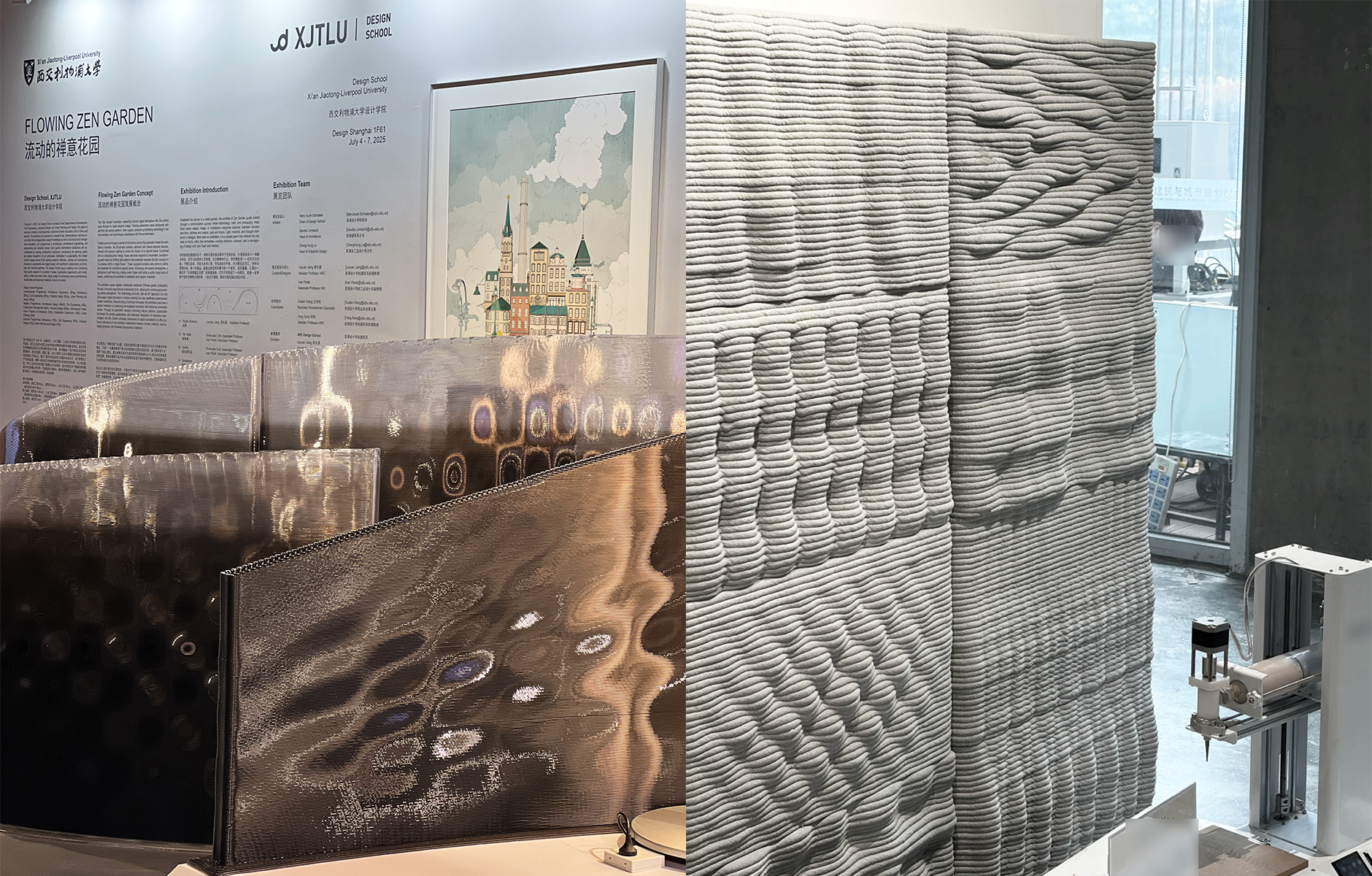
In June 2025, the Xi’an Jiaotong‑Liverpool University School of Design took part in Design Shanghai 2025, presenting an exhibition space themed “Flowing Zen Garden” that blends Eastern Zen aesthetics with digital‑construction artistry. Serving as the visual centrepiece of the exhibition zone, an artistic partition wall unfolds along visitor circulation routes. Its decorative panels were produced by AiUltraprod using large‑format robotic 3D printing with PETG material in monolithic forming.
The full wall was divided into 19 modular curved components, each featuring a unique curvature. Parametric design generated surface textures across the panels, producing layered light‑and‑shadow effects that shift along curved surfaces.
Traditional mould‑based manufacturing would have required custom‑built moulds for every distinct form, driving up costs and lead times significantly. For this reason, mould‑free 3D printing was adopted to produce parts directly from digital models. Production workflows also took on‑site assembly sequences into consideration. Each of the 19 components received a unique identification number and was packaged and shipped according to its installation position to prevent mis‑fitting or last‑minute adjustments during on‑site assembly.
This project highlights a key practical insight: for highly complex custom‑fabricated components, printing hardware represents only one part of production. Process control and delivery management are equally critical.
Tongji University Digital FUTURES: How Can Parametric Design Be Implemented in Production?
Within the Digital FUTURES International Digital Workshop hosted by Tongji University’s College of Architecture and Urban Planning (CAUP), design teams algorithmically generated a textured landscape wall composed of numerous uniquely shaped bricks(3D Printing Using Generative, Evaluative, and Construction AI Agents).
The full wall consists of a large number of bricks with varied forms. Every brick features a unique geometry, making traditional mould manufacturing unable to reconcile cost and production efficiency. Serving as the technical partner, AiUltraprod was responsible for the concrete 3D printing and project delivery.
During manufacturing, parametric models were first converted into executable print trajectories. Process parameters including layer height and tool‑path patterns were adjusted to match equipment capabilities and material properties. Prior to full‑scale production, prototype testing was carried out to verify inter‑layer bonding performance and surface texture quality.
One vital takeaway from this project is: design feasibility does not equal manufacturing feasibility. Parametric models must account for nozzle travel paths, material deposition behaviours, structural connections and subsequent assembly workflows. Factoring these constraints into early‑stage design reduces iterative revisions further down the production pipeline.
What Kinds of Projects Suit 3D‑Printing Manufacturing?
Drawing lessons from the two above‑mentioned projects, 3D printing demonstrates its core strengths for high‑variety, low‑volume production of complex geometries.
Typical use‑cases include:
- Complex curved components: eliminating the need for custom mould development.
- Custom architectural ornamentation: ideal for non‑standard components of varied dimensions and forms.
- Parametric landscape installations: enabling direct production adjustments derived from digital models.
- Bespoke furniture: supporting products with special stylistic and structural requirements.
- Exhibition and commercial interior spaces: delivering small‑batch custom components aligned with design briefs.
Nevertheless, 3D printing is not the optimal solution for every manufacturing scenario.
For simple‑shaped, high‑volume components with uniform specifications, traditional moulding or mass‑production techniques deliver better economic returns. Decision‑making should compare component complexity, production batch size, mould‑development costs, equipment occupancy hours and post‑processing expenses rather than merely chasing technological novelty.
How Can Scientific Research Outcomes Be Converted into Practical Production Capabilities?
Collaboration between universities and enterprises should go beyond showcase prototypes or laboratory validation. For manufacturing firms, lasting value lies in actionable assets retained once a project concludes. Several international research cases offer valuable references.
York University and Aretek
The Lassonde School of Engineering at York University partnered with concrete additive‑construction enterprise Aretek to research 3D‑printed wall systems. Tests were performed within existing masonry‑code frameworks. Findings supported regulatory approval for a three‑storey student‑apartment project at the University of Windsor. This case illustrates that real‑world architectural adoption of 3D concrete printing demands not only printing technology itself but also rigorous material testing and engineering validation.
The Pennsylvania State University and X‑Hab 3D
The two parties researched horizontal‑component fabrication, exploring embedding flexible tendons and mesh reinforcement mid‑print followed by post‑tensioning. This technique enables floor slabs to span across supporting walls and reduces reliance on conventional formwork.
While their research focuses differ, both cases address a shared challenge: adapting materials, structures and manufacturing workflows to real‑world operating environments.
From Delivering Single Projects to Building Replicable Production Know‑How
For AiUltraprod, participation in university‑led projects means more than completing standalone artworks. Validated methodologies developed through these projects are transferred to subsequent manufacturing assignments.
Practical assets accumulated include:
- Reference workflows for segmentation, labelling and assembly of curved components for analogous projects.
- Verified printing parameters documented as internal process specifications.
- Prototype and dimensional‑inspection datasets supporting future quotation and quality assessment.
- Hands‑on equipment‑operation and production expertise empowering the team to handle more sophisticated custom orders.
Still, industry‑university‑research partnerships do encounter obstacles. Academic research timelines, corporate order cycles and construction‑project delivery schedules frequently diverge. Overly broad research objectives without hands‑on manufacturing validation often produce outcomes difficult to integrate into regular enterprise‑level production.
Instead of conducting generic research such as “3D‑printing applications within architecture”, projects should target well‑defined practical questions: for example, assembly precision of interlocking structures, print stability of specific materials, or dimensional control for large‑scale curved components. More concrete research goals yield reusable technical deliverables.
Conclusion
Multiple bottlenecks related to materials, processes, production workflows and on‑site assembly separate conceptual 3D‑printing designs from practical real‑world deployment. From the 19‑panel curved partition featured at Design Shanghai to Tongji University’s parametric textured wall, AiUltraprod’s collaborative projects demonstrate that sophisticated digital designs can only materialise with manufacturing‑side process adaptation and robust production management.
Within the 3D‑printing industry, finishing one project marks only the starting point. The capacity to transfer proven processes, structural solutions and production insights to future assignments defines sustainable commercial‑technology maturity.